








Apex Ecotech Selectively Negotiates Rs 20-60 Crore Orders
MAX Plan at ₹4,999/yr

Find your next multibaggerBe a Pro Investor
Research stocks and track your picks on the go. Download the app.
Key highlights
- Apex Ecotech was negotiating five to six potential orders worth Rs 20 crore to Rs 60 crore each on November 19, 2026.
- Apex Ecotech said it rejected some larger contracts because payment terms or contribution were unacceptable.
- Apex Ecotech’s pending order book was more than Rs 55 crore at the end of H1 FY27.
- Revenue from operations rose approximately 189% to Rs 94.27 crore in H1 FY27 from Rs 32.57 crore in H1 FY26.
powered by IRIS
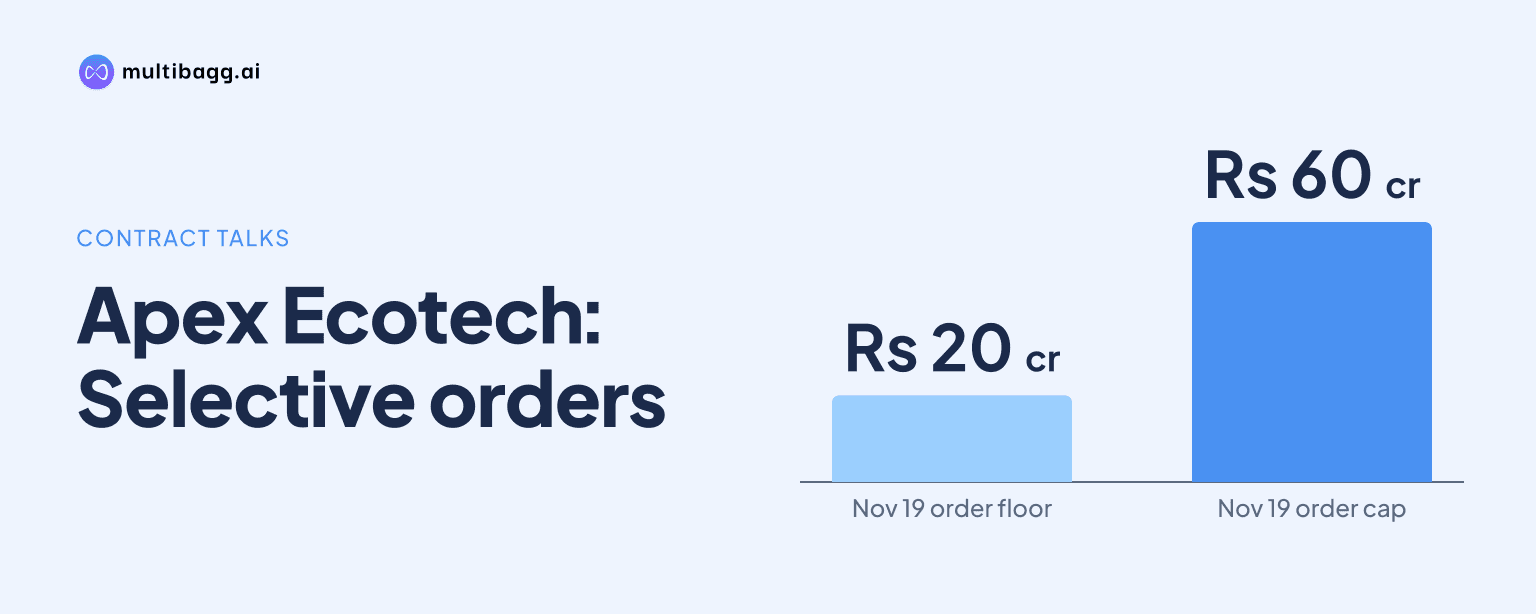
Apex Ecotech Limited said on November 19, 2026 that it was negotiating five to six potential orders worth Rs 20 crore to Rs 60 crore each, while rejecting some larger contracts whose payment terms or contribution did not meet its requirements. The opportunities remained unfinalised, against a pending H1 FY27 order book of more than Rs 55 crore.
Know Apex Ecotech inside out
Results, valuation, peers and who's buying, in one view.
What orders is Apex Ecotech negotiating?
Apex Ecotech is negotiating at least five or six large orders, each carrying a potential value of Rs 20 crore to Rs 60 crore. Managing Director Anuj Dosajh said the discussions had continued for about two to two-and-a-half months and had reached an advanced stage. He said the position could look different in the following one to one-and-a-half months, without identifying customers, sectors or individual project values.
The disclosed Rs 20 crore to Rs 60 crore range applies to individual opportunities, not a committed aggregate pipeline. Apex Ecotech said larger water and wastewater treatment projects are becoming more common, and it has used the execution of two large sites during the past two half-years to establish its capacity for higher-ticket contracts. The company cited more than 250 completed turnkey projects across 15 industries.
Why was Apex Ecotech’s H1 FY27 order flow muted?
Apex Ecotech said the muted order flow reflected delayed negotiations and deliberate commercial selectivity, rather than only a reduction in market opportunities. Management said several large negotiations had been expected to conclude in H1 FY27 but were still ongoing as of the November 19 call. It also said the company lost a couple of orders and chose not to accept some larger orders.
The rejected contracts did not satisfy Apex Ecotech’s requirements on either payment terms or contribution, according to Dosajh. Management said its selection process considers growth, profitability, execution capability and working-capital requirements. That framework is relevant because higher receivables and vendor advances increased working-capital deployment during H1 FY27 as project execution and invoicing rose.
The comparison with the prior year is affected by unusually large wins and subsequent execution. Management described H2 FY26 as a period of exceptional growth after receiving major orders from Larsen & Toubro and Reliance Industries, followed by spillover work in H1 FY27. An investor referred to a Reliance order above Rs 100 crore and an approximately Rs 40 crore Larsen & Toubro order, but management did not independently confirm those individual values in its response.
How does the potential pipeline compare with the order book?
Apex Ecotech’s pending order book was more than Rs 55 crore at the end of H1 FY27, after substantial project execution and completions in the first half. Since each negotiated opportunity is valued at Rs 20 crore to Rs 60 crore, a single conversion could be material relative to that reported order book. Management gave no probability of conversion, total pipeline value or assurance that all five to six projects would be signed.
The lower closing order book followed a large increase in revenue recognition from existing work. Revenue from operations rose about 189% year on year to Rs 94.27 crore in H1 FY27 from Rs 32.57 crore in H1 FY26. Management attributed the increase to higher execution, including major projects, rather than to a disclosed rise in newly booked H1 FY27 orders.
Revenue growth outpaced the reported growth in earnings before interest, tax, depreciation and amortisation, or EBITDA, because earlier contracts absorbed higher input costs and two large sites incurred installation and commissioning costs before their remaining revenue could be recognised. The order book therefore does not directly indicate H2 FY27 revenue, particularly while the five to six prospective orders are still under negotiation.
Got a follow-up? Ask IRIS
What could determine whether Apex Ecotech converts these orders?
Apex Ecotech said potential orders will be accepted only if they offer value addition and meet the payment and contribution discipline applied by management. Dosajh did not commit that all five to six negotiations would close. The stated one to one-and-a-half-month window was an expectation based on discussions already underway for about two to two-and-a-half months.
Working capital is a key part of that decision. In H1 FY27, higher execution and invoicing produced higher receivables, while vendor advances and payments to mitigate incremental costs increased cash deployment. Management said H2 FY27 priorities include meeting installation and commissioning milestones, accelerating collections and improving cash conversion, but did not provide a receivables or cash-flow target.
The completion of two large sites could also affect second-half profitability. Apex Ecotech said most material procurement for earlier contracts was substantially complete, meaning much of the input-cost impact had been absorbed in H1 FY27. It expects installation and commissioning milestones at the two sites to be completed in H2 FY27, allowing recognition of remaining related revenue and contributing positively to margins.
How is Apex Ecotech preparing for larger project execution?
Apex Ecotech said it is strengthening internal systems as it takes on larger and multiple projects, with an enterprise resource planning, or ERP, system expected to go live in the month after the November 19, 2026 call. Management also cited employee stock options, or ESOPs, as a tool to retain its bench strength, although it did not disclose the number of options, eligible staff or financial effect.
Management retained its previously communicated FY27 revenue-growth objective of about 30% to 40% year on year. It said H2 has historically been important for Apex Ecotech’s order inflows, execution, revenue and profitability. Beyond engineering, procurement and construction, or EPC, work, the company plans to begin commercialisation efforts in operation and maintenance toward the end of the current financial year to develop a recurring-revenue stream.
Conclusion
Apex Ecotech’s recent order inflow was affected by negotiations taking longer than expected and by management’s willingness to reject contracts with unsuitable payment terms or contribution. The five to six opportunities, each valued at Rs 20 crore to Rs 60 crore, could alter the order-book position, but they remain prospective rather than booked business.
The next points to watch are whether negotiations move to finalisation within the one to one-and-a-half-month period identified by management, and whether any signed orders meet its working-capital discipline. H2 FY27 completion of the two large-site commissioning milestones, collections progress, the expected ERP launch and planned operation-and-maintenance commercialisation are the disclosed execution markers.

