










Apollo Hospitals hospital revenue grows 23% as margin falls
Key highlights
- Apollo Hospitals' Healthcare Services revenue increased 23% to Rs 3,899.8 crore in Q2FY27.
- Q2FY27 inpatient discharges rose 14% to 185,980 and occupancy increased to 73% from 69%.
- Healthcare Services EBITDA margin was 24.0%, down 60 basis points, while established units reported 25.8%.
- New-unit pre-operative expenses and losses were Rs 34.8 crore in Q2FY27.
powered by IRIS
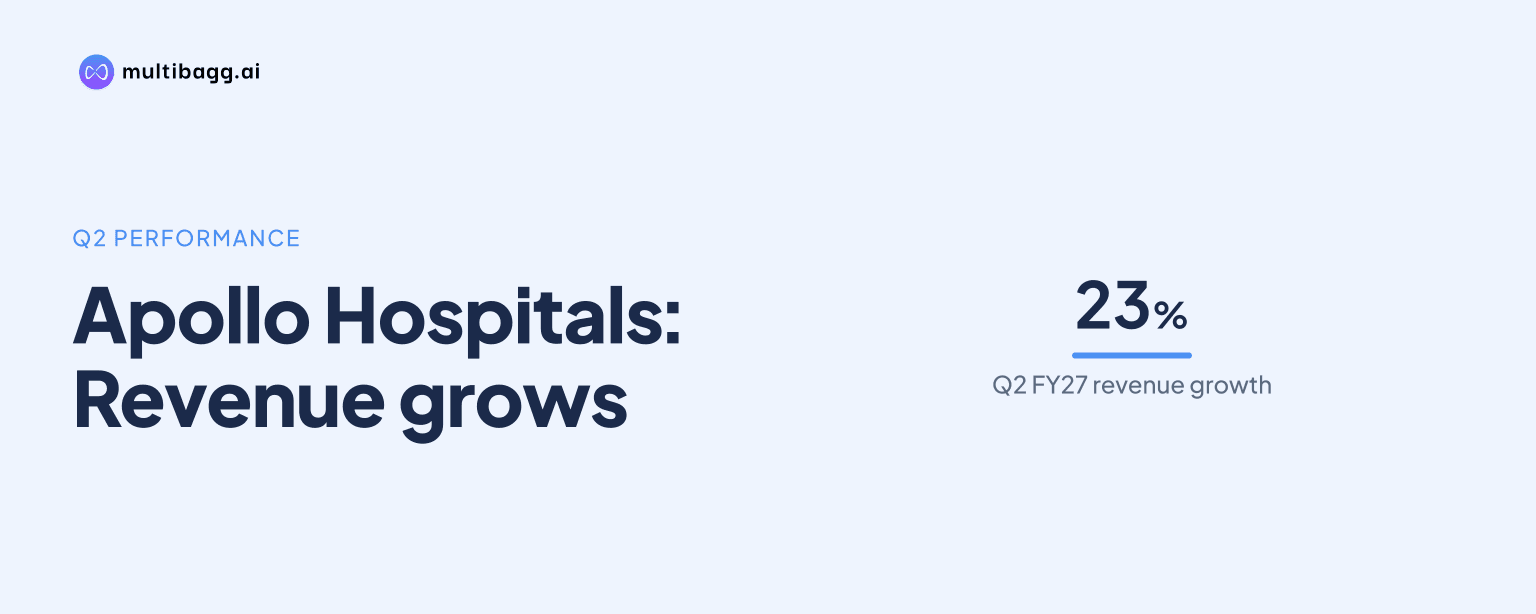
Apollo Hospitals Enterprise Ltd increased Healthcare Services revenue 23% year on year to Rs 3,899.8 crore in the second quarter of financial year 2027 (Q2FY27), while earnings before interest, tax, depreciation and amortisation (EBITDA) margin fell 60 basis points to 24.0% as new units recorded Rs 34.8 crore of pre-operative losses.
Know Apollo Hospitals Enterprise inside out
Results, valuation, peers and who's buying, in one view.
Why did Apollo Hospitals' hospital revenue grow 23%?
Apollo Hospitals increased Healthcare Services revenue by Rs 730.8 crore, from Rs 3,169 crore in Q2FY26 to Rs 3,899.8 crore in Q2FY27. In the first half of FY27 (H1FY27), revenue rose 22% to Rs 7,466.8 crore from Rs 6,104.2 crore in H1FY26. The business operated 48 hospitals and 8,522 beds in Q2FY27, compared with 45 hospitals and 8,050 beds a year earlier.
Apollo Hospitals reported 185,980 inpatient discharges in Q2FY27, up 14% from 162,984 in Q2FY26. Management attributed overall volume growth to a 10% rise at established units, while price contributed 4% and case mix and payor mix contributed 5%. These disclosed drivers accompanied revenue growth that exceeded the increase in inpatient discharges.
How did inpatient activity change at Apollo Hospitals?
Apollo Hospitals increased occupancy to 73% in Q2FY27 from 69% in Q2FY26 while adding 472 operating beds. In H1FY27, occupancy was 71%, compared with 67% a year earlier, and inpatient discharges reached 357,642, up 14% from 314,501. The occupancy increase occurred alongside a 5.9% expansion in the operating-bed base.
Average length of stay (ALOS) fell 2% to 3.07 days in Q2FY27 from 3.14 days in Q2FY26. At the same time, average revenue per inpatient increased 8% to Rs 1,86,880 from Rs 1,73,258. In H1FY27, average revenue per inpatient was Rs 1,86,760, 8% above H1FY26, while ALOS was 3.08 days versus 3.14 days.
Which specialties and payors generated Apollo Hospitals' inpatient revenue?
Apollo Hospitals' H1FY27 inpatient revenue mix was led by cardiac care at 18% and oncology at 17%, the two largest disclosed specialty categories. Orthopaedics accounted for 11%, neurology 10%, internal medicine 8% and gastroenterology 7%. The presentation defines oncology as including radiotherapy and chemotherapy.
Management said Q2FY27 growth was aided by high-complexity clinical work. Oncology revenue grew 28%, gastroenterology 27%, urology 26%, and cardiac care and orthopaedics each grew 20%. The presentation does not quantify the amount each specialty added to the Rs 730.8 crore increase in quarterly Healthcare Services revenue.
Insurance represented 46% of H1FY27 inpatient revenue, ahead of self-pay at 39%. Public-sector undertakings and government payors made up 9%, while the remaining category accounted for 6%. Insurance and self-pay therefore comprised 85% of the disclosed inpatient revenue mix, while cardiac care and oncology together comprised 35% of specialty revenue.
Got a follow-up? Ask IRIS
What caused Apollo Hospitals' EBITDA margin to decline?
Apollo Hospitals' Healthcare Services EBITDA increased 20% to Rs 936.5 crore in Q2FY27 from Rs 780 crore in Q2FY26, but the margin declined to 24.0% from 24.6%. In H1FY27, EBITDA rose 20% to Rs 1,797.8 crore, while margin declined 45 basis points to 24.1% from 24.5%.
Management disclosed Rs 34.8 crore of pre-operative expenses and losses from new units in Q2FY27. Established units recorded a 25.8% EBITDA margin, 180 basis points above the Healthcare Services segment's reported 24.0% margin. The comparison indicates that the new units reduced the reported segment margin relative to the established-unit result.
Other profit measures also rose more slowly than revenue in Q2FY27. Earnings before interest and tax increased 20% to Rs 749.9 crore from Rs 622.4 crore, and profit before tax rose 18% to Rs 712.3 crore from Rs 606.1 crore. Profit after tax increased 19% to Rs 486 crore from Rs 408.2 crore, with its margin moving to 12.5% from 12.9%.
How is Apollo Hospitals' hospital business positioned across locations?
Apollo Hospitals' six metro markets had 4,966 operating beds and 74% occupancy in Q2FY27, compared with 3,556 beds and 70% occupancy in non-metro markets. Average revenue per inpatient was Rs 2,22,626 in metros and Rs 1,33,654 in non-metros. The presentation includes new hospitals in both the geographic operating metrics and average-revenue figures.
Across India, Apollo Hospitals reported total net revenue of Rs 4,232.4 crore in Q2FY27, up 21.6% from Rs 3,481.1 crore. This measure differs from Healthcare Services segment revenue because it includes Delhi, which the presentation says is not consolidated under Indian Accounting Standard 116 because of joint control. Established-unit occupancy was 76%, compared with the disclosed comparative figure of 69%.
Capital employed was Rs 9,635.1 crore in Q2FY27, with return on capital employed (ROCE) reported at 29.7%. This capital-employed figure excludes Rs 1,528.8 crore of capital work in progress for projects under development. The exclusion separates operating capital reported for the period from project spending not yet completed.
Conclusion
The quarter combined higher occupancy, 14% growth in inpatient discharges and an 8% increase in revenue per inpatient with a lower reported EBITDA margin. The 25.8% margin at established units, compared with 24.0% for Healthcare Services, shows the difference between the established network and a segment that includes Rs 34.8 crore of new-unit pre-operative losses.
The next operating milestone is the phased activation of the remaining 480 census beds from the five newly commissioned hospitals, excluding Gurgaon, over the next 12 to 18 months. Management's expansion plan covers 4,718 census beds in total and states that about Rs 7,100 crore of the Rs 11,152 crore project cost remains to be spent.