










Apsis Aerocom H1 FY27 Revenue Rises 55% to ₹21.17 Crore
Key highlights
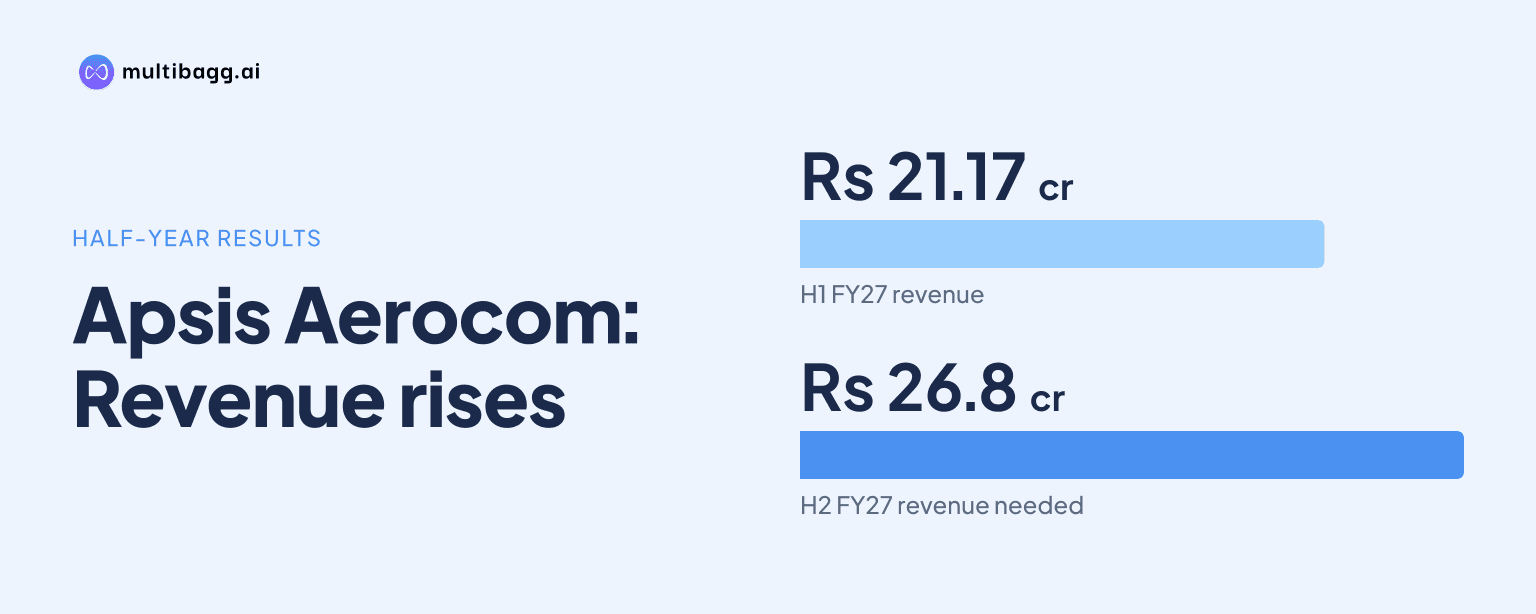
- Apsis Aerocom reported H1 FY27 revenue of ₹21.17 crore, up 55.1% year-on-year.
- Defence revenue rose 56.2% year-on-year to ₹12.86 crore in H1 FY27.
- EBITDA increased 35.7% to ₹6.52 crore, while EBITDA margin was 30.8%.
- Apsis Aerocom's ₹31.8 crore order book exceeded the roughly ₹26.8 crore H2 revenue needed for its FY27 target.
powered by IRIS
Apsis Aerocom Limited reported H1 FY27 revenue from operations of ₹21.17 crore, up 55.1% year-on-year, supported by higher defence and healthcare sales. EBITDA rose 35.7% to ₹6.52 crore and profit after tax increased 21.4% to ₹3.97 crore, while the company commissioned Unit II on August 14, 2026.
Know Apsis Aerocom inside out
Results, valuation, peers and who's buying, in one view.
What did Apsis Aerocom report for H1 FY27?
Apsis Aerocom reported broad-based growth for the half year ended September 30, 2026. Revenue from operations increased from ₹13.65 crore in H1 FY26 to ₹21.17 crore in H1 FY27. The result indicates a higher pace of execution across its key customer segments, especially defence.
EBITDA rose to ₹6.52 crore from ₹4.80 crore in the year-earlier period. However, EBITDA margin declined to 30.8% from 35.2%. Profit after tax was ₹3.97 crore, compared with ₹3.27 crore in H1 FY26, while PAT margin declined to 18.7% from 23.9%.
The company reported basic and diluted earnings per share of ₹3.29 for the half year. Its total revenue, including other income, stood at ₹21.25 crore, against total expenses of ₹15.95 crore. The reported figures were part of the unaudited results approved for the period ended September 30.
Which businesses drove Apsis Aerocom's revenue growth?
Apsis Aerocom's defence business remained the largest contributor, generating ₹12.86 crore in H1 FY27, an increase of 56.2% from the prior-year period. Defence accounted for more than half of the company's reported operating revenue, making it the principal driver of the half-year increase.
Aerospace revenue rose 26.5% year-on-year to ₹5.79 crore. Healthcare recorded the fastest growth among the main verticals, rising 197.5% to ₹2.24 crore. The smaller others category increased 215.9% to ₹0.29 crore. These segment figures together show that growth was not limited to a single business line.
The healthcare increase was notable because its revenue base was smaller than defence and aerospace. Even so, defence remained the largest absolute contributor to revenue growth. The segment mix also provides context for the company's planned capacity additions and its focus on precision manufacturing capabilities.
Got a follow-up? Ask IRIS
How does Unit II change Apsis Aerocom's manufacturing capacity?
Apsis Aerocom commissioned Unit II on August 14, 2026, taking its total CNC machine capacity to 33 machines. The facility expansion is linked to the company's plans to serve existing and prospective requirements across defence, aerospace and healthcare applications.
The company invested ₹23.33 crore during H1 FY27, including capital advances, mainly for advanced CNC machines and inspection equipment for Unit II. This spending reflects the scale of the expansion underway during the first half of the financial year.
Capacity commissioning does not by itself determine revenue, as production depends on utilisation and customer order execution. The company identified Unit II running costs ahead of utilisation as a risk. It also noted that material cost could rise to 37.5% of revenue from 33.6%, a factor relevant to future margins.
Can Apsis Aerocom meet its FY27 revenue target?
Apsis Aerocom reiterated its FY27 revenue target of about ₹48 crore after reporting ₹21.17 crore in the first half. Based on that target, the company needs about ₹26.8 crore of revenue in H2 FY27 to meet its stated full-year objective.
The company reported an order book of ₹31.8 crore as of September 30, 2026. This was about 1.5 times its H1 FY27 revenue and exceeded the revenue required for the second half under the reiterated target. An order book provides visibility, but reported revenue depends on the timing of execution and deliveries.
Apsis Aerocom has also outlined a revenue plan of about ₹80 crore for FY28 and indicated that Unit III capital expenditure is planned from FY29. These are company plans disclosed in the investor presentation, rather than reported financial results.
Why do the H1 FY27 results matter for investors?
The H1 FY27 results matter because revenue growth outpaced the company's prior-year base while the order book remained larger than the revenue needed for its stated H2 target. The commissioning of Unit II adds capacity at a time when the company is pursuing growth in its largest defence segment as well as aerospace and healthcare.
But profitability grew more slowly than revenue. EBITDA increased 35.7% and PAT rose 21.4%, compared with revenue growth of 55.1%, alongside lower EBITDA and PAT margins. Material-cost movements and the early operating costs of Unit II are therefore relevant to assessing the financial effect of higher revenue.
Conclusion
Apsis Aerocom's H1 FY27 performance combined 55.1% revenue growth with gains across defence, aerospace and healthcare. The company also expanded total CNC capacity to 33 machines through Unit II, while its ₹31.8 crore order book provided disclosed visibility against the remaining revenue needed for its FY27 target.
Investors will watch H2 execution against the approximately ₹26.8 crore revenue requirement for the reiterated ₹48 crore FY27 target. Other disclosed factors to monitor are Unit II utilisation, material-cost trends, margins and the company's stated FY28 revenue plan of about ₹80 crore.