










Aptech says AI creative placements carry Rs 7-10 lakh CTC
Key highlights
- Aptech says MAAC and Arena Animation learners entered AI-led creative roles with approximate annual CTC of Rs 7-10 lakh.
- MAAC applies AI to ideation, previsualisation, VFX, 3D and game workflows.
- Arena Animation applies AI to design, motion graphics, video and content creation.
- Aptech Learning is progressing from AI/ML learning toward AI-assisted development, vibe coding and agentic AI.
powered by IRIS
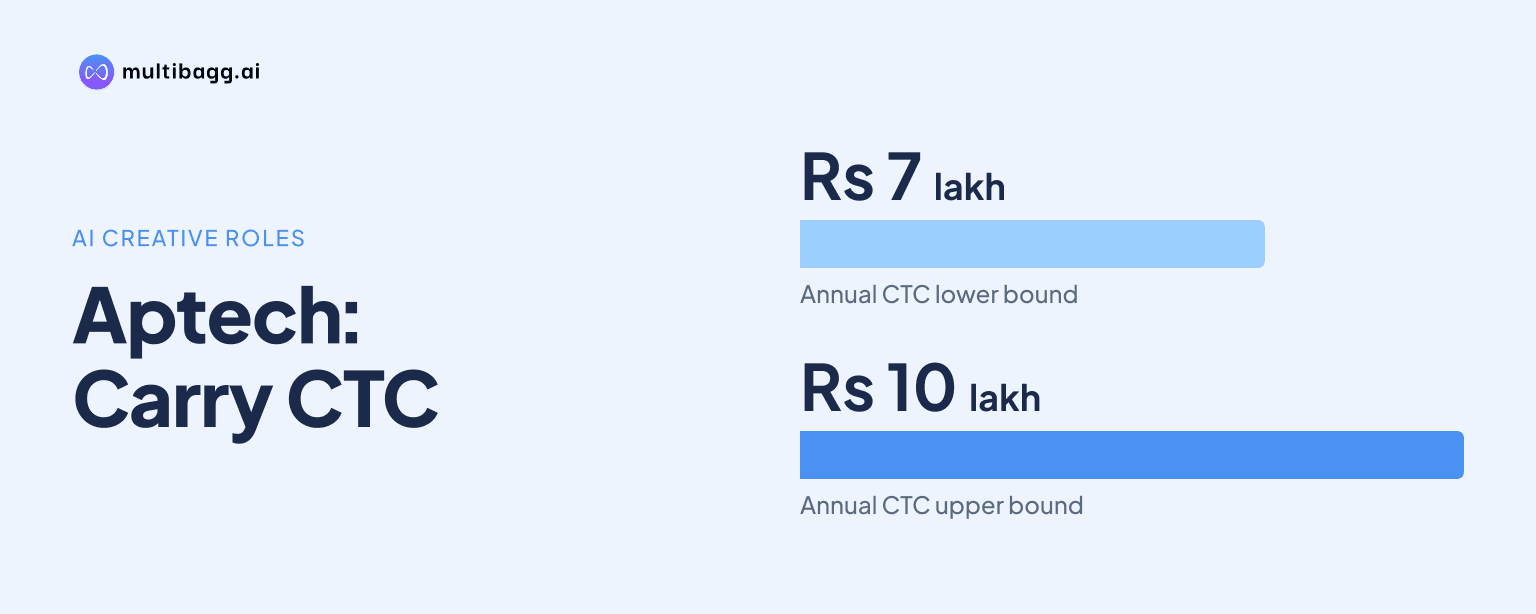
Aptech says MAAC and Arena Animation learners have been placed in artificial intelligence (AI)-led creative roles with an approximate annual cost to company (CTC) of Rs 7-10 lakh, according to its Q2 & H1FY2027 investor presentation. Aptech links that stated outcome to AI embedded in creative production, digital creation and technology-skills learning.
Know Aptech inside out
Results, valuation, peers and who's buying, in one view.
What pay does Aptech report for AI creative placements?
Aptech reports approximate annual CTC of Rs 7-10 lakh for MAAC and Arena Animation learners placed across AI-led creative roles. The Q2 & H1FY2027 presentation describes the placement outcome under its plan to build an AI-ready creative talent ecosystem through those two education brands. The stated range applies to placements across roles, rather than to a separately disclosed MAAC or Arena Animation pay measure.
The presentation does not disclose the number of learners placed at Rs 7-10 lakh, the employers involved, placement dates, or the split between MAAC and Arena Animation. It also does not provide an average, median or role-specific CTC figure within the stated range. Therefore, Aptech presents Rs 7-10 lakh as an approximate claimed placement outcome, not as a portfolio-wide placement rate or a compensation benchmark for every learner.
How is Aptech embedding AI across its learning portfolio?
Aptech is embedding AI alongside domain skills and applied learning across MAAC, Arena Animation and Aptech Learning. In Q2 & H1FY2027, Aptech describes AI fluency as becoming a baseline workforce expectation and positions its curriculum response around preparing talent for AI-native and AI-assistive work. AI-native work means creating directly with AI, while AI-assistive work uses AI to enhance established workflows.
The segment comparison shows that Aptech assigns AI different uses across its portfolio. MAAC is centred on production workflows including VFX, 3D and games, while Arena Animation is centred on design and content outputs such as video and motion graphics. Aptech Learning, by comparison, is focused on technology skills and is described as advancing toward AI-assisted development, vibe coding and agentic AI.
Aptech also frames this curriculum approach as a change from software training toward creative fundamentals and problem-solving. Its Product Academic Advisory Board lists production-pipeline awareness, collaboration and portfolio development among its industry-alignment priorities, while practical learning includes daily creative practice, project-based assessments and group projects. The company’s stated strategic outcome combines domain expertise, AI fluency, applied skills and human judgement.
Got a follow-up? Ask IRIS
Which AI-led creative roles does Aptech identify?
Aptech identifies five AI-led creative role labels: AI Cinematic Artist, AI Artist and Creator, AI Video Editor, Motion Graphics, and AI Content Creator. These labels appear alongside the Rs 7-10 lakh approximate annual CTC disclosure for learners from MAAC and Arena Animation. The presentation associates the roles with its wider AI-ready creative talent ecosystem rather than assigning a separate CTC range to each role.
The role labels align with the applications Aptech names in its two creative brands. MAAC’s AI-assisted ideation and previsualisation can relate to cinematic work, while its VFX, 3D and game workflows address production processes. Arena Animation’s AI-powered design, motion graphics, video and content creation correspond with the presentation’s AI Video Editor, Motion Graphics and AI Content Creator labels.
Aptech does not provide role definitions, course durations, learner enrolment figures or separate placement counts for the five labels. Nor does it say whether the Rs 7-10 lakh range was earned across all five roles or only some of them. The available disclosure establishes the types of work Aptech is targeting, but leaves the scale and role-by-role distribution of placements unresolved.
How does Aptech keep creative courses aligned with AI changes?
Aptech says its Product Academic Advisory Board validates and guides course content and curriculum to keep Arena Animation programmes aligned with technology and AI advances. The board includes members with backgrounds in animation, VFX and design, including a Head of CFX at DreamWorks Animation in Los Angeles and founders of creative studios and services businesses. Its stated objective is to move from job readiness to skill monetisation through industry-aligned, outcome-driven learning.
The board’s mechanism combines industry alignment, capability-led learning, practical learning and skill monetisation. Aptech says the approach incorporates production-pipeline awareness, collaboration and portfolio development, while moving beyond software training toward creative fundamentals and problem-solving. It also says students are being prepared for careers, freelancing, gigs and creator-led opportunities, alongside the five AI-led creative role labels presented for MAAC and Arena Animation.
The AI strategy extends beyond the placement claim. Aptech Learning is described as progressing from AI/ML learning toward AI-assisted development, vibe coding and agentic AI, while MAAC and Arena Animation address creative-production and digital-creation workflows. However, the Q2 & H1FY2027 presentation gives no completion date, learner target, programme rollout metric or revenue target for these AI-related initiatives.
Conclusion
Aptech’s disclosed outcome is that MAAC and Arena Animation learners have entered AI-led creative roles carrying approximate annual CTC of Rs 7-10 lakh. Its supporting curriculum model spans AI-assisted creative production at MAAC, AI-powered digital creation at Arena Animation, and technology-skills development at Aptech Learning. The presentation distinguishes these segment applications while linking them through domain expertise, AI fluency, applied skills and human judgement.
The next development to watch is Aptech Learning’s stated progression toward AI-assisted development, vibe coding and agentic AI, as well as future disclosures on placement volumes, employers and role-specific CTC. The Product Academic Advisory Board’s curriculum-validation role and Aptech’s focus on portfolio development, project work and skill monetisation provide the disclosed mechanisms through which the company plans to keep Arena Animation training aligned with AI changes.