










Arham enters IFPD manufacturing for low-penetration schools
Key highlights
- Arham cites a 20-25% CAGR for India’s IFPD market from 2025 to 2030.
- India has 15+ lakh schools, while cited smart-classroom penetration is below 15-20%.
- Samagra Shiksha Abhiyan has a Rs 42,100 crore allocation for school education in 2026-27, including ICT labs and smart classrooms.
- Arham acquired 6,350 square metres of land in Raipur, increasing its land bank by 250%.
powered by IRIS
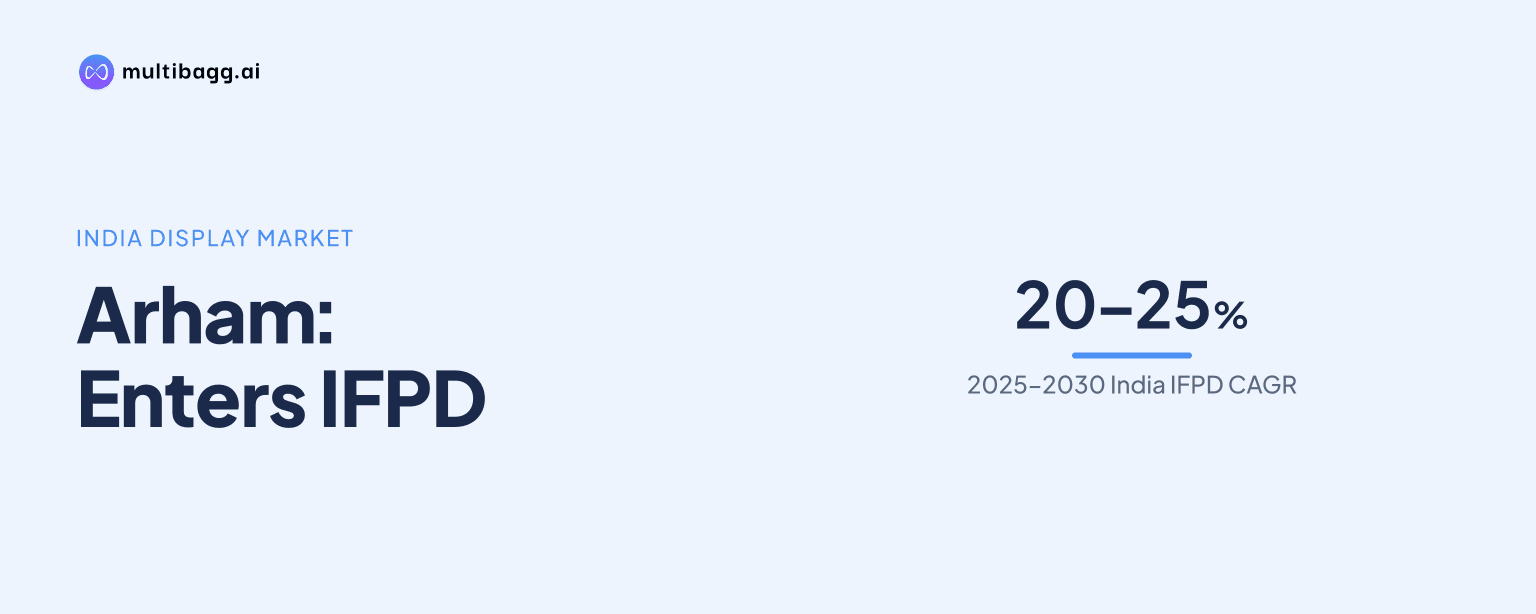
Arham Technologies Limited is entering domestic interactive flat-panel display (IFPD) manufacturing as its presentation cites a 20-25% compound annual growth rate (CAGR) for India’s IFPD market from 2025 to 2030 and smart-classroom penetration below 15-20%. The company has set up manufacturing infrastructure for IFPDs and identifies schools, digital signage and education technology as target applications.
Know Arham Technologies inside out
Results, valuation, peers and who's buying, in one view.
What market gap is Arham targeting with IFPDs?
Arham is targeting an institutional-display market with more than 15 lakh schools in India and cited smart-classroom penetration below 15-20%. It describes IFPDs as products for smart classrooms, digital signage and education technology, separating the opportunity from its existing smart television, fan and home-appliance portfolio.
The company cites a 20-25% CAGR for the Indian IFPD market between 2025 and 2030. Its presentation identifies replacement of traditional boards, new installations under government schemes, and expansion into corporates and education technology as the three demand drivers. Arham does not disclose a market-size estimate in rupees, its expected market share or its anticipated IFPD sales.
The presentation’s evidence is an adoption gap across the cited school base rather than a comparison with Arham’s historical IFPD revenue. Arham reports annual production capacity of 3,00,000 units for smart televisions, 5,00,000 units for fans and 50,000+ units for home appliances, but it gives no dedicated IFPD capacity figure.
How does education policy support Arham’s IFPD plan?
Arham links IFPD demand to the National Education Policy 2020, which it says promotes experiential, technology-enabled learning and the integration of digital tools. It also cites a Rs 42,100 crore allocation for school education under Samagra Shiksha Abhiyan in 2026-27, including information and communication technology laboratories and smart classrooms.
The presentation additionally cites more than Rs 400 crore of budget approval for digital classrooms in Chhattisgarh. The national 2026-27 allocation and the Chhattisgarh budget indicate that Arham’s demand case covers central education schemes and state-level adoption, although the source does not state what share of either allocation is for IFPDs.
Arham also refers to Digital India and digital public infrastructure as supports for digital ecosystems in schools and offices. Management describes its order pipeline as backed by government initiatives and rising demand from schools and institutions, but the presentation gives no pipeline value, tender award, customer name, conversion rate or delivery timetable.
Got a follow-up? Ask IRIS
What is Arham doing to manufacture IFPDs in India?
Arham says it has undertaken capital expenditure to set up a new manufacturing facility and infrastructure for IFPDs in India. The company says it is expanding into smart classrooms, digital signage and education technology products, while presenting IFPDs as high-value, technology-driven products with margin potential.
The IFPD entry forms part of a wider manufacturing and backward-integration programme. Arham says its assembly operations include light-emitting diode televisions, large-sized panels and IFPDs, while it plans to expand into 75-inch and 85-inch televisions and digital-signage solutions. In-house product development covers televisions, IFPDs and appliances.
Arham’s stated production model has changed across six processes. In the previous setup, design and development, tooling and process setup, and fabrication were outsourced; assembly, testing and final-product activities were in-house. In the current setup, the company lists all six processes as in-house, although its detailed presentation identifies tooling and fabrication as in-house and expanding.
Arham says the integration programme is intended to boost margins and allow benefits to be passed to distributors. This is management’s stated mechanism, not a reported financial result: the presentation does not provide an IFPD gross margin, cost saving, capital-expenditure amount or distributor incentive level.
What manufacturing and competitive conditions does Arham identify?
Arham says only two to three listed players manufacture IFPDs in India and characterises the wider market as highly fragmented. It pairs that observation with smart-classroom penetration below 15-20% and policy support for domestic manufacturing, but it does not name competitors or provide their capacities, prices or market shares.
The company describes its Raipur, Chhattisgarh facility as more than 45,000 square feet with 24/7 operational readiness and 100% multi-stage testing. Arham lists ISO 9001:2008, ISO 45001, ISO 14001, Bureau of Indian Standards, Bureau of Energy Efficiency and Zero Defect Zero Effect certifications, although it does not disclose IFPD output, capacity utilisation or a commissioning date for the IFPD facility.
For future expansion, Arham says it acquired 6,350 square metres of land in Raipur, increasing its land bank by 250% relative to its current footprint. The company gives a subsidised land cost of Rs 52.39 lakh against a stated market value of Rs 4.31 crore, but does not specify whether the land will be used for IFPDs or when any expansion will be commissioned.
Conclusion
Arham’s IFPD entry combines a cited 20-25% market CAGR for 2025-2030 with an institutional adoption gap of below 15-20% smart-classroom penetration across more than 15 lakh schools. The company is seeking to serve that opportunity through domestic manufacturing and a production model that moves design, tooling and fabrication from outsourced activities to in-house processes.
The next disclosed points to watch are the execution of the IFPD manufacturing facility, the expansion of tooling and fabrication capabilities, and the planned future use of the 6,350-square-metre Raipur land parcel. The Rs 42,100 crore Samagra Shiksha Abhiyan allocation for 2026-27 remains part of the policy backdrop, while Arham has not disclosed IFPD orders, capacity, revenue targets or a production timeline.