










Arvind Fashions direct channels reach 53% of Q2 FY27 revenue
Key highlights
- Arvind Fashions said direct channels accounted for 53% of Q2 FY27 revenue.
- Arvind Fashions’ retail channel grew 15.4% year on year, while retail LTL sales rose 7.3%.
- Arvind Fashions’ online B2C business grew about 28% year on year in Q2 FY27.
- Arvind Fashions added 24 gross EBOs and reported EBITDA of Rs 216 crore, up 15.5% year on year.
powered by IRIS
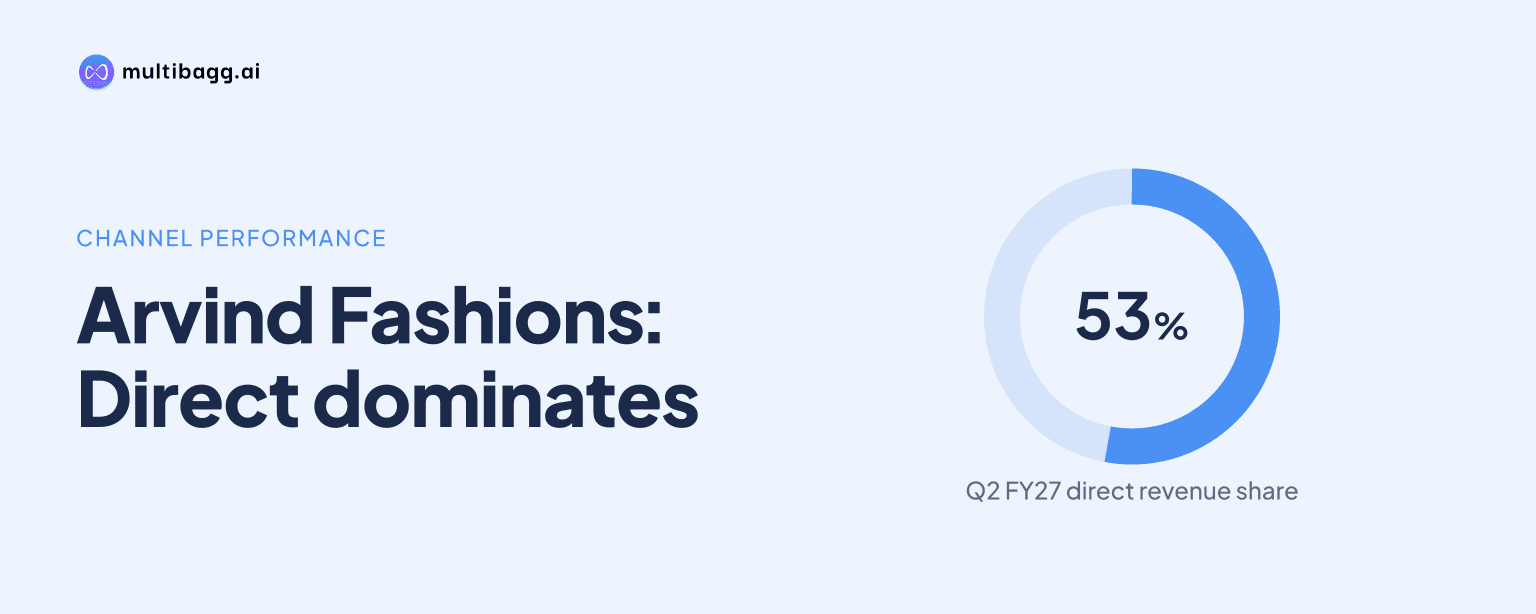
Arvind Fashions Limited said direct channels accounted for 53% of Q2 FY27 revenue, as retail sales rose 15.4% year on year and online business-to-consumer, or B2C, sales grew about 28%. The company reported overall revenue growth of 10%, with direct-channel growth exceeding wholesale consumer-sales growth in the mid-single digits.
Know Arvind Fashions inside out
Results, valuation, peers and who's buying, in one view.
How did Arvind Fashions’ channels perform in Q2 FY27?
Arvind Fashions’ retail and online B2C channels outgrew total revenue in Q2 FY27, while wholesale consumer sales rose at a mid-single-digit rate. Retail channel sales increased 15.4% year on year and online B2C grew about 28%, compared with 10% growth in total revenue. The company said wholesale growth was affected by the shift in festive timing.
Retail’s reported like-to-like, or LTL, sales growth was 7.3% in Q2 FY27, indicating that comparable stores contributed to the 15.4% channel increase alongside expansion of the store network. Arvind Fashions said lower discounting and retail execution supported the LTL result. It also reported that retail LTL would have been 10% after adjusting for the festive shift.
Online B2C was the fastest-growing channel disclosed by Arvind Fashions for Q2 FY27, at about 28% year on year. The company said online B2C growth would have been 45% after adjusting for the festive shift, compared with the reported 28%. This adjustment reflects management’s view that the timing of festival demand affected reported channel growth during the quarter.
What does the 53% direct-channel mix mean for Arvind Fashions?
Arvind Fashions’ direct channels, comprising retail and online B2C, accounted for 53% of revenue in Q2 FY27. The mix places more than half of the company’s revenue in channels that it sells through directly, while the filing describes wholesale consumer-sales growth as mid-single digit during the same period.
The difference in channel growth rates was material in Q2 FY27. Retail growth of 15.4% was 5.4 percentage points higher than the company’s 10% total revenue growth, while online B2C growth of about 28% was about 18 percentage points higher. Arvind Fashions did not disclose absolute quarterly revenue for retail, online B2C or wholesale in the supplied filing.
Management has set an FY27 objective to increase direct-channel share by 100 to 200 basis points. A basis point is one-hundredth of a percentage point. That objective covers retail and online B2C, and follows Q2 FY27 in which these two channels represented 53% of revenue.
The FY27 plan also calls for revenue growth of 12% to 15%, with acceleration in adjacent-category growth. Arvind Fashions reported 13% growth in adjacent categories in Q2 FY27, above its 10% overall revenue growth. These are management objectives and reported quarterly metrics, rather than a forecast of a specific future quarterly outcome.
Got a follow-up? Ask IRIS
What drove Arvind Fashions’ retail-channel growth?
Arvind Fashions said retail execution, LTL growth and store expansion drove the 15.4% increase in retail-channel sales in Q2 FY27. Reported retail LTL growth was 7.3%, and the company cited lower retail discounting as part of the performance. After the festive-shift adjustment, it put retail LTL growth at 10%.
The company added 24 gross exclusive-brand outlets, or EBOs, during the quarter and reported net retail-space addition of about 26,000 square feet. Its EBO count stood at 1,044 as of September 2026. The 24 gross additions and the net space increase expanded the physical network beyond the contribution from comparable-store sales.
The comparison between 7.3% reported LTL growth and 15.4% retail-channel growth shows that store additions were part of the retail sales increase, although the measures do not have identical definitions. Arvind Fashions specifically attributed retail growth to both strong LTL and store expansion. The 10% adjusted LTL figure was 2.7 percentage points above the reported 7.3% result.
For FY27, management aims for about 150 gross store openings, largely through the franchise-owned, franchise-operated, or FOFO, route. It also targets higher net square-foot additions than in FY26. The filing does not state how many of the planned FY27 gross openings had been completed by September 2026.
How did channel growth affect Arvind Fashions’ margins and operations?
Arvind Fashions reported earnings before interest, tax, depreciation and amortisation, or EBITDA, of Rs 216 crore in Q2 FY27, up 15.5% year on year. EBITDA growth exceeded the company’s 10% revenue growth by 5.5 percentage points, while EBITDA margin increased by 67 basis points.
Gross margin increased by 136 basis points in Q2 FY27, according to Arvind Fashions. The company attributed the change to strong LTL sales, lower retail discounting and a better channel mix. The filing does not quantify how much of the gross-margin movement came separately from retail, online B2C or wholesale.
Net working capital, or NWC, stood at 65 days in Q2 FY27, and inventory turns were about 3.4 times. Arvind Fashions’ FY27 objectives include higher free-cash-flow generation through NWC efficiency and an asset-light approach, as well as further improvement in return on capital employed, or ROCE. No prior-period NWC-day or inventory-turn figure was provided for comparison.
Management also plans to use data, analytics and artificial intelligence, or AI, for cost efficiency and front-end functions including retail execution, pricing, assortment and marketing effectiveness. This plan sits alongside the 100-to-200-basis-point direct-channel-share objective and the target for about 150 gross store openings in FY27.
Conclusion
Arvind Fashions’ Q2 FY27 results show that direct retail and online B2C channels were the principal disclosed contributors to its 10% revenue growth. Direct channels reached 53% of revenue, with retail up 15.4% and online B2C up about 28%, compared with mid-single-digit growth in wholesale consumer sales. Higher gross margin and 15.5% EBITDA growth accompanied the channel mix and lower retail discounting.
The next disclosures to watch are progress toward management’s FY27 aim to lift direct-channel share by 100 to 200 basis points and open about 150 stores, largely through FOFO. Updates on EBO additions beyond the 1,044 outlets reported in September 2026, net square-foot growth, festive-normalised LTL sales and NWC days will indicate how the stated plan is developing.