










Arvind Fashions reports record Q2 revenue and EBITDA growth
Key highlights
- Arvind Fashions reported Q2 FY27 revenue from operations of Rs 1,558.83 crore, up 10.0% year on year.
- Arvind Fashions’ Q2 FY27 EBITDA rose 15.5% to Rs 216 crore and margin reached 13.9%.
- Arvind Fashions’ gross margin increased 136 basis points to 53.9% in Q2 FY27.
- Arvind Fashions’ direct channel contributed 53% of Q2 FY27 revenue, up about 380 basis points year on year.
powered by IRIS
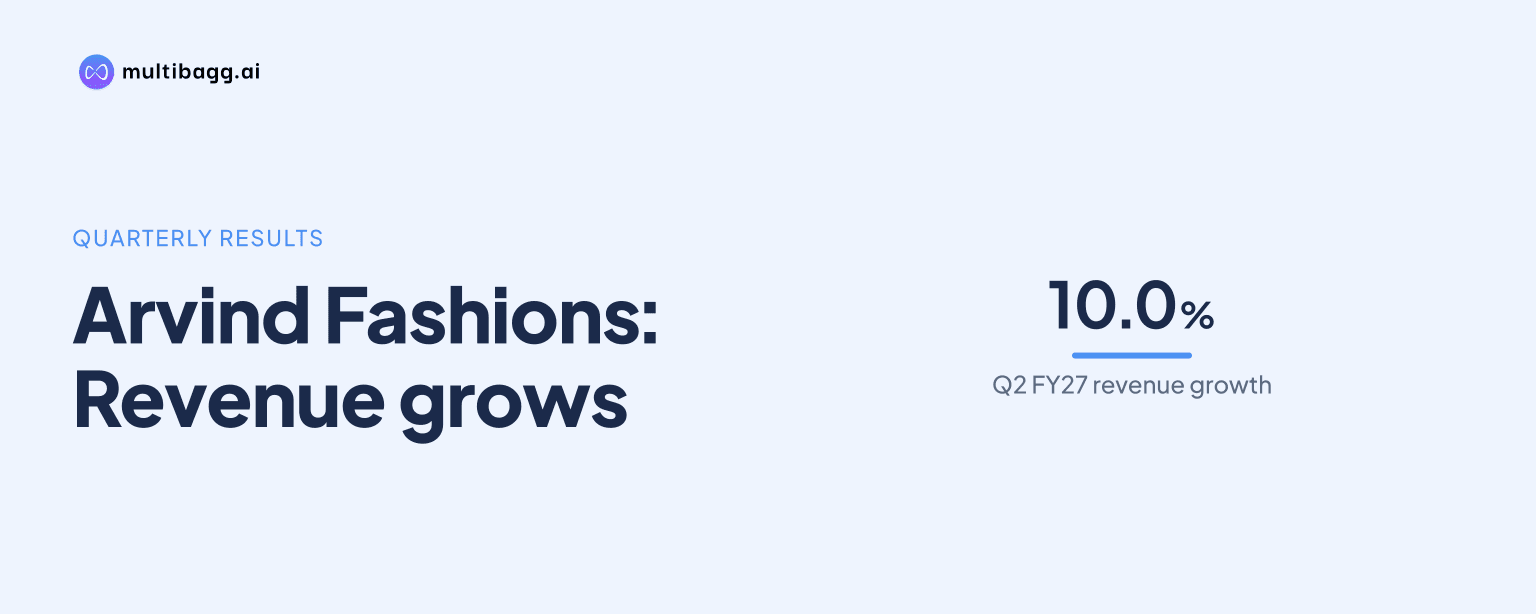
Arvind Fashions Limited reported record revenue from operations of Rs 1,558.83 crore and record EBITDA of Rs 216 crore in Q2 FY27 ended September 30, 2026, as revenue rose 10.0% year on year and continuing-business profit after tax, or PAT, rose 29.6% to Rs 49 crore on the company’s rounded measure.
Know Arvind Fashions inside out
Results, valuation, peers and who's buying, in one view.
How did Arvind Fashions perform in Q2 FY27?
Arvind Fashions increased revenue from operations by 10.0% to Rs 1,558.83 crore in Q2 FY27 from Rs 1,417.51 crore in Q2 FY26. Revenue also rose from Rs 1,278.50 crore in Q1 FY27, making the September quarter 21.9% higher sequentially. The company described both its Q2 revenue and EBITDA as its highest ever.
Earnings before interest, tax, depreciation and amortisation, or EBITDA, rose 15.5% to Rs 216 crore from Rs 187 crore in Q2 FY26, according to the company’s financial-performance summary. EBITDA margin improved by about 67 basis points to 13.9%, meaning EBITDA growth exceeded revenue growth by 5.5 percentage points during the quarter.
Arvind Fashions reported Rs 67.62 crore of consolidated profit after tax from continuing operations in Q2 FY27, compared with Rs 56.61 crore a year earlier. Total consolidated profit including discontinued operations was Rs 67.21 crore, because discontinued operations recorded a Rs 0.41 crore loss in the September 2026 quarter, compared with a Rs 0.26 crore loss in Q2 FY26.
What drove Arvind Fashions’ sales and margin increase?
Arvind Fashions said retail revenue grew 15.4% in Q2 FY27, while its direct channel contributed 53% of company revenue, about 380 basis points more than in Q2 FY26. Like-to-like retail sales, which compare stores operating in both periods, rose 7.3%, and online business-to-consumer sales increased about 28%.
Management said the timing of the festive season and online tower events affected the reported comparison. Adjusted for these events, Arvind Fashions estimated overall Q2 growth at about 15%, retail like-to-like growth at 10%, and online business-to-consumer growth at 45%; these are management-adjusted measures rather than figures in the consolidated financial statement.
Gross margin rose 136 basis points to 53.9% in Q2 FY27 from an implied 52.5% a year earlier. Arvind Fashions attributed the change to a better channel mix, like-to-like sales growth and lower discounting, while the 53% direct-channel share was 3.8 percentage points above the prior-year level.
What did Arvind Fashions report for the first half?
Arvind Fashions generated revenue from operations of Rs 2,837.33 crore in the six months ended September 30, 2026, up 12.4% from Rs 2,524.82 crore in H1 FY26. The company reported H1 EBITDA of Rs 376 crore, up 17.2% from Rs 321 crore, so EBITDA again grew faster than revenue by 4.8 percentage points.
Consolidated profit after tax from continuing operations reached Rs 95.64 crore in H1 FY27, against Rs 81.74 crore in H1 FY26. Arvind Fashions’ performance summary reported continuing-business PAT of Rs 59 crore, compared with Rs 51 crore a year earlier, a 16.4% increase.
The group reports branded-apparel manufacturing and trading as one operating segment under Indian Accounting Standard 108. Although Arvind Fashions identifies U.S. Polo Assn., Arrow, Tommy Hilfiger, Calvin Klein and Flying Machine in its release, the filing gives no revenue or EBITDA split by individual brand for Q2 FY27 or H1 FY27.
Got a follow-up? Ask IRIS
What do Arvind Fashions’ balance sheet and cash flows show?
Arvind Fashions had total assets of Rs 4,791.50 crore at September 30, 2026, compared with Rs 4,215.78 crore at March 31, 2026. Inventory increased to Rs 1,572.89 crore from Rs 1,389.56 crore, trade receivables rose to Rs 844.03 crore from Rs 751.58 crore, and cash and cash equivalents increased to Rs 88.42 crore from Rs 50.81 crore.
Net cash from operating activities was Rs 208.13 crore in H1 FY27, compared with Rs 119.35 crore in H1 FY26. Investing activities used Rs 105.25 crore, including Rs 103.97 crore of purchases of property, plant, equipment and intangible assets, while financing activities used Rs 65.27 crore; cash and cash equivalents consequently increased by Rs 37.61 crore over the six months.
Management reported gross working-capital days of 157 and net working-capital days of 65 in Q2 FY27, describing both as stable. Current borrowings were Rs 584.75 crore at September 30, 2026, up from Rs 426.42 crore six months earlier, while non-current borrowings were Rs 105.02 crore compared with Rs 104.92 crore at March 31, 2026.
What is Arvind Fashions planning and watching after Q2?
Arvind Fashions said it intends to accelerate profitable growth across its marquee brands, deepen consumer engagement, raise the share of direct channels and improve efficiency. Management said its estimated underlying Q2 growth of about 15%, adjusted for festive-season and online-event timing, was in line with its guidance, but the release did not disclose a numerical full-year revenue or EBITDA target.
Managing Director and Chief Executive Officer Amisha Jain said management remains watchful of inflation, geopolitical developments, a potential El Nino effect and changes in repo rates. The filing provides no date for the next results announcement, leaving subsequent reported trends in the 53% direct-channel share, 7.3% retail like-to-like growth and 65 net working-capital days as disclosed measures to monitor.
Conclusion
Arvind Fashions’ Q2 FY27 results show revenue rising to Rs 1,558.83 crore while EBITDA increased faster, reaching Rs 216 crore, alongside a 136-basis-point expansion in gross margin to 53.9%. Management linked the profit progression to retail execution, a direct-channel contribution of 53% of revenue and lower discounting, while continuing-business PAT rose 29.6% on the company’s rounded measure.
The company’s stated plan is to expand direct channels, deepen consumer engagement and drive efficiency across its brands. Management has also identified inflation, geopolitical developments, a possible El Nino effect and repo-rate changes as unresolved external factors that could affect future demand, discounting and the reported growth rate after Q2 FY27.