










Arvind Fashions holds working-capital days at 65 in Q2 FY27
Key highlights
- AFL held net working-capital days at 65 in September 2026, unchanged from June 2026.
- Inventory days rose to 108 in September 2026 from 105 in June 2026.
- Borrowings increased to Rs 690 crore at September 2026 from Rs 531 crore at March 2026.
- H1 FY27 revenue from operations rose to Rs 2,837 crore from Rs 2,525 crore in H1 FY26.
powered by IRIS
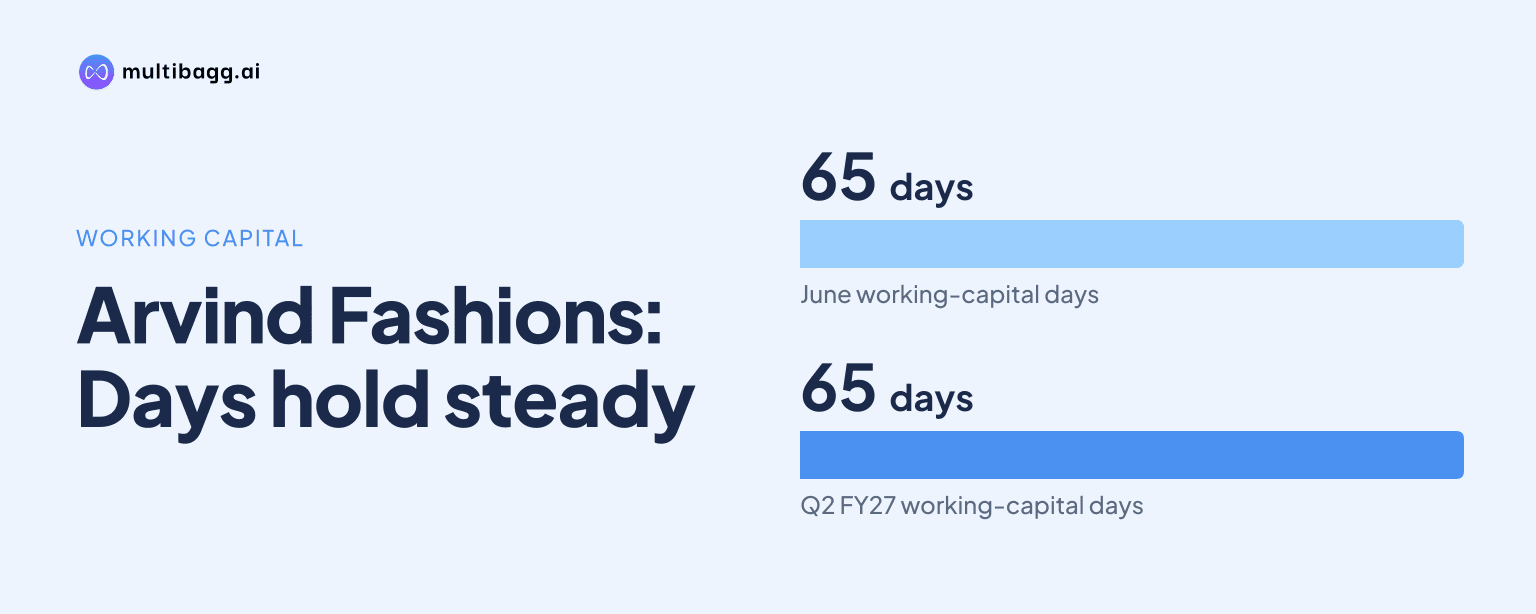
Arvind Fashions (AFL) held net working-capital days at 65 at 30 September 2026, unchanged from 30 June 2026, despite inventory days rising to 108 from 105 and borrowings increasing to Rs 690 crore from Rs 531 crore at 31 March 2026.
Know Arvind Fashions inside out
Results, valuation, peers and who's buying, in one view.
How did AFL's working capital change in Q2 FY27?
AFL reported net working capital, or NWC, of Rs 1,088 crore at September 2026, compared with Rs 1,016 crore at June 2026 and Rs 969 crore at March 2026. Despite the Rs 72 crore sequential rise in NWC, NWC days remained at 65, matching the June 2026 closing figure and standing one day above the 64 days reported at March 2026.
Gross working capital, or GWC, reached Rs 2,672 crore at September 2026, up from Rs 2,328 crore at June 2026 and Rs 2,356 crore at March 2026. GWC days were unchanged sequentially at 157 days, compared with 156 days at March 2026 and 152 days at September 2025, meaning stability in NWC days did not extend to every working-capital measure.
Why did AFL's inventory days rise to 108?
AFL's inventory days rose to 108 at September 2026, from 105 at June 2026, 102 at March 2026 and 96 at September 2025. Management attributed the higher inventory days to a higher share of the direct channel, rather than citing a change in the calculation method or a one-off balance-sheet item.
Inventory amounted to Rs 1,828 crore at September 2026, up Rs 184 crore from Rs 1,644 crore at June 2026 and Rs 223 crore from Rs 1,605 crore at March 2026. AFL calculates inventory days as average trailing 12-month, or TTM, inventory divided by TTM revenue and multiplied by 365, so the 108-day measure reflects both the inventory balance and revenue during that calculation period.
The direct-channel explanation aligns with AFL's disclosed plan to expand retail and online business-to-consumer, or B2C, operations. AFL said it intends to continue increasing direct-channel share through retail and online B2C expansion, while seeking margin expansion through a higher direct-channel mix and operating leverage.
Did receivables and payables offset AFL's inventory increase?
Yes. AFL's receivables increased to Rs 844 crore at September 2026 from Rs 684 crore at June 2026, while payables rose to Rs 1,584 crore from Rs 1,312 crore. The Rs 272 crore increase in payables was larger than the Rs 160 crore rise in receivables, while inventory increased by Rs 184 crore and NWC rose by Rs 72 crore over the quarter.
Receivable days declined to 49 at September 2026 from 52 at June 2026, 54 at March 2026 and 56 at September 2025. Payable days were 92 at September 2026, one day below the 93 days reported at June 2026 and March 2026, but one day above the 91 days reported at September 2025.
This movement explains how NWC days remained at 65 despite a three-day sequential increase in inventory days. AFL's components moved in different directions: inventory days rose, receivable days fell and payable days declined by one day, while the payables balance increased by Rs 272 crore.
Got a follow-up? Ask IRIS
How did AFL's borrowings and capital employed move?
AFL reported borrowings of Rs 690 crore at 30 September 2026, compared with Rs 531 crore at 31 March 2026, an increase of Rs 159 crore. Over the same period, net worth rose to Rs 1,231 crore from Rs 1,161 crore, while capital employed increased to Rs 1,921 crore from Rs 1,692 crore.
The balance-sheet movements included NWC rising to Rs 1,088 crore from Rs 969 crore and net fixed assets increasing to Rs 411 crore from Rs 361 crore between March and September 2026. Other assets increased to Rs 435 crore from Rs 373 crore, while discontinued operations remained at negative Rs 12 crore at both reporting dates.
What could affect AFL's working capital next?
AFL said it aims to deliver consistent double-digit revenue growth in a stable demand environment while deepening its position in five apparel categories: shirts, polos, denim, t-shirts and blazers. Its disclosed plan also includes scaling adjacent categories and increasing marketing investment for consumer connection, without a numerical financial target for those initiatives.
Management's direct-channel strategy is relevant after inventory days reached 108 at September 2026. AFL plans to expand retail and online B2C channels, pursue margin expansion through a higher direct-channel share and operating leverage, and increase return on capital employed, or ROCE, through margin expansion and free cash flow, or FCF, generation.
The September 2026 working-capital position coincided with higher first-half operating activity. Revenue from operations rose to Rs 2,837 crore in H1 FY27 from Rs 2,525 crore in H1 FY26, while earnings before interest, tax, depreciation and amortisation, or EBITDA, excluding other income increased to Rs 376 crore from Rs 321 crore.
Conclusion
AFL kept NWC days flat at 65 in September 2026 even as inventory days increased to 108 and inventory reached Rs 1,828 crore. Lower receivable days of 49 and payables of Rs 1,584 crore accompanied the result, while borrowings rose by Rs 159 crore from March 2026 to Rs 690 crore.
The next point to watch is how AFL's planned retail and online B2C expansion affects the direct-channel share that management linked to higher inventory days. Its stated aims of double-digit revenue growth, margin expansion, higher ROCE and FCF generation provide the disclosed framework for assessing subsequent working-capital and balance-sheet updates.