










Arvind Fashions direct channels lift Q2 sales by 10% year on year
Key highlights
- Arvind Fashions' Q2 FY27 sales rose 10% year on year to Rs 1,559 crore.
- Retail grew 15.4% and online B2C grew about 28% in Q2 FY27.
- Retail and online B2C increased to 53% of channel mix from 50% in Q2 FY26.
- Arvind Fashions opened 24 gross EBOs and added about 26,000 net square feet in Q2 FY27.
powered by IRIS
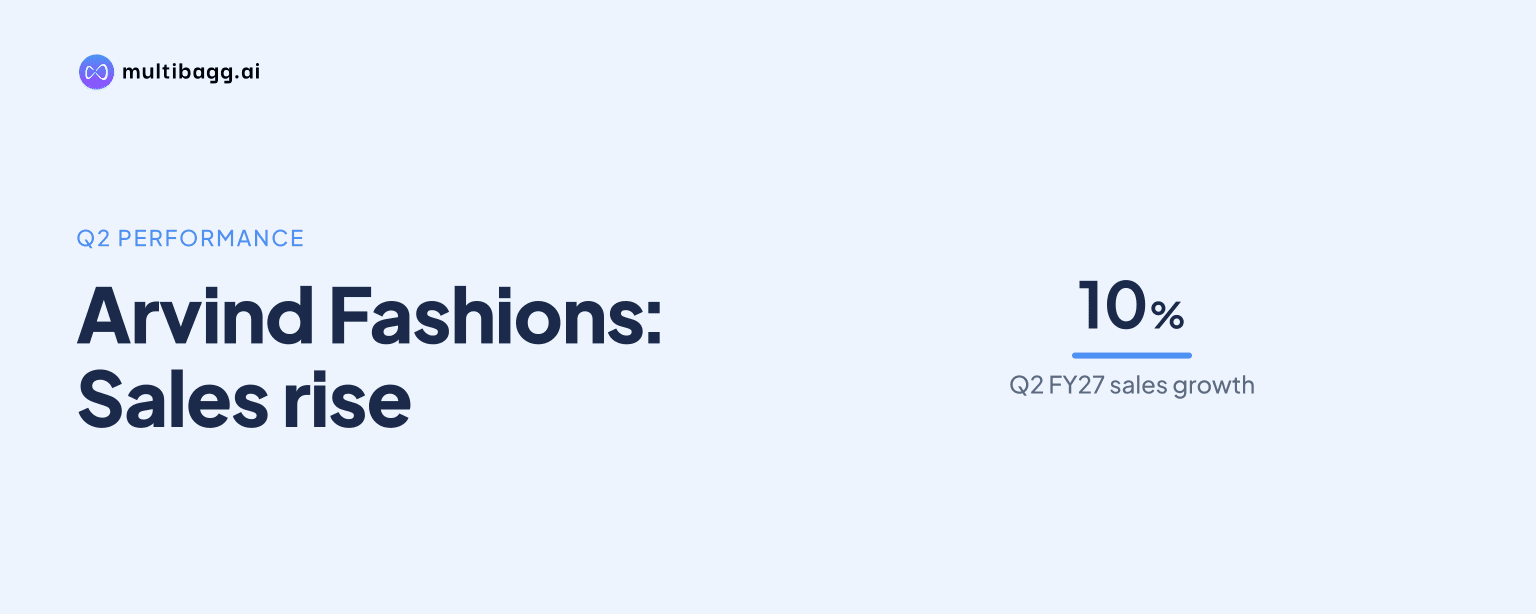
Arvind Fashions increased Q2 FY27 sales by 10% year on year to Rs 1,559 crore, led by 15.4% retail growth and about 28% growth in online business-to-consumer (B2C) sales. Retail and online B2C together represented 53% of channel mix, up from 50% in Q2 FY26.
Know Arvind Fashions inside out
Results, valuation, peers and who's buying, in one view.
How did direct channels drive Arvind Fashions' Q2 FY27 sales growth?
Direct channels grew faster than Arvind Fashions' overall sales in Q2 FY27, with retail rising 15.4% and online B2C increasing about 28%, against total sales growth of 10%. Sales rose by Rs 141 crore from Rs 1,418 crore in Q2 FY26 to Rs 1,559 crore in Q2 FY27. Management said direct-channel performance aided the increase, while wholesale consumer sales grew at a mid-single-digit rate because of a festive shift.
Retail like-to-like (LTL) sales, which compare sales from comparable stores, rose 7.3% in the reported quarter. Management said retail LTL would have been 10% after adjusting for the festive shift. Online B2C growth would similarly have been 45% on that adjusted basis, compared with the reported growth of about 28%.
What changed in Arvind Fashions' channel mix?
Arvind Fashions increased the combined share of retail and online B2C by 3 percentage points to 53% in Q2 FY27 from 50% a year earlier. Retail's share rose to 40% from 38%, while online B2C increased to 13% from 12%. The movement shows that each of the two direct channels added to the change in mix.
Wholesale, comprising multi-brand outlets (MBOs) and department stores, accounted for 33% of Q2 FY27 channel mix, compared with 31% in Q2 FY26. Online business-to-business (B2B) and other channels declined to 14% from 20%, the largest mix movement reported. The presentation provides channel shares rather than absolute channel revenue, so it does not quantify the sales change in online B2B and other channels.
How did store additions support Arvind Fashions' retail growth?
Arvind Fashions opened 24 gross exclusive brand outlets (EBOs) in Q2 FY27 and added about 26,000 net square feet of retail space. Its EBO count stood at 1,044 as of September 2026. The additional footprint accompanied 15.4% retail-channel growth and 7.3% reported LTL growth.
The company disclosed gross EBO openings and net space additions, but not the number of store closures during Q2 FY27. Therefore, the presentation does not provide a net change in EBO count for the quarter. Arvind Fashions also reported 13% growth in adjacent categories, while management linked retail momentum to execution and lower retail discounting.
Got a follow-up? Ask IRIS
What did the channel shift mean for Q2 FY27 profitability?
Arvind Fashions said stronger LTL sales, lower retail discounting and a better channel mix lifted gross margin by 136 basis points in Q2 FY27. Earnings before interest, tax, depreciation and amortisation (EBITDA) margin rose by 67 basis points year on year. One basis point equals one-hundredth of a percentage point.
EBITDA increased 15.5% to Rs 216 crore from Rs 187 crore in Q2 FY26, exceeding the 10% rise in sales. Profit before tax (PBT) rose to Rs 91 crore from Rs 87 crore, and profit after tax (PAT) from continuing operations increased to Rs 49 crore from Rs 38 crore. Arvind Fashions reported PAT growth of 29.6% from continuing operations.
What operating metrics did Arvind Fashions report alongside growth?
Arvind Fashions reported net working capital (NWC) days of 65 and inventory turns of about 3.4 times in Q2 FY27. The presentation does not include Q2 FY26 figures for these measures, so it does not show a year-on-year movement in either metric. Management's FY27 objectives include higher free cash flow through NWC efficiency and an asset-light approach.
Management also said external factors, including the West Asia conflict, El Nino's weather impact and repo-rate changes, could create inflationary pressure. It said it would seek to mitigate those pressures through pricing and cost measures. These comments sit alongside the Q2 FY27 gross-margin increase of 136 basis points and the 67-basis-point EBITDA-margin expansion.
What is Arvind Fashions planning for direct channels in FY27?
Arvind Fashions has set an FY27 objective to increase the share of direct channels, defined as retail plus online B2C, by 100 to 200 basis points. That objective follows the 3-percentage-point year-on-year increase in combined direct-channel mix reported in Q2 FY27. Management presents the objective as a target, not as a forecast of the eventual FY27 outcome.
Management also plans about 150 gross store openings in FY27, largely through the franchise-owned, franchise-operated (FOFO) route, and expects higher net square-foot additions than in FY26. It has stated an aspiration for revenue growth of 12% to 15%, with operating leverage intended to support EBITDA and PAT margin expansion. The presentation does not provide a schedule for the remaining store openings.
Conclusion
Arvind Fashions' Q2 FY27 sales growth was led by direct channels, as retail rose 15.4% and online B2C expanded about 28%, ahead of the 10% increase in total sales. Their combined channel-mix share rose to 53%, while the company reported higher gross margin, EBITDA of Rs 216 crore and PAT from continuing operations of Rs 49 crore.
What to watch next is management's execution against its FY27 plans for 12% to 15% revenue growth, a 100-to-200-basis-point increase in direct-channel share and about 150 gross store openings, largely through FOFO. Progress on net square-foot additions, retail LTL growth and the impact of pricing and cost measures on margins will indicate whether the Q2 trend continues.