








Asarfi Hospital says cancer ARPOB could normalise near Rs 35,000
MAX Plan at ₹4,999/yr

Find your next multibaggerBe a Pro Investor
Research stocks and track your picks on the go. Download the app.
Key highlights
- Asarfi Hospital said cancer ARPOB could be approximately Rs 35,000 after daycare-treatment reporting is clarified.
- More than 90% of Asarfi Hospital’s cancer patients are cashless patients under government, PSU or similar schemes.
- An analyst cited cancer ARPOB of about Rs 27,000 to Rs 60,000 across different quarters, including Rs 50,000 in the current quarter.
- Asarfi Hospital cited Rs 11.61 crore of cancer-unit revenue and Rs 40.72 crore of super-specialty revenue in the last quarter discussed.
powered by IRIS
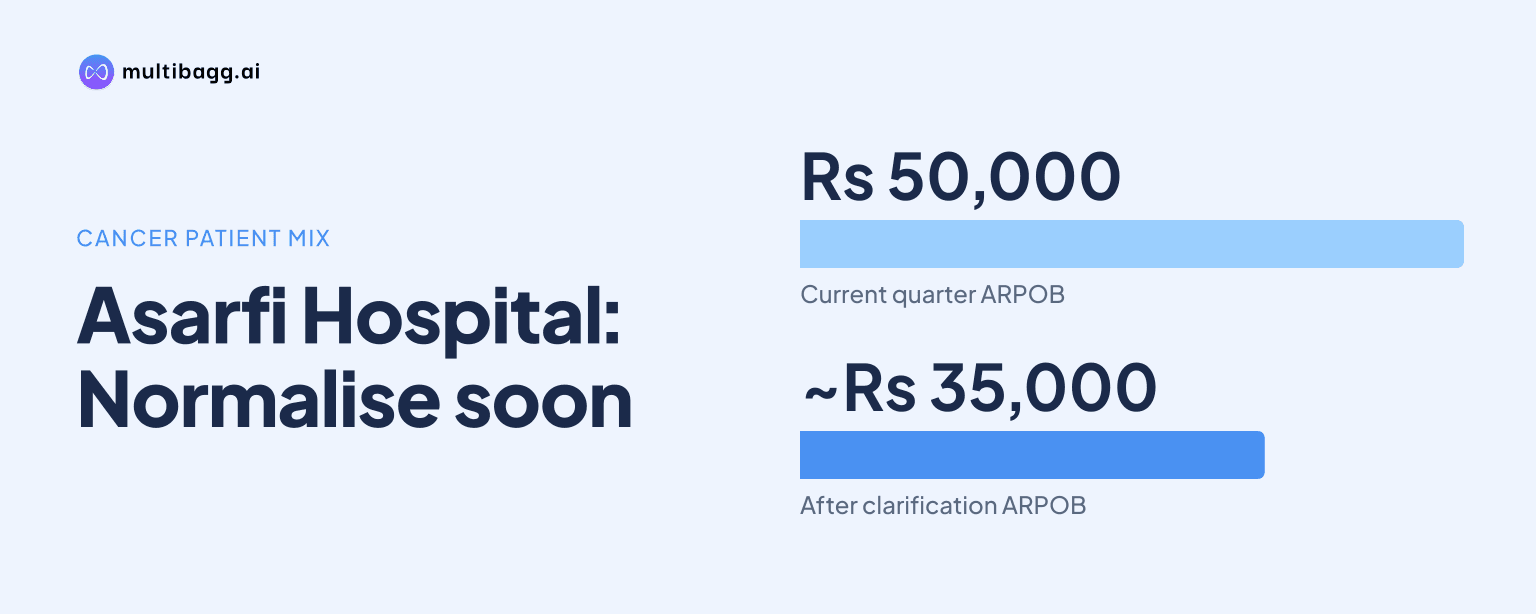
Asarfi Hospital said its cancer unit’s average revenue per occupied bed, or ARPOB, could be approximately Rs 35,000 after government and public-sector undertaking, or PSU, payers clarify the treatment of daycare patients. Management said more than 90% of cancer patients are cashless patients, and mandatory 24-hour admissions for some daycare cases distort the reported metric.
Know Asarfi Hospital inside out
Results, valuation, peers and who's buying, in one view.
Why is Asarfi Hospital’s cancer ARPOB volatile?
Asarfi Hospital said the volatility reflects how cashless daycare patients are recorded, rather than a direct relationship between occupancy and cancer revenue. An analyst said cancer ARPOB had ranged from about Rs 27,000 to Rs 31,000 in certain quarters, reached around Rs 60,000 in another quarter, and was Rs 50,000 in the current quarter cited on the call.
Management said more than 90% of cancer patients use cashless schemes, including Ayushman Bharat, the Central Government Health Scheme, government PSU arrangements and Jharkhand government programmes. A patient receiving chemotherapy or radiotherapy may arrive for treatment on a daycare basis, but the relevant payer may require the hospital to formally admit that patient.
Asarfi Hospital said it had received letters from PSUs requiring a 24-hour admission even where a daycare patient’s treatment had ended. Management said the hospital was discussing with the payers why patients should be retained for 24 hours after treatment, and that the admission rule affects the calculation of revenue per occupied bed.
What does Rs 35,000 mean for Asarfi Hospital’s cancer unit?
Asarfi Hospital said approximately Rs 35,000 is the ARPOB it expects if daycare treatment is treated as daycare rather than being included in the existing bed-based calculation. Management presented this as an approximate normalised reference point, conditional on clarification from PSUs and government counterparties, rather than as a revenue forecast or formal target.
The distinction is important because chemotherapy and radiotherapy are daycare procedures, according to management. Asarfi Hospital said cancer occupancy does not relate to revenue in the same way as occupancy at its super-specialty hospital. An analyst cited an example where cancer occupancy was about 56% when ARPOB was lower, while occupancy was 30% when ARPOB was Rs 50,000.
The cancer hospital had 65 operational beds during the call. Management said it was focused on raising utilisation and business before increasing bed capacity, while describing a 40% to 60% occupancy range for cancer operations and separately saying it was looking for 60% to 65% occupancy.
Asarfi Hospital also committed to provide more detail in its next investor presentation. When asked to separate daycare revenue from cancer revenue, management said it would give that breakdown, which could help readers distinguish bed-based activity from short-stay chemotherapy and radiotherapy revenue.
How large is the cancer business within Asarfi Hospital?
Asarfi Hospital said the cancer unit recorded Rs 11.61 crore in the last quarter cited on the call, compared with Rs 40.72 crore for the super-specialty hospital. On the combined Rs 52.33 crore base, the cancer unit accounted for about 22% of revenue and the super-specialty unit for about 78%, consistent with the analyst’s estimate of a 20% to 25% cancer share.
Asarfi Hospital said the two units have different payment mixes. The super-specialty hospital had a 50-50 cash and cashless mix, with the cashless category including third-party administrator, or TPA, and insurance business. In cancer, management said direct cash business was 7% to 8% and TPA business was another 7% to 8%, leaving most activity tied to government schemes.
Management said it was not planning to reduce government-scheme business during the cancer hospital’s initial phase because it needed to serve patients and build activity. Instead, Asarfi Hospital is targeting at least 30% cash business in cancer and 60% cash business in super-specialty, compared with about 15% cash business currently in cancer.
Got a follow-up? Ask IRIS
How does Asarfi Hospital plan to change its cancer patient mix?
Asarfi Hospital said it aims to reach 30% cash business in cancer within the next 12 months, or by the end of 2027, through a broader geographic patient mix. Management said the plan is not to deny scheme patients, but to improve the share of patients coming from its wider 10-district catchment area.
More than 50% of cancer business currently comes from Dhanbad, management said, while Giridih contributes 11%. Other districts account for 5%, 6%, 3% or 2% each. Asarfi Hospital said a more balanced contribution from the 10 districts could raise the cash share because patients travelling from more distant locations are more likely to pay cash.
This geographic plan also relates to the unit’s expansion timetable. Management said adding beds at the existing super-specialty unit was not possible at present because of building constraints. Cancer-bed expansion remained in the pipeline, but Asarfi Hospital said it would first seek better utilisation and consolidation at the existing 65-bed cancer hospital.
The hospital did not provide an organic revenue target for 2028 when asked during the call. Management said it was still assessing the factors affecting the cancer operation and would provide a considered response after reviewing them.
What should readers watch in Asarfi Hospital’s next disclosures?
Asarfi Hospital’s next investor presentation should show whether management delivers the promised split between daycare revenue and cancer revenue. That disclosure could help reconcile ARPOB with occupancy and procedure volumes after the analyst cited a range from about Rs 27,000 to Rs 60,000 across different quarters.
Readers should also watch progress in the hospital’s discussions with PSUs and government payers over the 24-hour admission requirement. Management did not give a date for resolving the issue. Until the classification is clarified, reported cancer ARPOB may continue to reflect payer-required admissions alongside the underlying volume of chemotherapy and radiotherapy procedures.
The cash-business target is another operating marker. Asarfi Hospital said cancer cash business was about 15% and targeted 30% by the end of 2027, while super-specialty cash business was targeted at 60% from a current 50-50 cash and cashless mix. The stated route is broader sourcing beyond Dhanbad and Giridih, not a reduction in patient access.
Conclusion
Asarfi Hospital’s explanation is that cancer ARPOB is influenced by payer administration as well as clinical activity. Cashless daycare patients can be recorded as 24-hour admissions, creating movements in the reported measure that do not necessarily track occupancy. Management’s approximately Rs 35,000 figure is therefore a conditional normalised reference point, not a reported result or revenue target.
Next, readers should watch for the promised daycare-revenue disclosure, progress in payer discussions and movement toward 30% cash business in cancer by the end of 2027. Management has linked any cancer-bed expansion beyond the present 65 beds to improved utilisation, making patient mix, treatment volumes and occupancy the main operational markers.

