








Asarfi Hospital targets 60% cash mix and 30% in cancer care
MAX Plan at ₹4,999/yr

Find your next multibaggerBe a Pro Investor
Research stocks and track your picks on the go. Download the app.
Key highlights
- Asarfi Hospital targets 60% cash business in super-specialty care, compared with a stated current 50%.
- Asarfi Hospital targets 30% cash business in cancer care, compared with a stated current 15%.
- Management said about 90% of cancer-hospital business is cashless.
- More than 50% of cancer business comes from Dhanbad and 11% from Giridih, according to management.
powered by IRIS
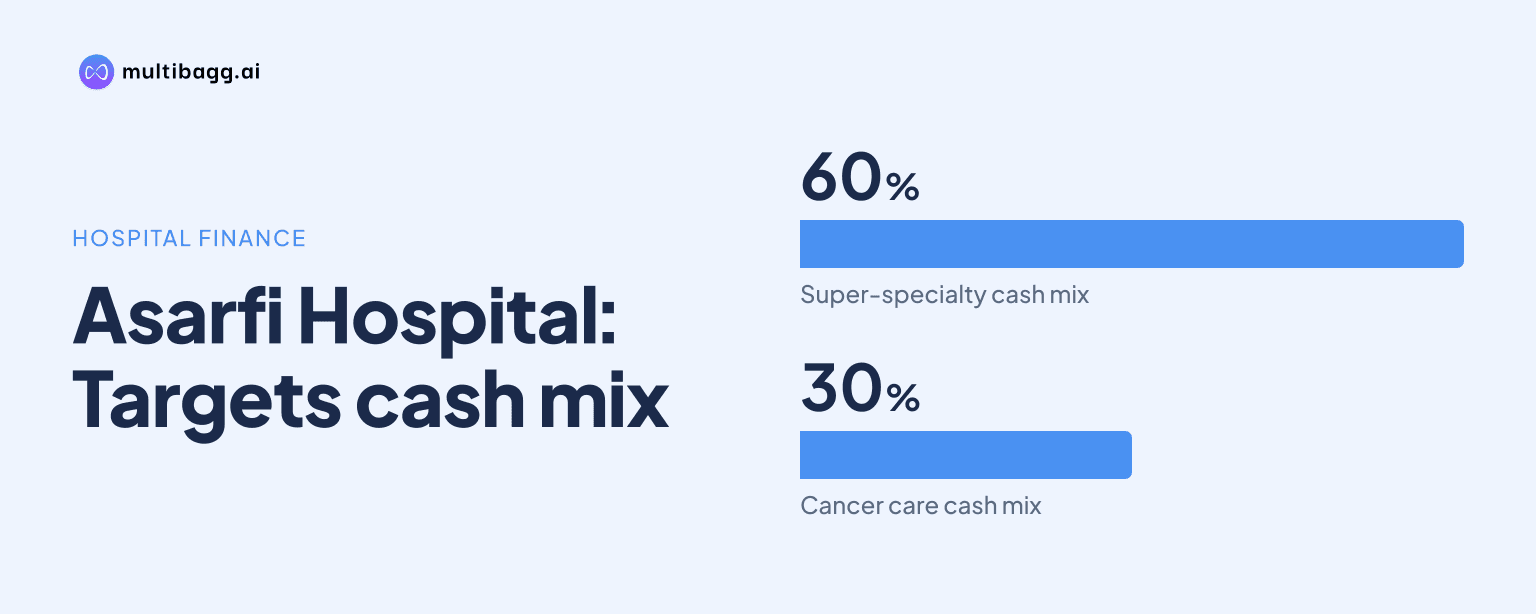
During its Q2 FY27 call, Asarfi Hospital said it was targeting 60% cash business in super-specialty care and 30% in cancer care, compared with a stated 15% cancer level, by expanding patient sourcing beyond Dhanbad amid delayed government-scheme collections.
Know Asarfi Hospital inside out
Results, valuation, peers and who's buying, in one view.
Why is Asarfi Hospital changing its payer mix?
Asarfi Hospital is changing its payer mix because delayed scheme collections have increased the importance of cash conversion, particularly at its cancer hospital. Management said the super-specialty hospital had a 50% cash and 50% cashless mix, while about 90% of cancer-hospital business was cashless. In cancer care, management separately cited direct cash business of 7% to 8% and third-party administrator, or TPA, business of another 7% to 8%, with the remainder from Ayushman Bharat and other government schemes.
The receivables issue was a central part of the call. An analyst cited about Rs 100 crore of first-half revenue and Rs 75 crore of receivables, while management said the balance included opening amounts and that some payments were pending for six to nine months. Management identified Jharkhand government payments as the continuing concern, while saying collections from other corporate payers were being managed through discussions.
The stated strategy does not involve refusing patients covered by government schemes. Management said it could not reduce such business during the initial phase of the establishment because it needed to continue treating patients and maintain operations. Instead, it plans to change the geographic and demographic mix of patients while continuing to serve insured and scheme-covered patients.
What cash-business targets has Asarfi Hospital set?
Asarfi Hospital has set a 60% cash-business target for its super-specialty hospital and a 30% target for its cancer hospital. Management said cancer cash business was currently 15% when discussing the target. It first said the cancer target could be reached in the next 12 months, then agreed with an analyst that the milestone would be reached by the end of 2027.
Management's cancer disclosures show why the target represents a material change in mix. In one answer, it described 7% to 8% as direct cash and 7% to 8% as TPA business, while it later used 15% as the current cash-business base for the 30% target. The transcript does not clarify whether the 15% measure includes all or part of TPA and insurance business, so the figures should not be treated as precisely identical categories.
The revenue split indicates that super-specialty care was the larger unit at the time. Management cited last-quarter revenue of Rs 11.61 crore for the cancer unit and Rs 40.72 crore for super-specialty care, and agreed that cancer represented about 20% to 25% of the combined business. A cash-mix change in super-specialty care would therefore affect the larger reported segment, while cancer has the lower stated cash share.
Got a follow-up? Ask IRIS
How will Asarfi Hospital raise cash business without denying patients?
Asarfi Hospital plans to raise cash business by expanding patient sourcing across 10 neighbouring districts rather than by limiting beds or denying patients using schemes. Management said more than 50% of cancer business came from Dhanbad and 11% from Giridih, while other districts accounted for shares such as 5%, 6%, 3% and 2%. Its aim is to make contributions across the 10-district catchment more balanced.
Management said patients travelling from more distant districts are more prepared to pay cash, whereas Dhanbad patients are more likely to seek discounts or use local connections. It described the hospital as the only provider of comprehensive cancer care across the neighbouring 10 districts. This wider catchment strategy, rather than a reduction in scheme admissions, is management's stated mechanism for increasing the cancer hospital's cash-business proportion.
The same outreach approach is being used for the super-specialty hospital. Management said it added second doctors in departments including gastroenterology and radiation oncology so that one doctor could remain at the hospital while another attended outreach clinics. Asarfi Hospital reported 107 total doctors in Q2 FY27, including 86 full-time doctors, compared with 103 total doctors and 70 full-time doctors in Q1 FY27.
Management said the rise in full-time doctors was not due to converting visiting doctors into employees. It said the total doctor count did not rise by the same amount because resident-doctor requirements fell after the start of the Diplomate of National Board, or DNB, course, whose students also work at the hospital. The purpose of the added specialist capacity is to improve access and visibility across the 10 target districts.
What could affect Asarfi Hospital's cancer cash target?
Asarfi Hospital's ability to meet the cancer cash target depends on building patient trust and increasing volumes, according to management. It said there was no infrastructure bottleneck but acknowledged that cancer occupancy had not risen as quickly as it wanted. Management attributed this mainly to patient confidence, saying Dhanbad and the neighbouring districts had not previously had an established cancer-treatment market and that Jharkhand had only three or four cancer units.
Cancer treatment's cost and duration add to the payer-mix challenge. Management said a patient might need treatment for one to two years and could spend Rs 15 lakh, Rs 20 lakh or Rs 30 lakh over that period. It also said private-insurance penetration was low in the area and that government health schemes continued to shape patient choices, leaving the hospital focused on attracting even a small share of patients able to pay cash.
Management said it was addressing trust through continuous medical education, doctor visits to referring clinicians and outreach clinics. It said cancer patients commonly arrive through referrals and that its specialists were building a network among referring doctors to explain available services and facilities. Management also said it had tried one-day visits by doctors from Kolkata, but patients did not see enough value where those doctors were not locally available on a continuing basis.
A reporting issue may also affect interpretation of cancer operating metrics. Management said daycare patients under public-sector undertaking schemes may have to be recorded as 24-hour admissions even when treatment does not require an overnight stay. If discussions clarify that such cases should be treated as daycare rather than included in revenue per occupied bed, management estimated cancer revenue per occupied bed could be about Rs 35,000. It said it would provide daycare and cancer-revenue details in the next presentation.
Conclusion
Asarfi Hospital's payer-mix plan responds to a cash-conversion issue in which cancer care remains predominantly cashless and management has acknowledged delays in Jharkhand government payments. Its approach is to broaden patient inflows from a 10-district catchment, where management believes patients travelling from more distant locations have a greater propensity to pay cash, rather than excluding scheme-covered patients.
The next indicators are whether cancer cash business advances from the stated 15% toward 30%, whether super-specialty care moves from its stated 50% cash mix toward 60%, and whether outreach improves cancer volumes. Management has also promised a daycare and cancer-revenue split in the next presentation, which could clarify the revenue-per-occupied-bed measure.

