








Asarfi Hospital defers cancer beds to lift utilisation
MAX Plan at ₹4,999/yr

Find your next multibaggerBe a Pro Investor
Research stocks and track your picks on the go. Download the app.
Key highlights
- Asarfi reported Rs 11.60 crore of cancer-hospital revenue in Q2 FY27.
- The cancer unit has 65 operational beds, and management is seeking 60% to 65% occupancy.
- Haemato-oncology and head-and-neck oncology grew 46% and 43%, respectively, in Q2 FY27.
- Consolidated Q2 FY27 operating revenue rose 18.1% year on year to Rs 53 crore.
powered by IRIS
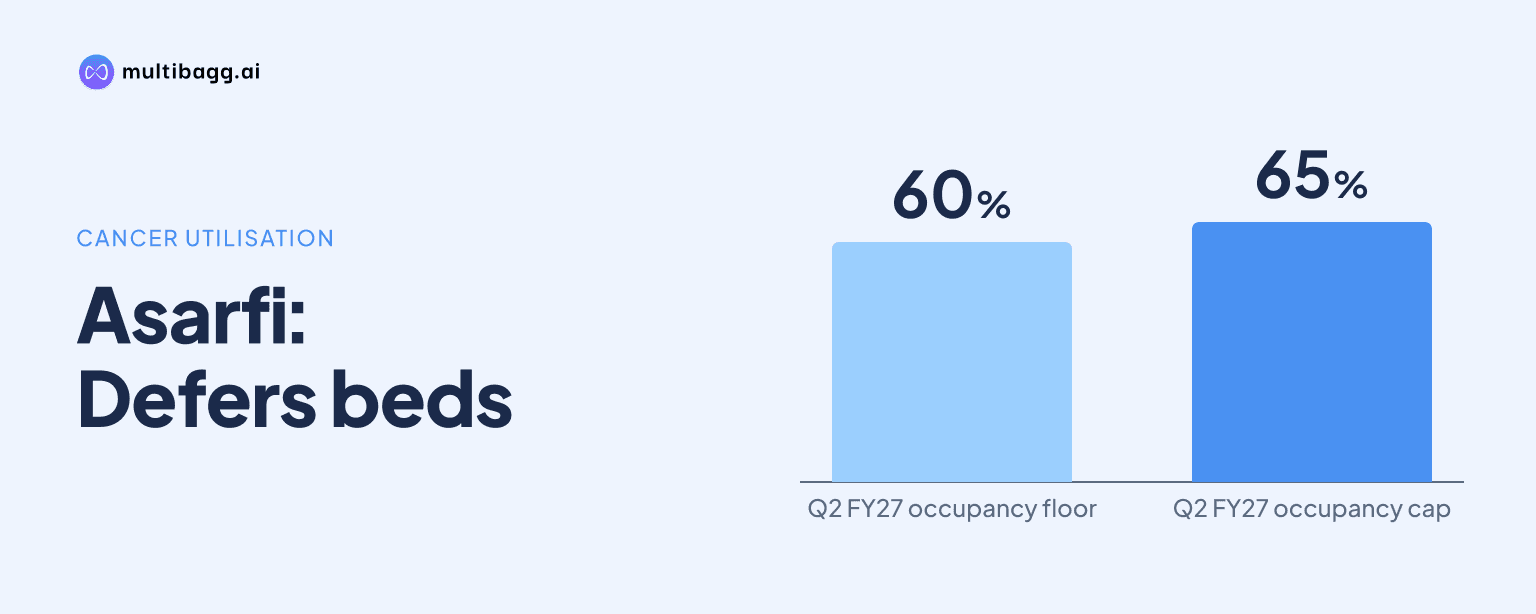
Asarfi Hospital said in Q2 FY27 that it will not add beds to its 65-bed cancer unit yet, choosing first to raise utilisation and build patient trust; management said it was seeking 60% to 65% occupancy while emphasising that chemotherapy and radiotherapy include day-care activity.
Know Asarfi Hospital inside out
Results, valuation, peers and who's buying, in one view.
Why is Asarfi delaying cancer-bed expansion?
Asarfi is delaying additional cancer beds because management considers the unit to be in a consolidation and trust-building phase rather than capacity-constrained. In the Q2 FY27 discussion, management said patients newly diagnosed with cancer often seek their initial treatment in metro cities, where they perceive treatment quality to be more established. It said the hospital is therefore working to build rapport locally before pursuing wider expansion through acquisitions or other locations.
The immediate priority is to strengthen the nearby cancer hospital, which management described as easier to monitor, rather than make a hurried move into other sites. Asarfi said it is monitoring disease-free survival rates, staying in contact with patients after they return home and developing doctor networks. Those mechanisms, rather than new beds, are central to management’s expectation that the cancer unit can eventually generate higher revenue and margin.
What is Asarfi’s cancer-unit occupancy target?
Asarfi said it is looking for cancer-unit occupancy of 60% to 65%, although management also described a 40% to 60% occupancy range when explaining how the metric should be read. The distinction matters because the 65-bed unit performs chemotherapy and radiotherapy, which are day-care procedures and do not necessarily require overnight bed use. Management therefore said occupancy does not relate to revenue in the cancer hospital in the same direct way as it does in a conventional inpatient facility.
An investor noted that cancer occupancy had varied across quarters and asked whether 65 operational beds were sufficient when utilisation was around 40% to 50%. Management answered that the capacity was sufficient for now and that the time for expansion had not matured. It said expansion is desired in the longer term, but the current focus is increasing both occupancy and business volumes, especially as radiation and chemotherapy services build.
How did Asarfi’s cancer hospital perform in Q2 FY27?
Asarfi’s cancer hospital generated Rs 11.60 crore of revenue in Q2 FY27, while the super-specialty hospital generated Rs 41.30 crore, making the latter the larger contributor to the group’s Rs 53 crore consolidated operating revenue. Management reported 46% growth in haemato-oncology and 43% growth in head-and-neck oncology, describing those increases as evidence of gradually strengthening specialised oncology services.
The comparison with the established super-specialty unit shows why management is focused on maturing the cancer franchise. Super-specialty revenue rose from Rs 32.20 crore in Q2 FY26 to Rs 41.30 crore in Q2 FY27, and cardiology remained its largest specialty after growing 14%. Paediatrics and neonatology grew 78%, neurosciences 42%, obstetrics and gynaecology 41%, and orthopaedics 36%, whereas the cancer business is still building local acceptance.
The broader operating data also show growing hospital activity during Q2 FY27. The two units together served 4,429 inpatients and 41,285 outpatients; inpatient volumes rose 13% year on year and outpatient volumes rose 25%. Surgeries increased 25% to 2,295, while inpatient revenue rose 17% and outpatient revenue rose 39%, supporting the consolidated revenue increase.
Got a follow-up? Ask IRIS
How does day-care treatment affect Asarfi’s cancer metrics?
Asarfi said day-care treatment can distort revenue per occupied bed, or RPOB, because more than 90% of its patients are cashless patients covered by schemes including Ayushman Bharat, Central Government Health Scheme, government public-sector undertakings or the Jharkhand government. Management said some payers require day-care patients to be admitted for 24 hours, meaning that the reported admission count can change with the treatment and payer mix.
Management said it is discussing that requirement with public-sector undertakings because it does not see a need to keep patients for 24 hours after treatment is complete. It indicated that, if day-care treatment is consistently classified as day care rather than in the RPOB calculation, cancer-unit RPOB should be about Rs 35,000. Management also agreed to provide a detailed split between day-care and cancer revenue in the next investor presentation.
This accounting and administrative issue helps explain why management does not treat bed occupancy as a standalone measure of cancer-unit performance. Chemotherapy and radiotherapy can add revenue without an overnight stay, while a compulsory 24-hour admission for a day-care case can affect occupancy and RPOB measures. The disclosed Rs 35,000 approximate RPOB was conditional on clarification of this treatment with payers, not a formal financial target.
What capacity options does Asarfi have beyond the cancer unit?
Asarfi said adding beds at the existing super-specialty unit is not possible at present because of building constraints. Management clarified that an earlier 350-bed figure included 285 existing super-specialty beds and 65 cancer beds, and did not represent an immediate organic expansion of the existing super-specialty building. It also said 80 beds had been associated with a proposed acquisition.
That acquisition remains unresolved because share transfer has been delayed by issues involving certain deceased minority shareholders and transfers to legal heirs. Management said that if acquisition cannot be completed, it intends to take over the unit under an operations and maintenance contract from April 1. It said the absence of the acquisition would affect FY27 revenue by at least Rs 15 crore and indicated revenue should reach about Rs 240 crore.
Asarfi also said its previously discussed cancer expansion remains in the pipeline, but did not provide a revised bed count or timetable. When asked for organic FY28 revenue guidance without the acquisition, management said it was still assessing the effect of cancer and other factors and could not provide a figure. That leaves the 65-bed unit’s utilisation trajectory, rather than a committed expansion schedule, as the disclosed near-term cancer capacity plan.
Conclusion
Asarfi’s Q2 FY27 position is that the cancer hospital has sufficient capacity at 65 beds, but must establish clinical trust, strengthen referrals and increase utilisation before management expands it. The group’s Rs 53 crore quarterly operating revenue, 46% haemato-oncology growth and 43% head-and-neck oncology growth indicate activity is increasing, while the Rs 41.30 crore super-specialty business remains the larger and more established revenue contributor.
Investors should watch the next presentation for the promised day-care and cancer-revenue detail, which may clarify the approximate Rs 35,000 RPOB calculation. Other disclosed milestones are progress toward 60% to 65% cancer occupancy, a potential operations and maintenance arrangement from April 1 if the acquisition fails, and management’s still-undetermined organic FY28 revenue outlook.

