








Asarfi Hospital Limited delays institute revenue to FY29
MAX Plan at ₹4,999/yr

Find your next multibaggerBe a Pro Investor
Research stocks and track your picks on the go. Download the app.
Key highlights
- Asarfi Hospital Limited moved Healthcare Management Research Institute revenue from FY28 to FY29.
- Management said a position-related issue delayed construction and pushed the institute back by about one year.
- Asarfi said its existing education operation is in its second batch after courses began last year.
- The proposed Dhanbad medical college has a projected Rs 352 crore cost, while its letter of intent remains pending.
powered by IRIS
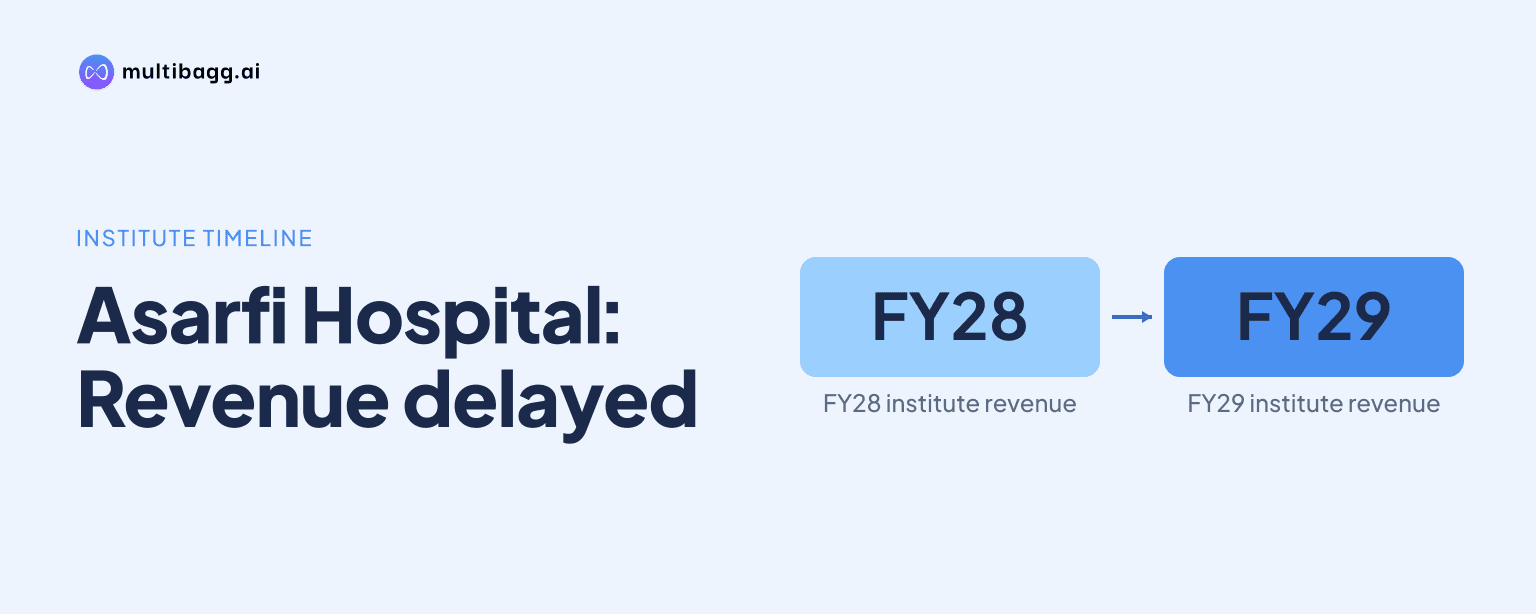
Asarfi Hospital Limited said on November 24, 2026 that Healthcare Management Research Institute revenue will begin in FY29 instead of FY28 after a position-related issue delayed construction, moving the project’s planned revenue contribution back by about one year.
Know Asarfi Hospital inside out
Results, valuation, peers and who's buying, in one view.
Why did Asarfi delay Healthcare Management Research Institute revenue?
Asarfi said a position-related issue delayed construction work and consequently pushed Healthcare Management Research Institute revenue from FY28 to FY29. Chief Financial Officer Harendra Singh gave that explanation during the November 24, 2026 earnings call in response to an investor asking about the Ranchi Management and Research Institute, which the investor understood to be under construction.
Management did not explain the precise nature of the position-related issue, identify the construction stage reached, or give a revised completion date. The disclosed sequence was limited to the issue, a construction delay and a later revenue start. Asarfi did not say that the institute had been cancelled, but it also did not provide a specific quarter in FY29 for first revenue.
Asarfi did not disclose a revenue target, enrolment plan, fee structure, operating-cost estimate or profit target for the institute for either FY28 or FY29. The call therefore establishes a timing change rather than a quantified reduction in revenue, earnings before interest, tax, depreciation and amortisation, or EBITDA, and profit after tax, or PAT.
When will Asarfi’s institute start generating revenue?
Asarfi expects Healthcare Management Research Institute revenue to start in FY29. Singh said the earlier FY28 revenue projection had “a little bit of delay” and that the project would take another year, but management did not state an opening date, student intake date or FY29 quarterly revenue profile.
The FY29 start is separate from Asarfi’s existing education activity. Management said it started education courses last year and that the current intake is the second batch. It also said education revenue had started picking up, indicating that some education income was already being generated while the Healthcare Management Research Institute remained a later project.
An investor referred to nursing and allied paramedical courses and asked whether programmes such as hospital management or pharmacy diplomas had begun. Asarfi did not confirm course-level offerings, revenue or targets during the November 24, 2026 call. Singh asked the investor to email the company so it could provide detail for the previous year and the current year.
That leaves the scale of the FY29 institute contribution undisclosed. Management did not provide the number of students, courses, approvals, capital expenditure or expected margins for Healthcare Management Research Institute, so the revised FY29 date should be read as a management timetable rather than financial guidance.
How does this compare with Asarfi’s other expansion projects?
Asarfi’s institute delay sits alongside a Dhanbad medical-college proposal whose timetable was also unresolved as of November 24, 2026. Management said it had been declared the L1 bidder, meaning the lowest bidder, after the financial bid, but had not received the government’s letter of intent for the public-private partnership, or PPP, project.
The Dhanbad medical college has a total projected cost of Rs 352 crore, according to management. Asarfi said the government guideline provides a Rs 200 crore capital grant to the successful bidder, while funding would operate on a 60:40 proportional basis: 30% from the central government, 30% from the state government and 40% from the bidder.
Management said the medical-college timeline would begin only after the letter of intent was received. It said Asarfi would need to sign an agreement with the state within one month after that letter, after which the relevant timeline would be linked to an application to the National Medical Council. Unlike the institute, the medical-college project had no stated operational or revenue year.
Asarfi also described acquisitions and operations-and-maintenance, or O&M, arrangements as possible routes to a 1,000-bed target before 2030. Management said it had identified facilities in Jharkhand and one in Asansol, West Bengal, but had not aggressively pursued the Asansol opportunity while it focused on improving the cancer business. If an acquisition does not materialise, management said it may pursue an O&M model next year with lower initial investment and cost.
Got a follow-up? Ask IRIS
What operating issues could affect Asarfi’s expansion plans?
Asarfi said cancer-business development in Dhanbad was taking time because it was building awareness, trust and a market for comprehensive cancer care. Management said the Dhanbad cancer facility was established 2.5 years ago, while Ranchi, Jamshedpur and Dhanbad are roughly 150 kilometres apart and Ranchi and Jamshedpur already have cancer hospitals.
The company also discussed collections as part of the context for future expansion. Asarfi said private insurers and third-party administrators generally pay in 45 to 60 days, and sometimes in 30 days. Management said payment timing differs among corporate customers, adding that a Coal India Limited subsidiary in Dhanbad takes longer because of financial issues.
An investor asked about a previously cited Rs 75 crore receivables figure, but management did not give an updated amount during the call. Singh said government payments generally increase toward the end of the financial year and that Asarfi was discussing payment-cycle concerns with Jharkhand government officials, including the need for timely treatment funding for patients.
The investor also argued that limited free cash flow and receivables could constrain growth or require debt or equity funding as revenue expands. Singh agreed that this was a problem Asarfi needed to solve before taking major steps, although he did not specifically link that issue to the FY29 institute start or provide a revised capital-spending plan.
What did Asarfi say about its current financial performance?
Asarfi said Q2 FY27 was its highest-ever quarterly period for revenue, EBITDA, earnings before interest and tax, or EBIT, and PAT. In closing comments on November 24, 2026, management also said EBITDA margin improved, but the supplied call excerpt does not state the underlying figures or the comparison period.
Management said the cancer hospital had not developed at the desired speed, which had reduced some guidance, while maintaining that Asarfi was still pursuing its plans. The contrast is that Q2 FY27 was described as a record quarter, whereas the institute’s FY28 expected revenue and some cancer-business expectations have been delayed or moderated.
Asarfi’s stated approach is to improve operations and clinical capabilities while expanding across Eastern India. However, the call provides no numerical bridge between Q2 FY27 performance and the institute project, and no evidence from which to calculate whether operating results can offset the absence of anticipated FY28 institute revenue.
Conclusion
The central disclosed change is that Asarfi has deferred Healthcare Management Research Institute revenue by about one year, from FY28 to FY29, because a position-related matter delayed construction. The company did not quantify revenue deferred, give a completion date, or disclose the institute’s student capacity, cost or margin, leaving the economic effect unmeasured in the call.
The next items to watch are construction progress against the FY29 revenue plan and further detail on the existing education business, now in its second batch. Management also identified a pending letter of intent for the Rs 352 crore Dhanbad medical-college PPP as the event that will start that project’s timeline, while retaining a target of 1,000 beds before 2030.

