










Asgard Alcobev targets 48 million beer cases by expansion
Key highlights
- Asgard targets 48 million annual beer cases, compared with 8.4 million cases of installed capacity today.
- Asgard plans to have 10.8 million cases of annual capacity operational by March 2027.
- The Byrnihat platform expanded from 1.2 million cases in 2012 to 8.4 million cases in May 2020.
- Asgard’s Meghalaya platform serves 5 brand owners and supports 7 owned beer labels.
powered by IRIS
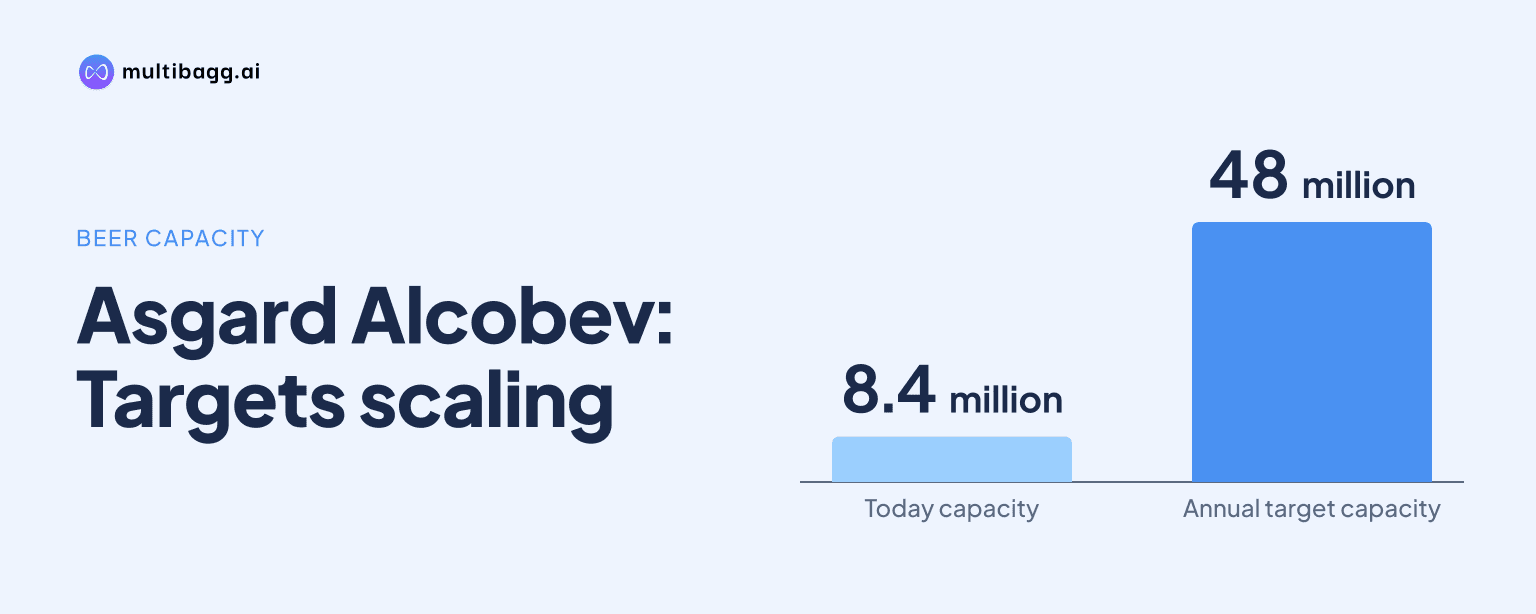
Asgard Alcobev targets annual beer capacity of 48 million cases, up from 8.4 million cases today, with its defined first expansion to 10.8 million cases planned to be operational by March 2027. The longer-term four-plant rollout is contingent on higher contracted demand and entry into additional Indian markets.
Know Asgard Alcobev inside out
Results, valuation, peers and who's buying, in one view.
How will Asgard reach 48 million beer cases?
Asgard plans to develop a four-plant, pan-India brewing platform with 48 million cases of annual capacity, beginning with its existing facility at Byrnihat, Meghalaya. The company identifies Karnataka, Maharashtra, Rajasthan and Uttar Pradesh as target high-growth markets, while Byrnihat remains its Northeast anchor.
The stated path is 8.4 million cases today, 10.8 million cases by March 2027 and 48 million cases thereafter. The 48 million-case figure is about 5.7 times current installed capacity, but the presentation does not provide a completion date for that final target or a timeline for the additional plants.
Asgard’s capacity timeline shows growth from 1.2 million cases in 2012 to 2.4 million in 2013, 3.6 million and 4.8 million during 2014, 6 million in 2018, and 8.4 million in May 2020. The company describes this history as demand-led capacity expansion since commercial production began.
When will Asgard’s next capacity expansion be operational?
Asgard says its expansion to 10.8 million annual cases will be operational by March 2027. The capacity timeline lists the 2024-27 project as underway and associates it with the Carlsberg partnership and Asgard’s acquisition of CMJ Breweries Private Limited.
The immediate addition is linked to the Byrnihat platform, where CMJ has operated since 2012. Asgard holds a 78.90% interest in CMJ, and the subsidiary produces partner brands as well as seven owned labels from the Meghalaya site.
The plant has a canning line with capacity of 16,000 cans per hour and handles 330 millilitre, 500 millilitre and 650 millilitre formats. Asgard lists Siemens for process control, KHS for packaging, Praj for brewhouse equipment and M & L for filtration, with automation intended to support throughput, yield and production to partner specifications.
What will determine Asgard’s expansion outside the Northeast?
Asgard says geographical expansion will be led by higher contracted demand. Its contract-manufacturing arrangements provide a conversion fee per case under multi-year agreements, while brand owners retain brand ownership, marketing investment, demand risk and most working capital requirements.
Five beer companies manufacture at the Meghalaya platform: Mohan Meakin Limited, United Breweries Limited, Yuksom Breweries Limited, Sona Beverages Private Limited and Carlsberg India Limited. The relationships began with Asia 72 and Golden Eagle in 2012, Kingfisher and He-man 9000 in 2014, Simba in 2015, and Carlsberg and Tuborg in 2024.
This model makes contracted volume a stated condition for capacity investment rather than a direct bet on retail sales. Asgard’s role is to produce beer end-to-end to a brand owner’s specification and audit standards, while the partner manages demand generation and marketing expenditure.
Alcohol regulation is also relevant to a multi-state rollout because licensing, excise rules, labelling, pricing and distribution requirements are state-specific. Asgard says its Byrnihat site occupies the Meghalaya-Assam corridor serving Northeast India and providing Bhutan access, while future South, West and Central capacity would broaden its manufacturing footprint.
Got a follow-up? Ask IRIS
Which products can Asgard produce on the expanded platform?
Asgard’s current platform combines production for five brand owners with seven owned beer labels. Its owned range comprises Shimla, Magpie, The Himalayan Monkey, Nutcracker 9000, Savawm, Savage and Red Indian across lager, India Pale Ale and strong-beer categories.
The portfolio covers several alcohol-by-volume and pack formats. Shimla and The Himalayan Monkey are listed below 4.8% alcohol by volume, Magpie below 5%, and Nutcracker 9000, Savawm, Savage and Red Indian below 8%; pack sizes range from 330 millilitres to 650 millilitres.
Asgard says owned brands can provide margin upside on the same platform and plans to expand them selectively in markets already proven by partners. Its strategic priorities also include serving mainstream and premium beer through partner lagers and its own strong-beer labels.
The company frames the market opportunity against India consumption of about 420 million cases versus about 4,200 million cases in China, a tenfold difference. Those figures are Asgard’s market context and do not represent a forecast of its own production or sales volumes.
What does the plan mean for Asgard’s present operating base?
Asgard is pursuing the 48 million-case plan from one automated brewery with 8.4 million cases of installed annual capacity, rather than from an existing national plant network. The company’s previous additions included canning in 2014 and the fifth expansion to 8.4 million-case bottling capacity in May 2020.
The reported operating base grew in the first half of financial year 2027. Revenue from operations was Rs 101.96 crore in H1FY27, compared with Rs 45.28 crore in H1FY26, while earnings before interest, tax, depreciation and amortisation rose to Rs 12.48 crore from Rs 2.45 crore.
EBITDA margin was 12.24% in H1FY27, compared with 5.41% in H1FY26. These financial results reflect the current business and should be distinguished from the longer-term 48 million-case capacity objective, which depends on future contracted demand and new regional infrastructure.
The presentation says the financial statements were restated under Indian Accounting Standard 8 for deferred tax liabilities and depreciation related to a Rs 33.12 crore fair-value adjustment for CMJ, acquired on February 17, 2026. That restatement relates to the reported financial figures rather than the March 2027 capacity milestone.
Conclusion
Asgard’s expansion plan sets out a staged move from an 8.4 million-case Northeast brewery to a 48 million-case, four-plant platform. The near-term project is a 2.4 million-case addition at Byrnihat, while the eventual national footprint would require capacity in markets beyond Meghalaya.
The next disclosed milestone is whether the 10.8 million-case expansion becomes operational by March 2027. Thereafter, the key unresolved factor is whether higher contracted demand supports Asgard’s planned manufacturing investments across South, West and Central India.