










Asgard Alcobev Q2 EBITDA rises 42% as margin reaches 14.9%
Key highlights
- Asgard Alcobev reported Q2 FY27 EBITDA of Rs 7.33 crore, up 42.3% quarter on quarter.
- Q2 FY27 EBITDA margin rose 527 basis points quarter on quarter to 14.98%.
- Q2 FY27 production increased 18.6% to 1.38 million cases and capacity utilisation reached 78.6%.
- Asgard Alcobev plans to expand capacity to 10.8 million cases by March 2027.
powered by IRIS
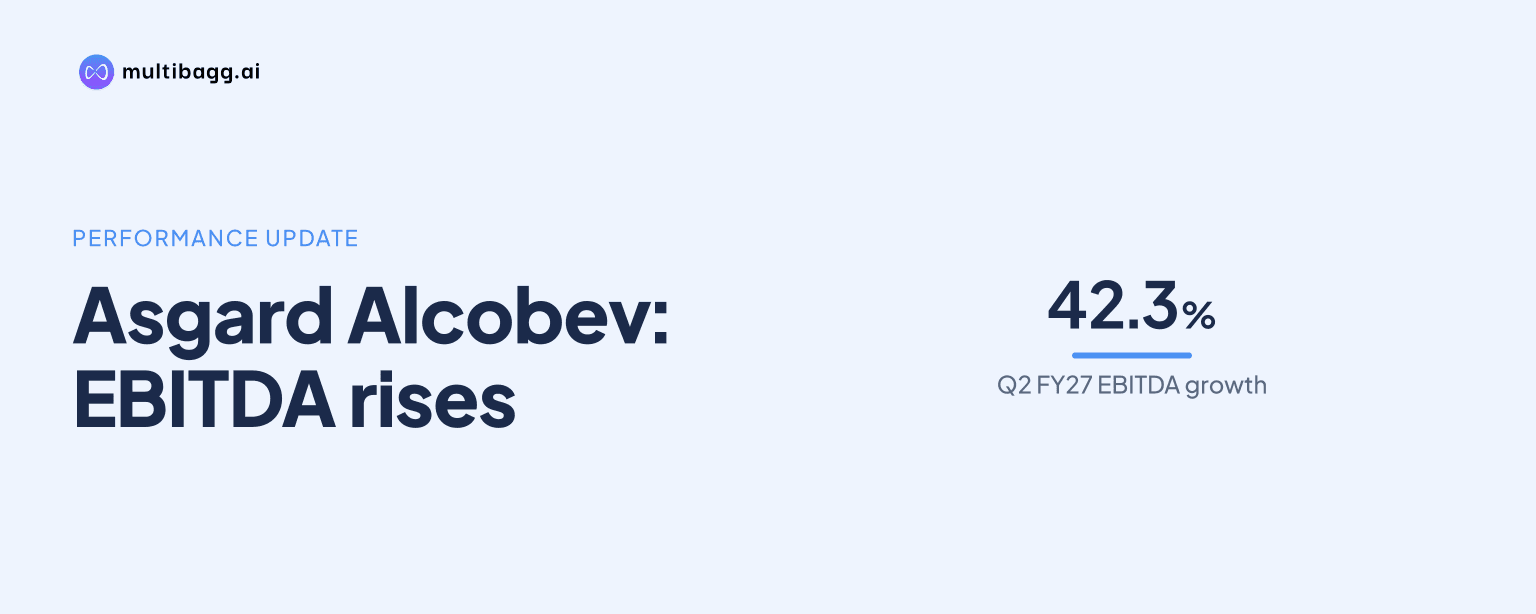
Asgard Alcobev Limited reported Q2 FY27 EBITDA of Rs 7.33 crore, up 42.3% quarter on quarter, despite a 7.8% decline in revenue from operations to Rs 48.926 crore. EBITDA margin rose 527 basis points to 14.98% as production increased 18.6%, capacity utilisation reached 78.6%, and operating costs declined.
Know Asgard Alcobev inside out
Results, valuation, peers and who's buying, in one view.
Why did Asgard Alcobev's Q2 EBITDA rise despite lower revenue?
Asgard Alcobev's Q2 FY27 EBITDA rose because lower operating costs and greater plant utilisation outweighed the sequential decline in revenue. Revenue from operations decreased to Rs 48.926 crore from Rs 53.038 crore in Q1 FY27, while EBITDA increased to Rs 7.33 crore from Rs 5.151 crore. This lifted EBITDA margin from 9.71% to 14.98%.
Cost of goods sold fell to Rs 20.95 crore in Q2 from Rs 24.066 crore in Q1, while other expenses declined to Rs 17.008 crore from Rs 20.383 crore. Management said other costs were 34.8% of Q2 revenue and attributed the result to cost efficiencies and operating leverage. The presentation does not provide a detailed cost bridge for each movement.
Employee-benefit expense increased to Rs 3.638 crore from Rs 3.439 crore, and finance costs rose to Rs 1.854 crore from Rs 1.215 crore. Changes in inventories of stock-in-trade moved to negative Rs 4.877 crore in Q2 from positive Rs 2.199 crore in Q1. Profit after tax nevertheless rose 50.5% sequentially to Rs 2.546 crore.
How did Asgard Alcobev's volumes and utilisation change in Q2 FY27?
Asgard Alcobev produced 1.38 million cases in Q2 FY27, up 18.6% from 1.17 million cases in Q1, while dispatches increased 14.0% to 1.36 million cases from 1.19 million cases. H1 FY27 production and dispatches both totalled 2.55 million cases.
Capacity utilisation increased to 78.6% in Q2 from 63.1% in Q1, an improvement of 15.5 percentage points. Management linked the higher utilisation and production volume to improved operational efficiency. Revenue did not rise in line with case volumes, falling 7.8% sequentially to Rs 48.926 crore.
Can production increased 67.7% quarter on quarter and represented 36.1% of Q2 output. For H1 FY27, cans accounted for 31.3% of production and bottles made up 68.7%. The presentation does not disclose revenue, gross profit or EBITDA separately for cans and bottles.
The company reported a Q2 gross margin of 57.1%, compared with an H1 FY27 gross margin of 55.8%. However, Q2 gross profit was Rs 27.977 crore, below Rs 28.973 crore in Q1, reflecting the lower quarterly revenue base. The margin percentage rose even as gross profit in rupee terms declined.
What do Asgard Alcobev's H1 FY27 results show after the beer pivot?
Asgard Alcobev reported H1 FY27 revenue from operations of Rs 101.9646 crore, up 125.2% year on year, and EBITDA of Rs 12.48 crore, up 409.5%. H1 EBITDA margin reached 12.24%, compared with 5.41% in H1 FY26, while profit after tax increased 416.1% to Rs 4.2386 crore.
The company changed its line of business effective 17 February 2026, and it says prior-year figures represent the earlier business. Asgard Alcobev therefore uses quarter-on-quarter comparisons for operating metrics, while presenting year-on-year financial growth since the pivot. This limits the use of H1 FY26 as a like-for-like operating comparison.
Q2 FY27 revenue was 102.8% higher year on year than Rs 24.1203 crore in Q2 FY26, while EBITDA rose 723.9% from Rs 0.8897 crore. Q2 profit after tax increased from Rs 0.1695 crore to Rs 2.546 crore. The larger increase in profitability than revenue coincided with EBITDA margin expanding from 3.69% to 14.98%.
Got a follow-up? Ask IRIS
What accounting and balance-sheet matters did Asgard Alcobev disclose?
Asgard Alcobev restated its financial statements under Indian Accounting Standard 8, or Ind AS 8, to correct the non-recognition of deferred tax liabilities and depreciation on a Rs 33.1234 crore fair-value adjustment. The adjustment relates to CMJ Breweries Private Limited, acquired on 17 February 2026.
The presentation does not provide a period-by-period reconciliation of the restatement's effect on revenue, EBITDA, profit after tax or diluted earnings per share. It reports diluted earnings per share of Rs 0.06 in Q2 FY27, Rs 0.041 in Q1 FY27 and Rs 0.101 in H1 FY27. These are the restated financial statements presented by the company.
Borrowings decreased by Rs 11.70 crore since March 2026, according to the Q2 highlights. The supplied presentation does not disclose closing borrowings, repayment sources, maturity dates or interest rates. Finance costs nevertheless rose from Rs 1.215 crore in Q1 FY27 to Rs 1.854 crore in Q2 FY27.
What is Asgard Alcobev targeting after Q2 FY27?
Asgard Alcobev management expects quarterly EBITDA of about Rs 6 crore to Rs 7 crore and has issued FY27 EBITDA guidance of Rs 24 crore to Rs 28 crore. Management linked this outlook to increasing production volumes, cost efficiencies and operating leverage. The guidance is a management expectation, not a reported financial result.
The company plans to expand capacity to 10.8 million cases by March 2027, a 28% increase from existing capacity. Management said the project should provide headroom for future demand. Its stated levers include raising utilisation, expanding manufacturing capability, automation, geographical expansion and deeper contract-manufacturing partnerships.
Asgard Alcobev's broader plan calls for four plants and 48 million cases of capacity, although the presentation gives no completion date for that target. It says it manufactures beer for five brand owners, including UBL and Carlsberg, and has seven own labels. The nearer disclosed execution deadline is the 10.8-million-case capacity target for March 2027.
Conclusion
Asgard Alcobev's Q2 FY27 results show a divergence between revenue and profitability: revenue from operations fell 7.8%, while EBITDA rose 42.3% and margin increased to 14.98%. Production of 1.38 million cases, utilisation of 78.6%, lower cost of goods sold and lower other expenses coincided with profit after tax rising to Rs 2.546 crore.
The next disclosed markers are management's FY27 EBITDA guidance of Rs 24 crore to Rs 28 crore and the planned expansion to 10.8 million cases by March 2027. Progress in utilisation, production, cost control, finance costs and the capacity-expansion schedule will indicate whether the Q2 profitability level can be maintained.