










Asgard earns per-case fees while brands carry demand risk
Key highlights
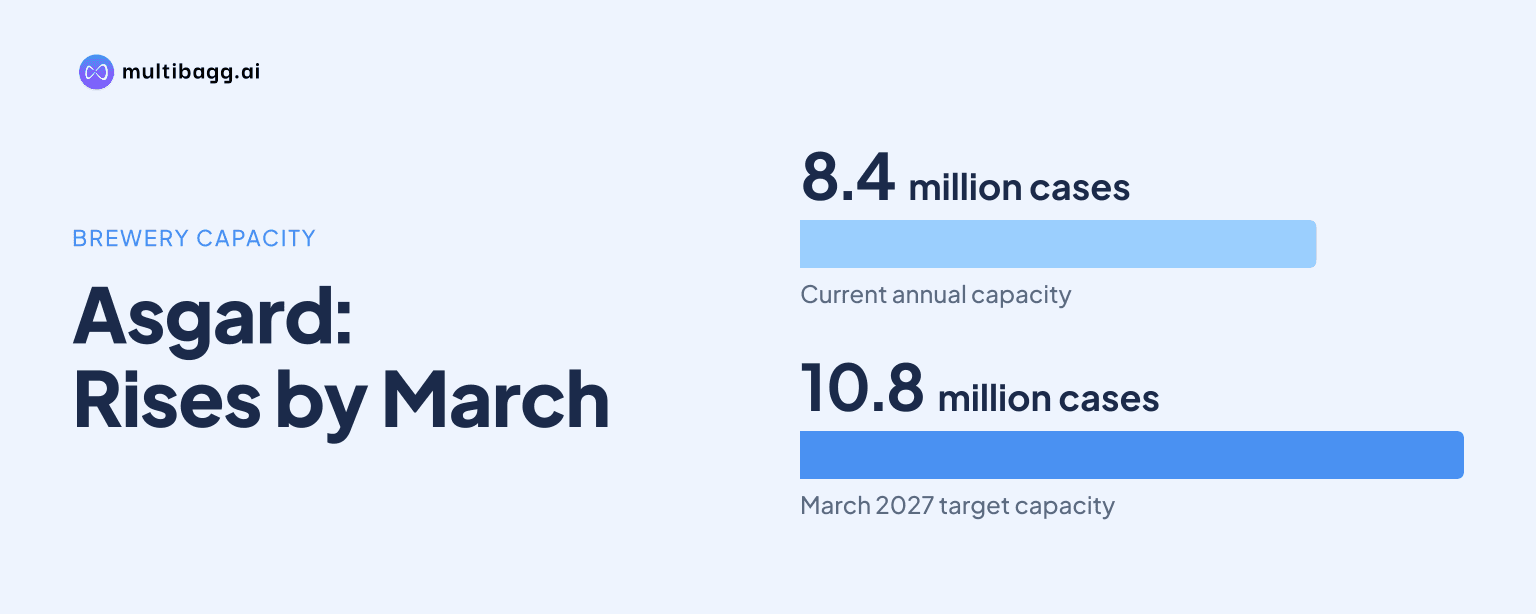
- Asgard’s 8.4 million-case annual brewery capacity is targeted to rise to 10.8 million cases by March 2027.
- Asgard lists five brand-owner manufacturing partners, with Carlsberg India added in 2024.
- The Golden Eagle manufacturing agreement runs for three years and covers two variants across seven states and Bhutan.
- Asgard’s long-term plan targets 48 million cases of capacity across four plants.
powered by IRIS
Asgard Alcobev earns a conversion fee for each case it produces under multi-year brewing contracts, while five partner brand owners retain brand ownership, demand risk and marketing investment. The model is supported by an 8.4 million-case annual brewery platform in Byrnihat and a three-year Golden Eagle manufacturing agreement covering seven states and Bhutan.
Know Asgard Alcobev inside out
Results, valuation, peers and who's buying, in one view.
How does Asgard’s contract-brewing model work?
Asgard produces beer end-to-end to a partner’s specification and audit requirements, then receives a contracted conversion fee per case. The partner retains the brand, takes end-consumer demand risk, funds marketing and carries most working capital, according to the presentation’s allocation of responsibilities. Asgard’s manufacturing revenue is therefore tied to contracted production rather than directly to retail consumer demand.
The stated commercial mechanism is multi-year deals that provide repeatable contracted revenue, not a disclosed percentage of brand sales or retail price. Asgard says the built brewery can create operating leverage as volumes rise. The presentation does not disclose per-case fee rates, minimum-volume commitments, renewal dates or capacity utilisation.
Which brands and partners does Asgard manufacture for?
Asgard manufactures partner products for five brand owners through its subsidiary, CMJ Breweries Pvt. Ltd.: Mohan Meakin, United Breweries, Yuksom Breweries, Sona Beverages and Carlsberg India. The products listed include Golden Eagle and Asia 72, Kingfisher, He-man 9000, Simba, Carlsberg and Tuborg.
The partner base expanded over more than a decade. CMJ Breweries began commercial production in 2012 with Asia 72 for Mohan Meakin, added United Breweries and Yuksom Breweries in 2014, added Sona Beverages in 2015, and added Carlsberg India in 2024. The platform moved from one named brand-owner relationship in 2012 to five listed relationships by 2024.
Asgard also operates seven owned labels on the same brewery platform, separating part of its portfolio from contract manufacturing. The labels span lager, India Pale Ale and strong beer, including Shimla, Magpie, The Himalayan Monkey, Nutcracker 9000, Savawm, Savage and Red Indian. Management says owned brands offer scope for higher margins, but provides no revenue or volume split between owned labels and partner brands.
Why do brand owners use Asgard’s brewery?
Asgard says partners use its Byrnihat, Meghalaya brewery for consistent production, regulatory compliance and regional supply economics across Northeast India. The brewery uses process control from Siemens, packaging lines from KHS, brewhouse equipment from Praj and filtration systems from M & L. It produces bottles and cans in 330 millilitre, 500 millilitre and 650 millilitre formats.
The company says alcohol regulation is state-specific, covering licensing, excise rules, labelling, pricing and distribution, while its Meghalaya-Assam corridor location serves seven states and Bhutan. Producing closer to markets can reduce freight costs, and state excise structures affect distribution economics. Partners require Asgard to meet specifications, pass audits and deliver on time into the regulated supply chain.
Automation is central to the proposition because Asgard says integrated controls maintain one specification across long runs and brand switches. Its 16,000 cans-per-hour line was added in 2014, and automation covers brewing, fermentation and packaging. The presentation compares the platform’s automation level with Carlsberg and Heineken but provides no measured cost, downtime or quality comparison.
Got a follow-up? Ask IRIS
How has Asgard expanded brewing capacity?
Asgard increased installed annual capacity from 1.2 million cases at commercial production in 2012 to 8.4 million cases after its fifth expansion in May 2020. That was a sevenfold increase over eight years, consistent with the presentation’s statement that capacity growth has been demand-led. The facility is described as one of Northeast India’s largest brewing platforms.
Management’s next disclosed step is an increase to 10.8 million cases, with the expansion operational by March 2027. Its longer-term target is 48 million cases across four plants, with planned infrastructure in South, West and Central India. These are management plans and targets rather than reported capacity additions, and the presentation says future expansion will be led by higher contracted demand.
Asgard’s plan moves from the single Byrnihat plant’s 8.4 million cases to 10.8 million cases before pursuing a 48 million-case network. The presentation links the near-term expansion to the Carlsberg partnership and Asgard acquisition. It does not disclose capital expenditure, financing, locations beyond broad regions or a date for the 48 million-case target.
What does the Golden Eagle agreement add for Asgard?
Asgard says CMJ Breweries secured a three-year Golden Eagle Manufacturing Agreement covering two variants across seven states and Bhutan. Golden Eagle is listed under Mohan Meakin, whose manufacturing relationship with CMJ Breweries began in 2012. The agreement is presented as a recent contract win within the company’s long-term partner structure.
The seven-state and Bhutan coverage aligns with Asgard’s stated geographic advantage from the Meghalaya-Assam corridor. It provides a specific example of a multi-year manufacturing arrangement, rather than a general statement about relationship longevity. The presentation does not disclose contracted case volumes, the fee per case, revenue contribution, start date or whether the work displaces capacity used by other brands.
Asgard describes all five manufacturing relationships as long-term and supported by recurring agreement renewals. That supports its stated revenue-visibility rationale for the expanded platform. However, a three-year agreement establishes duration rather than demand volume, because demand risk remains with the brand owner under the stated model.
Conclusion
Asgard’s disclosed model places its 8.4 million-case brewery at the manufacturing end of beer brands’ supply chains: it produces specified products, earns per-case conversion fees and has no direct end-consumer demand exposure. Its five brand-owner relationships and seven owned labels combine contract brewing with a proprietary-brand opportunity, while partners retain marketing, demand and most working-capital responsibilities.
The next item to watch is commissioning of the 10.8 million-case expansion by March 2027, alongside execution of the three-year Golden Eagle agreement across seven states and Bhutan. Management’s 48 million-case, four-plant target depends on higher contracted demand, while contract economics, utilisation, expansion spending and the timetable for plants outside Meghalaya remain undisclosed.