










Ashapura Minechem Reports 12% Q2 Revenue Growth, Lower PBT
Key highlights
- Ashapura Minechem reported Q2 FY27 income from operations of ₹1,063 crore, up 12% year-on-year.
- Q2 FY27 profit before tax declined to ₹78 crore from ₹81 crore in Q2 FY26.
- Guinea bauxite exports fell to 1.21 million tonnes in Q2 FY27 from 2.34 million tonnes in Q1 FY27.
- The GSM jetty is expected to lift combined Guinea port capacity to 18 million tonnes per annum by March 2027.
powered by IRIS
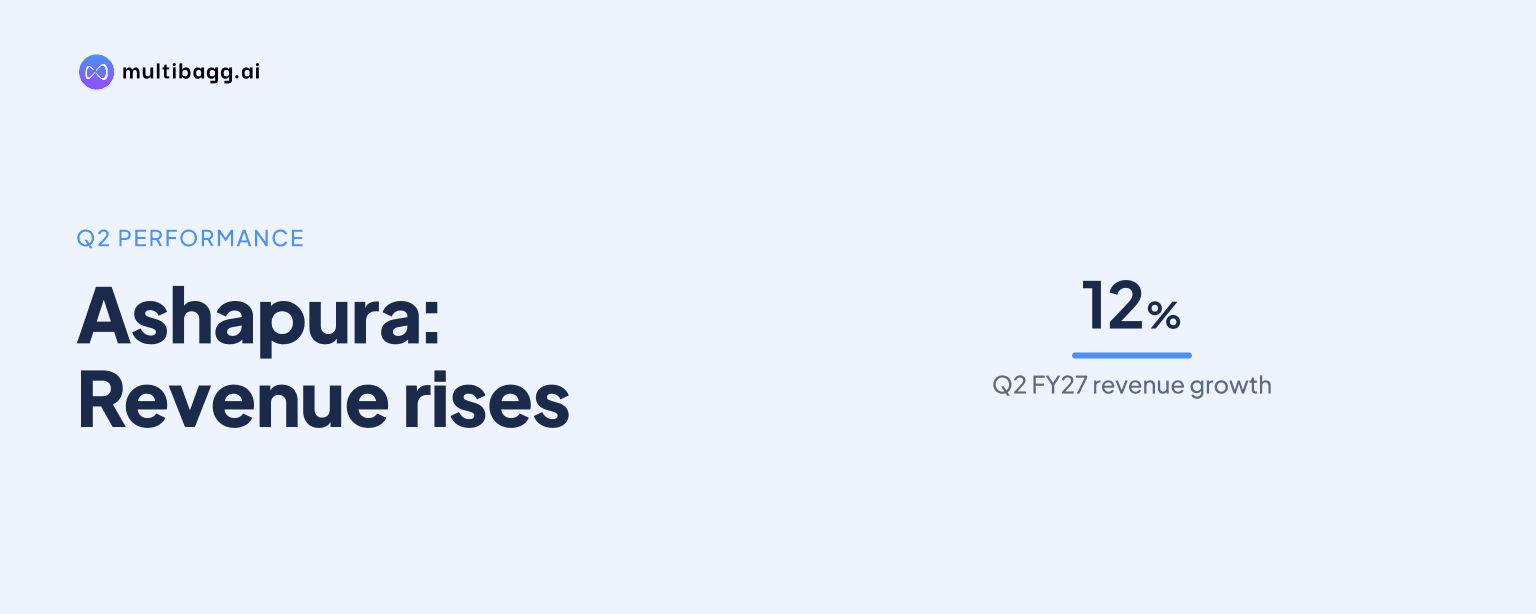
Ashapura Minechem Limited reported Q2 FY27 income from operations of ₹1,063 crore, up 12% year-on-year, while profit before tax declined to ₹78 crore from ₹81 crore in the comparable quarter. The result reflects lower seasonal bauxite dispatches from Guinea and pressure from freight, logistics and raw-material costs.
Know Ashapura Minechem inside out
Results, valuation, peers and who's buying, in one view.
What did Ashapura Minechem report for Q2 FY27?
Ashapura Minechem reported consolidated income from operations of ₹1,063 crore for the quarter ended September 2026, compared with ₹953 crore in Q2 FY26. EBITDA increased to ₹138 crore from ₹132 crore a year earlier, while profit before tax fell to ₹78 crore from ₹81 crore.
On a sequential basis, the quarter was weaker. Reported revenue declined 34.20% from ₹1,616.12 crore in the preceding quarter, while operating profit fell 31.01% to ₹125.07 crore. Profit before tax was down 40.19% quarter-on-quarter from ₹130.03 crore.
The company said the September quarter is traditionally a relatively slower period for some businesses. Guinea bauxite operations were affected by the monsoon, which slows mining and dispatch activity, while higher ocean freight and fuel-linked logistics costs added pressure.
Why did Guinea bauxite volumes and margins weaken?
Guinea bauxite exports fell to 1.21 million tonnes in Q2 FY27 from 2.34 million tonnes in Q1 FY27, reflecting the seasonal monsoon impact. Management described the quarter as seasonally weak because rainfall disrupts mining activity and the movement of material to export points.
Higher freight costs also influenced customer buying decisions and profitability. Management indicated that EBITDA per tonne in Guinea had declined to about US$5.3 from US$6.3 in Q1 FY27, compared with levels close to US$9 per tonne in earlier quarters. Bauxite pricing did not rise enough to offset the increase in shipping costs.
The company said bulk shipping rates on its route had peaked near US$43 per tonne and were around US$36 per tonne at the time of the call. Forward freight rates were stated to be 10% to 15% below spot rates. Management said lower freight costs could support volumes by allowing the company to compete for larger contracts, rather than necessarily translating directly into per-tonne margin expansion.
Guinea recorded turnover of ₹783 crore and EBITDA of ₹109 crore during the quarter. The company said near-term Guinea EBITDA per tonne could remain at similar levels amid the prevailing environment.
What is Ashapura Minechem's export and port-capacity plan?
Ashapura Minechem has targeted more than 5 million tonnes of bauxite exports in the second half of FY27, taking its full-year export estimate to about 8.5 million tonnes. This is lower than the earlier 12 million-tonne target cited during the call discussions.
For FY28, management outlined a target of 15 million tonnes of bauxite exports. The company said its mining, road and port infrastructure is in place, and that improved market conditions remain important for a higher level of utilisation.
Bofa port capacity has increased from 5 million tonnes per annum to 8 million tonnes per annum. The new jetty at the GSM port is expected to raise GSM capacity from 6 million tonnes per annum to 10 million tonnes per annum by March 2027. This would take combined port capacity to 18 million tonnes per annum.
Management expects to utilise 15 million tonnes of this combined capacity in FY28. It also said it expects to provide a more detailed update on iron ore guidance by the next financial year. Once commercialised, iron ore volumes of 3 million to 4 million tonnes could be the minimum scale discussed by management.
Got a follow-up? Ask IRIS
How is the India business responding to cost pressure?
Ashapura Minechem said its India business maintained steady operations during the quarter, but profitability remained under pressure from higher freight, logistics and raw-material costs. The company noted that a part of revenue growth in India reflected higher logistics costs being billed to customers, while efforts to pass through the full increase were still in progress.
Higher sulphuric-acid prices particularly affected bleaching clay margins. Freight and logistics costs also weighed on advanced ceramics and other product lines. The India business, comprising bentonite and allied minerals, white performance materials and other operations, reported turnover of ₹280 crore and EBITDA of ₹29 crore in Q2 FY27.
The company plans capital expenditure of ₹150 crore to ₹170 crore across Indian projects and business verticals. Its stated focus is on developing and commercialising products that customers currently import, including applications in oil and gas, foundry, paints and coatings.
Management has set a longer-term objective for new value-added products to account for about 40% of India-business turnover over roughly four years. This plan is intended to broaden the product mix beyond existing lines, although the company did not provide a year-wise revenue contribution target for the new products.
What could change the outlook for Guinea bauxite operations?
A potential export quota in Guinea was among the issues discussed during the earnings call. Management referred to consideration of a possible cap of around 150 million tonnes of bauxite exports, though it said no formal decision had been announced.
Management said such a quota, if introduced, could reduce supply and potentially improve EBITDA per tonne by at least a couple of dollars. This remains conditional on policy action and market conditions, and should not be treated as company guidance.
For investors, the main near-term operating indicators are bauxite dispatches in the second half, the movement in freight rates, and progress on the GSM jetty. The difference between year-on-year revenue growth and lower profit before tax illustrates the effect of higher logistics costs and lower quarterly export volumes on earnings conversion.
The company also said income-tax cost as a percentage of profit before tax is expected to increase over the next two to three quarters as the relevance of past losses reduces. That factor may affect the relationship between pre-tax and post-tax earnings even if operating conditions improve.
Conclusion
Ashapura Minechem's Q2 FY27 performance showed 12% year-on-year growth in income from operations, led by contributions from Guinea and India, but profit before tax fell as bauxite volumes, freight costs and input-cost pressure limited earnings. Guinea remained the larger contributor, accounting for ₹783 crore of turnover and ₹109 crore of EBITDA.
The next disclosed milestones are more than 5 million tonnes of bauxite exports in H2 FY27, completion of the GSM jetty by March 2027, and the planned rise in combined port capacity to 18 million tonnes per annum. Investors will also watch whether freight rates continue to decline and whether Guinea announces a formal export-quota policy.