










Ashapura targets 15 million tonnes as freight limits exports
Key highlights
- Ashapura exported 1.21 million tonnes of bauxite in Q2 FY27, versus 2.34 million tonnes in Q1 FY27.
- Guinea EBITDA was US$5.3 per metric tonne in Q2 FY27, down from US$6.3 per metric tonne in Q1 FY27.
- Ashapura targets more than 5 million tonnes of bauxite exports over the final two quarters of FY27.
- Boffa and GSM are expected to provide combined port capacity of 18 million tonnes per annum after GSM is completed by March 2027.
powered by IRIS
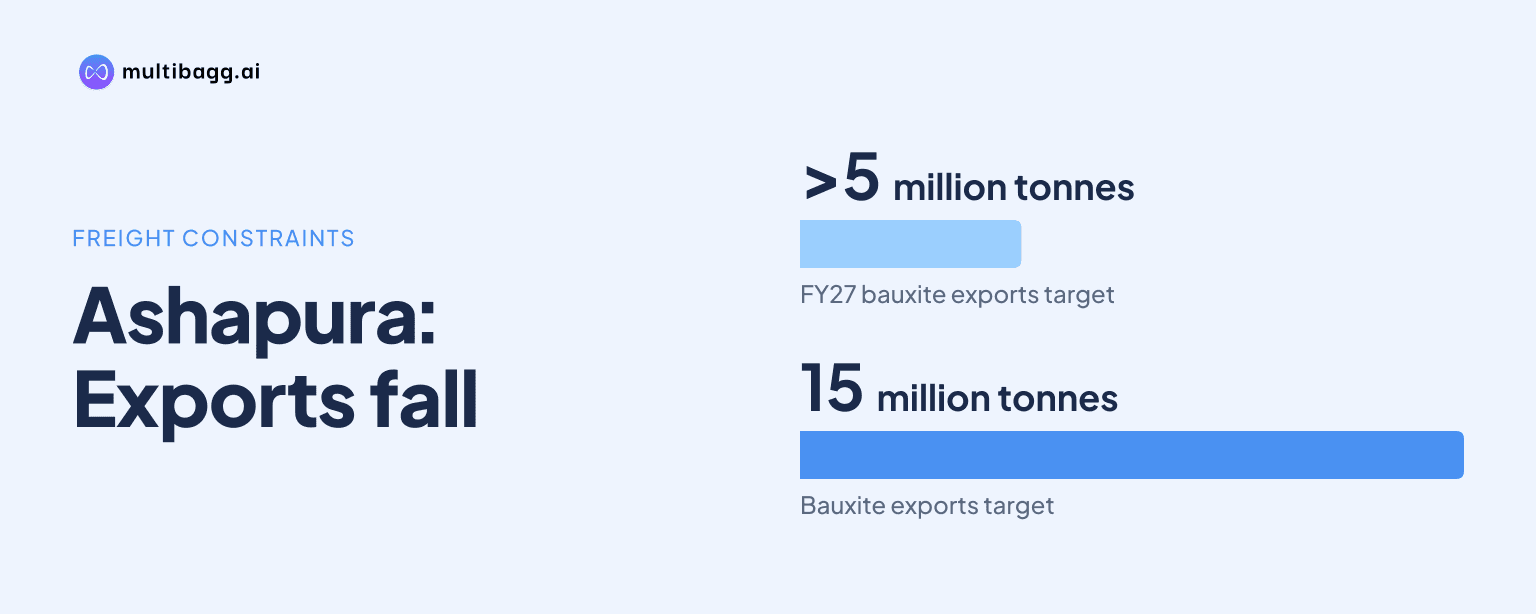
Ashapura Minechem Limited is targeting 15 million tonnes of bauxite exports in FY28, despite Q2 FY27 exports falling to 1.21 million tonnes from 2.34 million tonnes in Q1, as management said elevated ocean freight, rather than mine or port capacity, is limiting commercially viable cargoes.
Know Ashapura Minechem inside out
Results, valuation, peers and who's buying, in one view.
Why did Ashapura's Q2 bauxite exports decline?
Ashapura's Q2 FY27 bauxite exports fell 48% sequentially to 1.21 million tonnes from 2.34 million tonnes in Q1, primarily because Guinea's monsoon disrupted mining and dispatches. Management said Q2 and part of Q3 are routinely weaker in Guinea's equatorial climate, while higher fuel and ocean-freight costs also affected the business.
The lower shipment volume coincided with Guinea business earnings before interest, tax, depreciation and amortisation, or EBITDA, declining to US$5.3 per metric tonne in Q2 from US$6.3 per metric tonne in Q1. Management said freight had risen sharply while bauxite prices had not increased proportionately because of softer alumina-market conditions.
Ashapura reported H1 FY27 bauxite exports of 3.55 million tonnes and is targeting more than 5 million tonnes over the next two quarters. Achieving that H2 objective would take FY27 exports above 8.55 million tonnes, although management did not issue revised full-year export guidance during the November 13, 2026 call.
Can Ashapura reach 15 million tonnes of exports in FY28?
Ashapura says it remains confident of exporting 15 million tonnes in FY28, supported by expected combined port capacity of 18 million tonnes per annum after the GSM jetty is completed by March 2027. Management said it expects to use 15 million tonnes of that capacity next year, implying 3 million tonnes of port headroom against the target.
Boffa port capacity has increased to 8 million tonnes per annum from 5 million tonnes per annum. The new GSM jetty is expected to raise GSM capacity to 10 million tonnes per annum from 6 million tonnes per annum; management said the facilities handle different material qualities and customer groups.
Management said the port expansions allow faster loading and more simultaneous vessel loading, but should not by themselves materially change margins. It also said Ashapura has sufficient mining equipment, road infrastructure, resources, transport and barging capacity to execute 15 million tonnes or more.
The constraint is therefore external demand economics, according to management. Buyers have been cautious about committing to cargoes while spot freight remains elevated, even though Ashapura says its mine-to-port infrastructure is in place for the FY28 plan.
How important are freight rates to Ashapura's FY28 target?
Freight is the main variable in Ashapura's route from the current export pace to 15 million tonnes, management said. Lower freight would allow it to bid for and contract larger cargoes, with the near-term benefit potentially weighted more towards volume than EBITDA per tonne.
Management referred to the C3 index, a bulk-shipping benchmark for Capesize vessels, rather than container rates. It said the relevant rate had fallen by about 15% to 20% from highs reached a few months earlier, with a recent peak near US$43 and spot rates around US$36 at the time of the call.
Longer-term freight rates appeared more than 10% to 15% below spot rates, management said, while crude oil prices had declined from recent highs. These were management market observations rather than formal guidance, and it did not provide a future EBITDA-per-tonne forecast.
Ashapura also said customer enquiries continued despite freight costs and that bauxite prices between Q2 and Q3 had remained broadly stable or increased slightly. That leaves freight movements, rather than a disclosed recovery in bauxite pricing, as the immediate factor for higher volumes.
Got a follow-up? Ask IRIS
What did Ashapura report for Q2 and H1 FY27?
Ashapura reported consolidated Q2 FY27 income from operations of Rs 1,063 crore, up 12% from Rs 953 crore in Q2 FY26. EBITDA increased to Rs 138 crore from Rs 132 crore, but profit before tax declined to Rs 78 crore from Rs 81 crore.
For H1 FY27, consolidated income from operations rose 16% to Rs 2,680 crore from Rs 2,308 crore in H1 FY26. EBITDA increased to Rs 327 crore from Rs 320 crore, while profit before tax fell to Rs 208 crore from Rs 213 crore.
The Guinea business recorded Q2 turnover of Rs 783 crore and EBITDA of Rs 109 crore. Bentonite, Allied Minerals, White Performance Materials and other India businesses recorded turnover of Rs 280 crore and EBITDA of Rs 29 crore, showing the larger contribution from Guinea during the monsoon-affected quarter.
Management said higher logistics charges passed through to customers accounted for some India-business revenue growth, particularly in Middle East and Europe markets. It plans Rs 150 crore to Rs 170 crore of India capital expenditure across projects and verticals, including products for oil and gas, foundry, paints, coatings and other applications.
Could a Guinea quota policy change Ashapura's outlook?
A Guinea quota policy could improve Ashapura's bauxite pricing and freight economics, but no formal quota system had been announced as of November 13, 2026. Management expected a possible government update by the end of the quarter and said the policy status had not changed from the preceding quarter.
Management said a quota near 150 million tonnes, compared with a market volume it described as about 15% to 20% higher, could reduce supply and improve bauxite prices. It also said lower export volumes from Guinea could reduce freight costs, but any outcome depends on the policy's eventual design.
Management suggested that a quota near 150 million tonnes could improve EBITDA by at least a couple of dollars per tonne, while stressing that it could not quantify the effect without the final policy. The company said it would communicate any formal government update because it would be material to its Guinea business.
Conclusion
Ashapura's FY28 objective depends on a substantial recovery in commercially viable shipping demand rather than a further build-out of internal capacity. The Q2 decline to 1.21 million tonnes reflected recurring monsoon disruption and higher freight, while the planned 18 million tonnes of combined port capacity provides the operational base for management's 15 million-tonne target.
The next disclosed milestone is completion of the GSM jetty by March 2027. Management is also targeting more than 5 million tonnes of exports over the final two quarters of FY27, expects freight conditions to become more manageable over coming quarters, and awaits a possible Guinea government update on the quota policy by the end of the quarter.