










Ashapura Minechem Limited targets 40% India value-added sales
Key highlights
- Ashapura plans Rs 150 crore to Rs 170 crore of capital expenditure across its India portfolio.
- Management targets new value-added products at about 40% of India-business turnover in roughly four years.
- Q2 FY27 India businesses excluding equity-accounted entities reported Rs 280 crore turnover and Rs 29 crore EBITDA.
- Consolidated Q2 FY27 income from operations rose 12% year on year to Rs 1,063 crore.
powered by IRIS
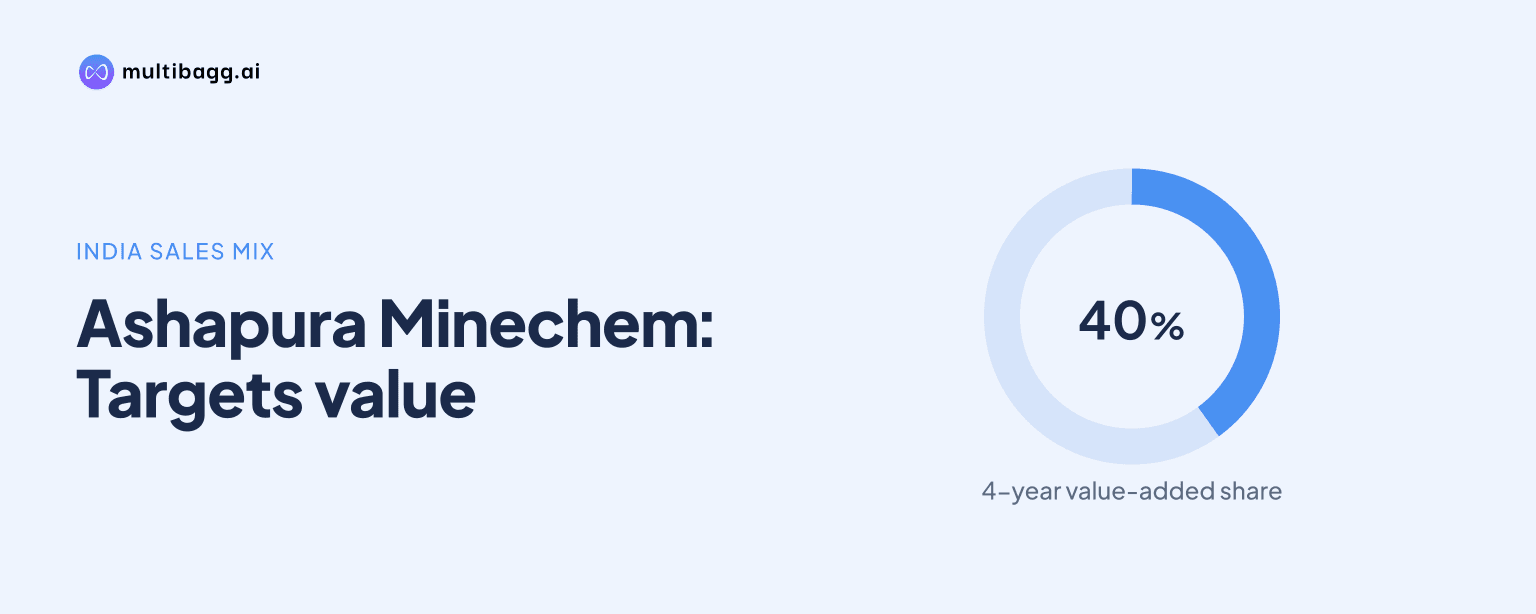
Ashapura Minechem Limited said on November 13, 2026 that it aims for new value-added products to reach about 40% of India-business turnover in roughly four years, backed by planned capital expenditure of Rs 150 crore to Rs 170 crore. Management said the spending will commercialise import-substitute mineral products and expand higher-value industrial applications.
Know Ashapura Minechem inside out
Results, valuation, peers and who's buying, in one view.
What is Ashapura's value-added sales target in India?
Ashapura's target is for new value-added products to contribute about 40% of turnover in its India business over the next four years. Management described the objective as a headline-level, rough estimate and did not disclose the current value-added sales mix, annual milestones or a corresponding profit target.
The goal applies to the India business rather than consolidated group turnover, which includes Guinea bauxite exports. In Q2 FY27, the Guinea business reported turnover of Rs 783 crore, compared with Rs 280 crore for Bentonite and Allied Minerals, White Performance Materials and other India businesses. Management said the new products remain a small part of the company’s overall turnover in FY27.
Ashapura is focusing on higher-value applications in its wholly owned Bentonite and Allied Minerals and White Performance Materials businesses. The India portfolio also includes Specialty Absorbent Solutions, a bleaching-clay business operated through 50% joint venture Ashapura Perfoclay Limited, and Advanced Ceramic Materials, where it holds a 32% investment in Orient Ceratech Limited.
How much India capex is Ashapura planning?
Ashapura plans Rs 150 crore to Rs 170 crore of capital expenditure across India projects and business verticals. Management said the investment will strengthen manufacturing capabilities, broaden the product portfolio and support growth, but gave no project-wise allocation, commissioning timetable, capacity addition or expected revenue contribution.
The proposed spending covers new oil-and-gas applications, pet-related products and some capacity intended to improve volumes in existing businesses. Management said most of the India capex is directed toward higher-value products instead of traditional mineral products, although it did not quantify that proportion.
For coatings products, Ashapura said it had completed successful proof of concepts, or POCs, with customers and that capex would support commercialisation. It also identified white-mineral products traditionally imported into India, alongside bentonite-related products designed either to substitute imports or offer a cost advantage against traditional materials.
Which industries will Ashapura's new products serve?
Ashapura said its capex-backed products will serve oil and gas, foundry, paint and coatings, and, to some extent, paper industries. Management’s stated proposition is to provide materials with superior performance, replace imported products or improve the cost-benefit outcome for industrial customers.
In White Performance Materials, management said substantial capex is directed at products traditionally imported. In bentonite and related products, the development work addresses imported materials and alternatives that can offer a significant cost advantage. Ashapura said it has dedicated research, sales and production efforts to individual applications after research and development work and customer POCs.
Ashapura already supplies India-business customers across metals and foundries, oil and gas, edible oils, petrochemicals, paints and coatings, construction and automobiles. The programme is therefore intended to alter product mix within existing industrial markets, rather than representing a disclosed entry into one new customer segment.
Quartz purification for semiconductor applications remains a research and development project that is not close to commercialisation, according to management. That separates it from coatings and other industrial-mineral products for which Ashapura has cited customer POCs and capex-supported commercialisation plans.
Got a follow-up? Ask IRIS
What is pressuring Ashapura's India business now?
Ashapura said higher freight, logistics and raw-material costs reduced India-business profitability in Q2 FY27 despite steady operations. It also said some revenue growth reflected higher logistics costs passed through in customer billings, particularly for Middle Eastern and European customers affected by elevated ocean freight over the preceding two quarters.
Management said freight costs had started to moderate and expects volumes in those markets to improve gradually. Until then, Ashapura is concentrating on domestic, Asian and African markets, where it said supply-chain conditions are relatively more manageable.
Specialty Absorbent Solutions faced higher input costs, particularly sulfuric acid, during Q2 FY27. Management said sulfuric-acid prices had corrected from their peak and may decline further, which it believes could support margins over time. Advanced Ceramic Materials recorded revenue growth in the quarter, but higher freight and logistics costs affected its profitability.
How does Ashapura's India plan compare with group results?
Ashapura reported consolidated Q2 FY27 income from operations of Rs 1,063 crore, up 12% from Rs 953 crore in Q2 FY26, while earnings before interest, tax, depreciation and amortisation, or EBITDA, rose to Rs 138 crore from Rs 132 crore. Profit before tax declined to Rs 78 crore from Rs 81 crore, showing that higher revenue and EBITDA did not result in higher pre-tax profit.
For H1 FY27, consolidated income from operations rose 16% to Rs 2,680 crore from Rs 2,308 crore in H1 FY26. EBITDA increased to Rs 327 crore from Rs 320 crore, while profit before tax fell to Rs 208 crore from Rs 213 crore. The India capex programme is a product-mix and commercialisation strategy, not management guidance for FY27 or FY28 earnings.
Standalone H1 FY27 income from operations was Rs 188 crore, down from Rs 193 crore in H1 FY26, and standalone profit before tax declined to Rs 49 crore from Rs 69 crore. Management linked current India-business pressure to freight, logistics and raw-material costs while presenting the new-product capex as a longer-term growth plan.
Conclusion
Ashapura has set out a four-year ambition to make new value-added products about 40% of India-business turnover, using Rs 150 crore to Rs 170 crore of capex to commercialise import substitutes and other industrial mineral applications. The strategy focuses on oil and gas, foundries, coatings and paper, while Q2 FY27 results show continuing cost pressure from freight, logistics and sulfuric acid.
The next disclosures to watch are capex execution, commercialisation following coatings POCs, and any update on the present value-added sales mix or project capacities. Management expects freight moderation to support a gradual recovery in Middle East and Europe volumes, while quartz purification remains an R&D-stage project rather than a near-term commercial initiative.