










Gokaldas Exports says U.S. tariff reset restores parity
Key highlights
- Final U.S. Section 301 tariff rates took effect on July 21, 2026, placing India on equal footing with Bangladesh, Cambodia, Indonesia and Sri Lanka, management said.
- Gokaldas Exports said China and Vietnam face about 12.5% U.S. tariffs, compared with additional duties of up to 50% on Indian apparel a year earlier.
- Gokaldas Exports’ India business grew 10% year on year in Q2 FY27, while its Africa business grew 32% and consolidated EBITDA increased 48%.
- AGOA has been extended through December 2028, while the India-U.K. agreement took effect on July 15, 2026.
powered by IRIS
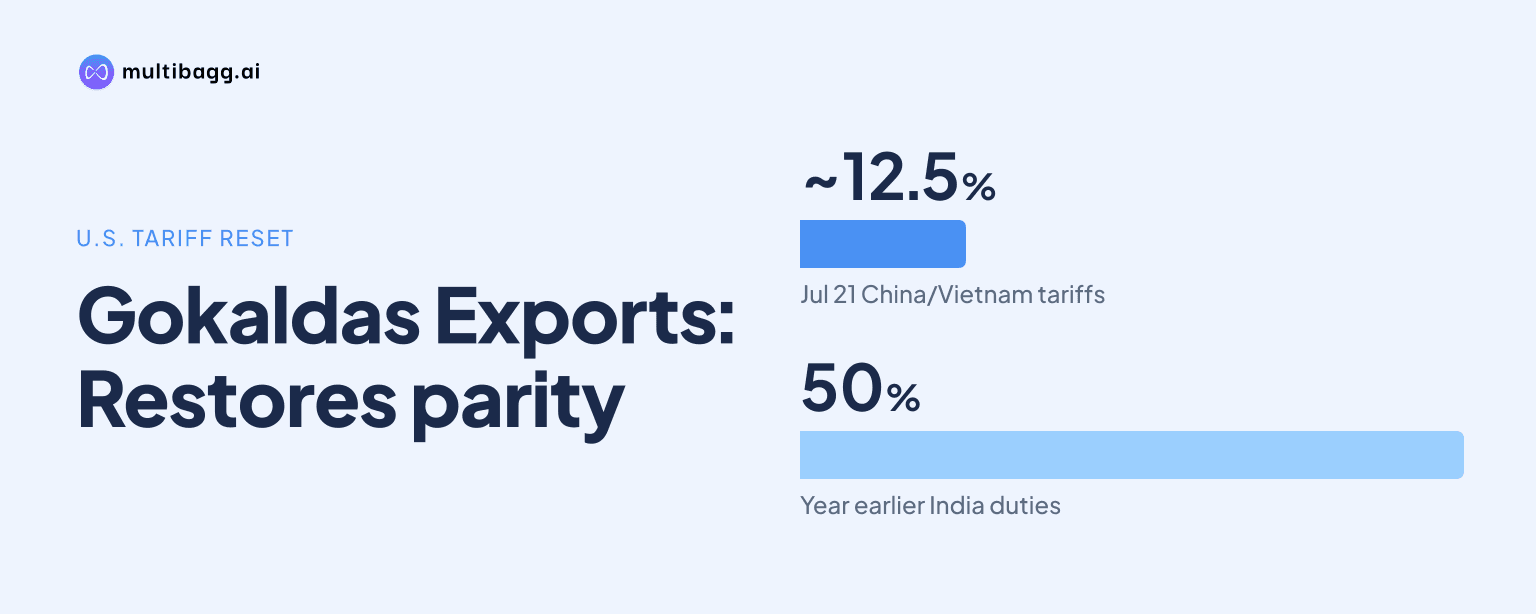
In Q2 FY27, Gokaldas Exports Limited said final U.S. Section 301 tariffs effective July 21, 2026 restored India to equal footing with Bangladesh, Cambodia, Indonesia and Sri Lanka, replacing an earlier Indian apparel disadvantage of up to 50% additional duties. Management said the clearer regime supports a gradual recovery in sourcing volumes.
Know Gokaldas Exports inside out
Results, valuation, peers and who's buying, in one view.
How did the U.S. tariff reset change India’s position?
Gokaldas Exports said India is now on equal footing in the U.S. with Bangladesh, Cambodia, Indonesia and Sri Lanka under final Section 301 tariff rates that took effect on July 21, 2026. Management contrasted this with the position a year earlier, when Indian apparel faced additional duties of up to 50%.
Management also said India retains an advantage over China and Vietnam, which face tariffs of about 12.5% in the U.S. The company did not quantify the revenue or order-book effect, and said brands need time to move orders across sourcing countries after a policy change.
Gokaldas Exports linked the reset to the end of tariff uncertainty that had kept retailer inventories tight for much of 2026. Management said last year’s comparison was elevated because brands had brought shipments forward before expected tariff increases, while imports into the U.S. and European Union returned to positive growth in August 2026.
What do AGOA and the U.K. agreement add?
Gokaldas Exports said the African Growth and Opportunity Act, or AGOA, has been extended through December 2028, including the third-country fabric provision. Management said this gives its Africa business several years of visibility on preferential U.S. market access.
The India-U.K. Comprehensive Economic and Trade Agreement took effect on July 15, 2026, according to management. Gokaldas Exports said it gives India duty parity with Bangladesh and Vietnam in the U.K., along with a 12% duty advantage over China.
Management said an India-European Union free-trade agreement is expected to be signed soon, but that remains an expected event rather than an implemented policy. It also said Bangladesh’s least-developed-country status is due to expire in November 2026, with a three-year grace period technically running to November 2029, while noting that Bangladesh retains a wage-cost advantage.
Why does Gokaldas Exports expect a gradual recovery?
Gokaldas Exports expects sourcing recovery to be gradual rather than immediate because retailers continue to manage inventories tightly. Management cited the National Retail Federation’s forecast of 4.2% year-on-year U.S. retail-sales growth for the year-end holiday season, while also pointing to inflation, fuel prices and household-budget pressure.
Management expects that environment to favour value-oriented buying, shorter lead times and more frequent replenishment. Gokaldas Exports said its customer base spans value, mainstream and premium segments, and management believes this mix supports its ability to serve customers that are consolidating supplier relationships.
The company’s Q2 FY27 performance provides operating context for that view. Its India business grew 10% year on year in a seasonally weak quarter, compared with 1.2% growth in Indian apparel exports overall, while its Africa business grew 32%, consolidated income rose 13% and earnings before interest, tax, depreciation and amortisation, or EBITDA, increased 48%.
Got a follow-up? Ask IRIS
How is Gokaldas Exports building capacity for demand?
Gokaldas Exports is expanding facilities in Bhopal and Ranchi as management anticipates growth in European business after trade agreements. The company is setting up a 1,000-machine factory in Ranchi and is expanding its Bhopal capacity.
Management said labour availability is not a significant current constraint, including for incremental capacity in central and eastern India. Gokaldas Exports uses migrant labour where shortages arise in the south and runs training camps across central and eastern India through to the northeast, including Arunachal Pradesh.
The company also uses the Deen Dayal Upadhyaya Grameen Kaushalya Yojana, or DDU-GKY, training programme, although management said the company undertakes most workforce training itself. Management expects the India-U.K. agreement’s order impact to be more visible in FY28 because many orders for the current financial year had already been placed by July 2026.
What do Africa and BTPL plans indicate?
Gokaldas Exports said it has secured two new Africa customers, one American and one European, scheduled to begin operations from April in FY28. Management also cited customer discussions around diversifying production into Kenya to benefit from duty differentials.
For Atraco, management said Q2 is seasonally weak because lower order volumes leave fixed costs spread across a smaller production base. It described the forward order book as robust and said pricing and orders should support improvement from Q3, targeting an EBITDA margin of around 10% within six months.
Gokaldas Exports expects due process for the BTPL merger to finish in Q3. Management said BTPL recorded about Rs 170 crore of Q2 revenue, expects about Rs 220 crore to Rs 225 crore in Q3 and about Rs 250 crore in Q4, and is working towards EBITDA break-even in Q3 and profit-before-tax break-even in Q4.
Conclusion
The combined picture is that Gokaldas Exports sees a policy-led improvement in market access rather than an immediate order surge. The July 21, 2026 U.S. tariff reset removed the earlier additional duties of up to 50% on Indian apparel relative to several Asian peers, while AGOA through December 2028 and the July 2026 U.K. agreement provide additional access visibility.
Next, the key disclosed milestones are whether sourcing discussions convert into orders during FY28, whether the two Africa customers start from April as planned, and whether Atraco reaches management’s roughly 10% EBITDA-margin target within six months. The expected Q3 BTPL merger completion, Q3 EBITDA break-even and Q4 profit-before-tax break-even are further operational measures to watch.