










Gokaldas plans Rs 4,000 crore India capacity by FY2028
Key highlights
- Gokaldas targets about Rs 4,000 crore of India revenue capacity in FY 2028, versus roughly Rs 3,000 crore discussed currently.
- Gokaldas expects its Ranchi factory to add about Rs 400 crore of annual top-line capacity through a 1,000-machine, two-shift model.
- Gokaldas expects Bhopal Phase Two to add about Rs 200 crore of capacity and reach full ramp-up by the end of the current financial year.
- Gokaldas expects automation and throughput projects to add 4% to 5% of revenue capacity across existing factories.
powered by IRIS
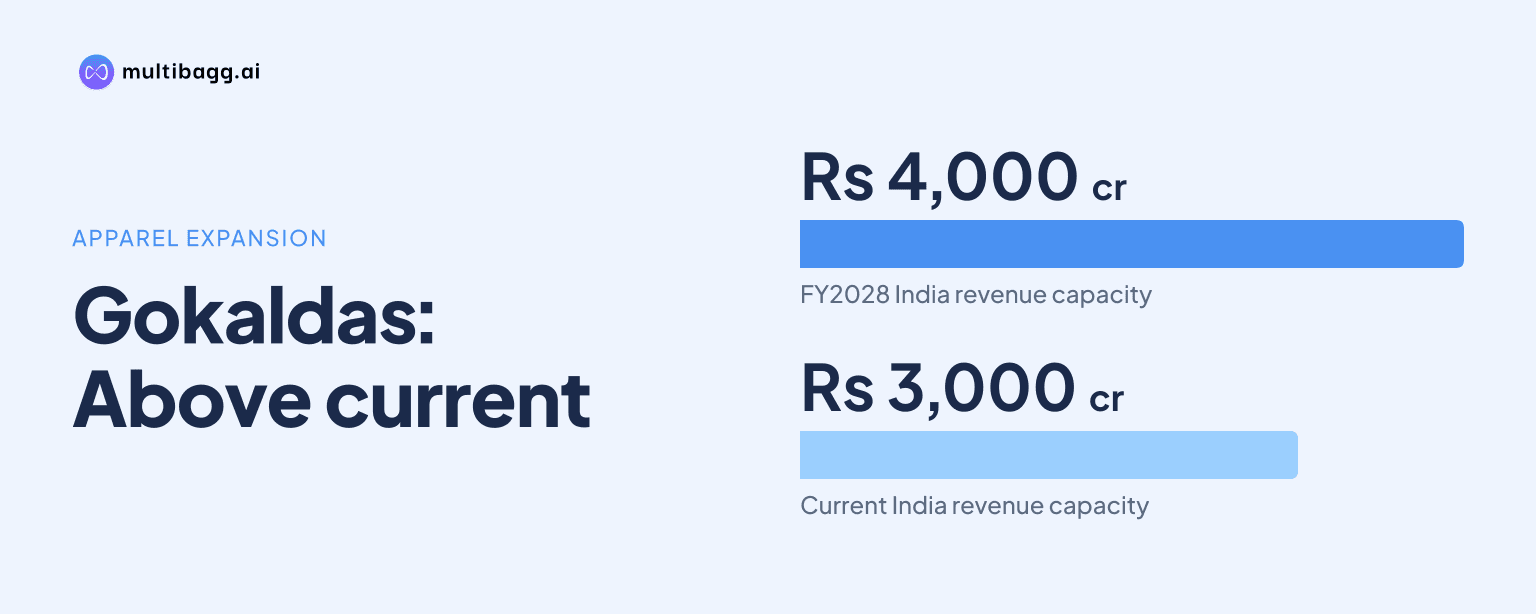
Gokaldas plans to raise India revenue capacity to about Rs 4,000 crore in FY 2028 from roughly Rs 3,000 crore discussed on the call, led by Bhopal Phase Two, a Ranchi factory with Rs 400 crore of annual capacity, further proposed plants and 4% to 5% debottlenecking gains.
Know Gokaldas Exports inside out
Results, valuation, peers and who's buying, in one view.
What is Gokaldas’ India revenue-capacity target?
Gokaldas’ India revenue-capacity target is about Rs 4,000 crore in FY 2028. Management gave that estimate while outlining capacity across India, Africa and BTPL, with Africa projected at about Rs 1,250 crore and BTPL, its fabric business, at about Rs 1,200 crore in FY 2028.
The India figure compares with roughly Rs 3,000 crore of capacity discussed by the analyst and confirmed by management, implying an increase of about Rs 1,000 crore. Management described the Rs 4,000 crore as revenue capacity rather than reported revenue guidance, so the result depends on factories being completed, ramped up and supplied with customer volumes.
BTPL’s Rs 1,200 crore capacity is separate from the India capacity target and requires consolidation adjustments. Management said about 35% of BTPL revenue capacity could be netted off to the extent Gokaldas buys fabric from BTPL, because those sales would be intra-company transfers.
How much will Bhopal and Ranchi add to capacity?
Bhopal Phase Two is expected to add about Rs 200 crore of revenue capacity and was scheduled to be fully ramped up by the end of the current financial year. Management said prior brownfield expansions in Karnataka and Jharkhand had been completed, while Bhopal Phase Two was still in ramp-up when the call took place.
The Bhopal Phase Two unit has capacity for 3.5 million pieces, according to management. Its Rs 200 crore annual revenue-capacity estimate shows that Gokaldas is adding output both through new production lines and through the phased scaling of units that have already been built.
Ranchi is planned as a 1,000-machine factory operating in two shifts, which management described as effectively equivalent to a 2,000-machine facility. The company expects Ranchi to contribute about Rs 400 crore of annual top-line capacity, making it the largest individually specified India addition disclosed on the call.
Management said work had started on Ranchi and anticipated that ramp-up would begin around Dussehra or Diwali in the following year, around the middle of the third quarter. It also said most of Ranchi’s revenue contribution should come from FY 2029 onwards, distinguishing the start of operations from a fully productive annual run rate.
Will Gokaldas build more factories after Ranchi?
Gokaldas is actively considering at least two more factories, each with 1,000 machines, based on customer projections. Management said the two proposed plants would together add about Rs 400 crore of top-line capacity, or roughly Rs 200 crore per factory.
The company did not disclose the locations, capital cost, construction timetable or final approval status of those additional plants. Management linked the plan to projected customer demand, meaning the facilities are an expansion intention rather than completed or committed capacity at the time of the call.
Management said it had visibility on optimal utilization for the FY 2028 capacities under discussion. It expected India utilization of installed capacity to be about 92% to 93% in the third quarter, compared with about 80% to 85% in Africa, where it also expected utilization to rise.
The utilization comparison matters because a Rs 4,000 crore capacity target does not itself establish output or sales. Gokaldas’ India plan assumes the existing network, Bhopal Phase Two, Ranchi and any further additions can be supplied with sufficient orders to operate near the utilization levels management identified.
Got a follow-up? Ask IRIS
How will debottlenecking support the India target?
Gokaldas expects brownfield debottlenecking to produce 4% to 5% additional revenue across its factories. Management said the continuing work consists of automation and improved throughput projects, which raise output from existing plants rather than requiring a separate greenfield factory.
Using an India revenue base of about Rs 2,000 crore to Rs 3,000 crore, management illustrated a 4% increase as about Rs 125 crore of additional revenue. The calculation indicates that operational changes are intended to make a material contribution alongside the Rs 200 crore Bhopal addition and the Rs 400 crore Ranchi project.
Debottlenecking differs from the Ranchi investment in both scale and mechanism. Ranchi is a specified Rs 400 crore annual-capacity factory based on an effective 2,000-machine, two-shift configuration, while debottlenecking is a recurring improvement programme spread across the manufacturing network.
Management described debottlenecking as an ongoing activity, so the final contribution will depend on the execution of automation and throughput projects at individual factories. The 4% to 5% estimate is therefore a management expectation, not a reported increase in capacity or revenue.
What margins and demand assumptions support the expansion?
Management assessed that India could generate a 13% EBITDA margin at optimal utilization in FY 2028. EBITDA means earnings before interest, tax, depreciation and amortization. Management gave corresponding optimal-utilization assessments of 10% for Africa and 10% for BTPL in BTPL’s first year, FY 2028.
These margin figures are management assessments rather than reported current-period performance. Their realization depends on utilization, pricing, product mix and the timing of new-factory ramp-ups, particularly because Ranchi is expected to generate most of its revenue from FY 2029 onwards.
Management also said its American business had a strong order book for the third and fourth quarters and described the second quarter as a plateau or trough. It expected growth from the third quarter and said FY 2028 growth could be at least 28%, although that outlook was broader than the India capacity programme.
European business, including the United Kingdom, accounted for about 15% of Gokaldas’ current business, according to management. It said this share could rise to about 25% over four to five years based on customer projections, while noting that an India-European Union free-trade agreement would have to take effect before it could create incremental order benefits.
Conclusion
Gokaldas has identified several routes to about Rs 4,000 crore of India revenue capacity in FY 2028, compared with roughly Rs 3,000 crore discussed currently. Bhopal Phase Two adds Rs 200 crore, Ranchi is intended to add Rs 400 crore, two further proposed factories could add Rs 400 crore, and debottlenecking is expected to lift revenue capacity by 4% to 5% across existing factories.
The next disclosed milestones are full ramp-up of Bhopal Phase Two by the end of the current financial year and the planned start of Ranchi ramp-up around Dussehra or Diwali in the following year. Investors should also watch whether Gokaldas finalizes the two additional 1,000-machine factories and whether India reaches management’s expected third-quarter utilization range of 92% to 93%.