










Ashok Leyland Limited Q2 FY27 Profit Rises 8.7% to ₹891 Crore
Key highlights
- Ashok Leyland reported Q2 FY27 consolidated revenue of ₹17,029.87 crore, up 35.4% year on year.
- Consolidated net profit rose 8.7% year on year to ₹891.45 crore in Q2 FY27.
- Commercial-vehicle volumes increased 32% to 64,677 units, led by 44% growth in MHCV volumes.
- Ashok Leyland's domestic truck market share excluding defence reached 31.5%, up 150 basis points year on year.
powered by IRIS
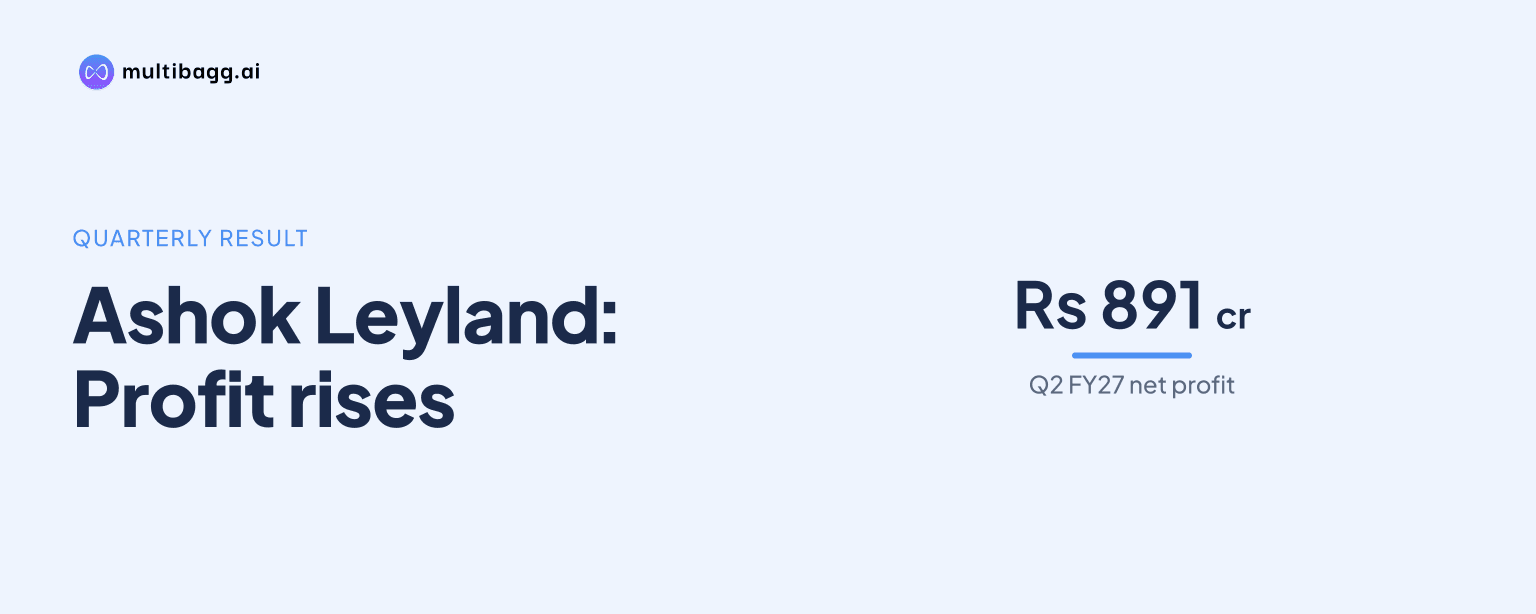
Ashok Leyland Limited reported consolidated net profit of ₹891.45 crore for the September 2026 quarter, up 8.7% year on year, as consolidated revenue rose 35.4% to ₹17,029.87 crore. Higher commercial-vehicle volumes supported the growth, though material and service costs increased faster and pressured margins.
Know Ashok Leyland inside out
Results, valuation, peers and who's buying, in one view.
What did Ashok Leyland report in Q2 FY27?
Ashok Leyland reported a consolidated net profit of ₹891.45 crore in Q2 FY27, compared with ₹820 crore in the corresponding quarter of the previous year. Consolidated revenue from operations increased to ₹17,029.87 crore from ₹12,576.86 crore, reflecting a 35.4% year-on-year rise.
On a standalone basis, Ashok Leyland recorded net profit of ₹869.02 crore, up 12.7% from ₹771.06 crore a year earlier. Standalone revenue from operations was ₹13,364.28 crore, a 39.4% increase from ₹9,588.18 crore in Q2 FY26. The results were announced on November 14, 2026, for the quarter ended September 30, 2026.
The company also reported a stronger sequential revenue performance. Consolidated revenue was ₹13,070 crore in the June 2026 quarter, making the September-quarter revenue 30.3% higher quarter on quarter. Consolidated operating profit increased 9.1% year on year to ₹1,114.3 crore.
How did commercial-vehicle volumes support the revenue increase?
Commercial-vehicle volumes supported Ashok Leyland's revenue increase, with total volumes rising 32% year on year to 64,677 units from 49,116 units. The volume growth was led by medium and heavy commercial vehicles, where the company reported a 44% rise in sales to 37,958 units.
The medium and heavy commercial vehicle, or MHCV, performance exceeded industry volume growth of 39% stated for the segment. This made the segment the largest contributor to the company's reported unit growth during the quarter.
Light commercial vehicle volumes grew 21% to 21,371 units from 17,697 units in the year-earlier quarter. Export volumes stood at 5,102 units, representing a 7% year-on-year increase. These figures indicate that growth came from domestic truck demand as well as overseas shipments, although the supplied results do not provide revenue by vehicle category or geography.
Ashok Leyland reported a 31.5% share of the domestic truck market excluding defence during the quarter. This was a gain of 150 basis points, or 1.5 percentage points, from the prior-year position. The company said it introduced models across tipper, bus and haulage categories during the period.
Why did Ashok Leyland's operating margin decline despite higher revenue?
Ashok Leyland's operating margin declined because costs of materials and services grew faster than revenue. The company reported material and services consumed at ₹9,899 crore, a 45% year-on-year increase, compared with the 35.4% rise in consolidated revenue.
Consolidated operating profit was ₹1,114.3 crore, up 9.1% year on year, but operating margin fell to 6.5% from 8.1%. That represents a contraction of 158 basis points. The margin was nevertheless higher than 5.8% in the June quarter, improving by 77 basis points sequentially alongside the rise in revenue.
Standalone cost trends were also elevated. Total expenses rose 42% year on year to ₹12,242 crore, while raw-material costs increased 47% to ₹9,105 crore, according to the reported standalone figures. Higher input costs therefore limited the conversion of revenue growth into profit growth.
For investors, the quarter shows that sales momentum and market-share gains did not translate into a proportionate increase in operating profitability. The figures establish the cost pressure reported for the period but do not provide a company forecast for commodity costs or margins in subsequent quarters.
Got a follow-up? Ask IRIS
What do the first-half results and dividend declaration show?
Ashok Leyland's first-half FY27 consolidated revenue rose 23.9% to ₹30,099.46 crore, while net profit increased 5.5% to ₹1,559.22 crore. Profit before tax for the April-September period grew 11% to ₹2,236.88 crore.
The first-half figures place the September quarter in a broader period of expanding revenue and profit. However, the difference between revenue and profit growth, both in the quarter and the half year, reflects the impact of cost growth on earnings conversion.
The board declared an interim dividend of ₹1 per share. The record date is November 20, 2026, and payment is due by December 13, 2026. The declaration returns part of the period's earnings to eligible shareholders, subject to holding the shares on the specified record date.
Ashok Leyland ended the quarter with net cash of ₹3,546 crore, compared with ₹990 crore in the year-earlier period, based on the reported figures. This balance-sheet measure is relevant alongside the dividend decision, although the supplied information does not provide a detailed reconciliation of the cash movement.
What should investors note about the reported results and review?
Investors should note that the standalone limited review was unmodified, while the auditors disclaimed a conclusion on the consolidated results because of unresolved loan-balance reconciliation differences at subsidiary HLFL. The disclosure is separate from the reported revenue, volume and profit figures, but it is a material point in assessing the consolidated financial statements.
Ashok Leyland's quarter combined 32% commercial-vehicle volume growth, a 150-basis-point domestic truck market-share gain and 35.4% consolidated revenue growth. At the same time, the 45% increase in materials and services consumed contributed to lower operating margin. The results therefore show strong demand and market positioning alongside a clear cost-related profitability constraint.
Conclusion
Ashok Leyland delivered higher Q2 FY27 revenue and profit on broad-based commercial-vehicle volume growth, particularly in MHCVs. Its domestic truck market share rose to 31.5%, and standalone as well as consolidated revenue increased sharply. Yet the increase in material and service costs exceeded revenue growth, resulting in lower operating margin year on year.
The next disclosed dates are the November 20, 2026 record date for the ₹1-per-share interim dividend and the payment due by December 13, 2026. Investors will also watch subsequent disclosures on costs, commercial-vehicle demand, market share and the unresolved HLFL loan-balance reconciliation matter cited in the consolidated review.