








Asian Paints links 169,000 touchpoints to eight plants, local deliveries
MAX Plan at ₹4,999/yr

Find your next multibaggerBe a Pro Investor
Research stocks and track your picks on the go. Download the app.
Key highlights
- Asian Paints has more than 169,000 retail touchpoints across India and added more than 6,000 in FY26.
- Asian Paints’ eight decorative plants have combined annual capacity of 2.29 million KL.
- Asian Paints says local dealers receive two to three deliveries a day through its replenishment system.
- Asian Paints commissioned 150,000 metric tonnes of annual VAE emulsion capacity in Q2FY27.
powered by IRIS
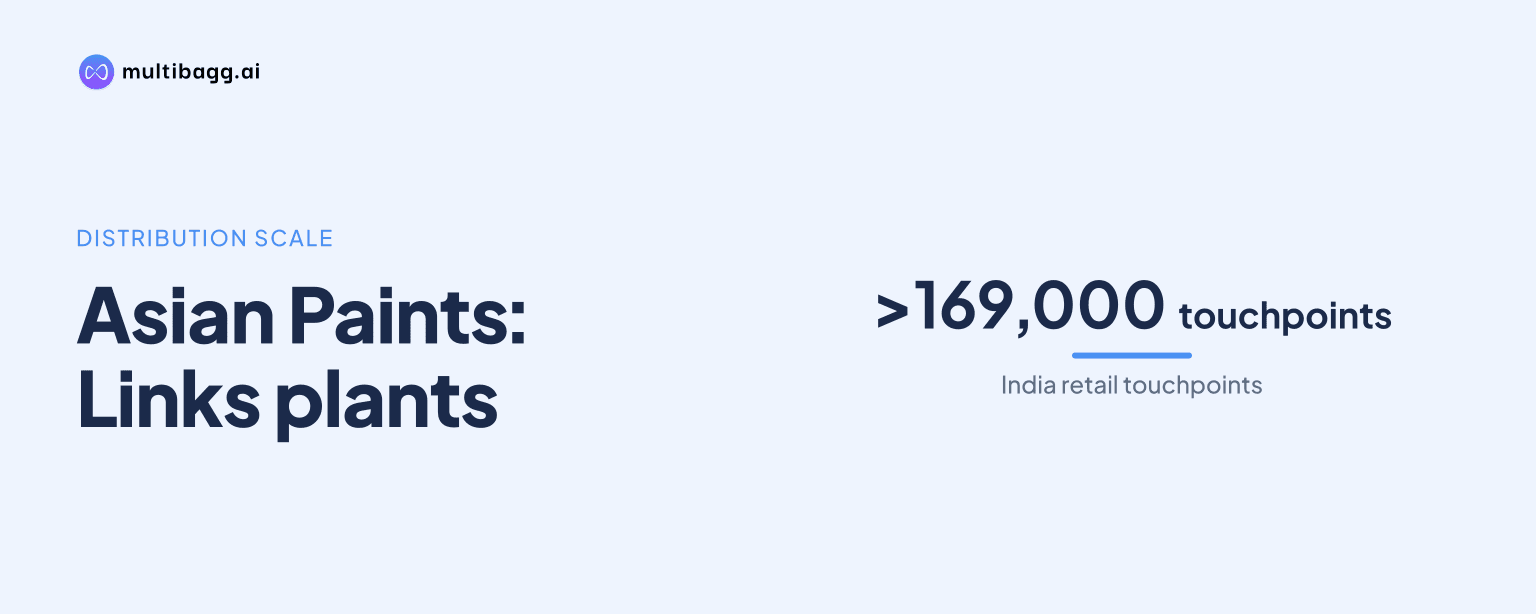
Asian Paints links more than 169,000 retail touchpoints to eight decorative plants with 2.29 million kilolitres (KL) of annual capacity, using depot-stock-keeping-unit (SKU) forecasting and two to three daily local deliveries, while adding more than 6,000 touchpoints in FY26.
Know Asian Paints inside out
Results, valuation, peers and who's buying, in one view.
How does Asian Paints reach 169,000 retail touchpoints?
Asian Paints reaches more than 169,000 retail touchpoints across India and added more than 6,000 touchpoints in FY26. The presentation describes this as the deepest retail reach in the Indian paint industry and says the outlets are neighbourhood shops with in-store tinting, serviced directly from company warehouses. Decorative and Home Décor India accounted for 86.8% of consolidated revenue in FY26, making this network relevant to the group’s largest business.
The network is supported by multiple retail formats rather than a single standard outlet. Colour Cube is a neighbourhood format designed to help customers compare shades, while Colour Ideas operates as a décor hub offering paints, textures, finishes and guided consultations. Asian Paints also had 74 Beautiful Homes stores across 20 states, providing an integrated home décor experience alongside the broader dealer-led network.
The physical footprint is paired with consumer-facing service activity. Beautiful Homes Painting Service served more than 175,000 customers in FY26, involved more than 3,900 dealers and operated in more than 650 towns. Its FY26 Net Promoter Score was 73.6, while more than 945,000 painters had been trained at Beautiful Homes Academy, extending the company’s interaction beyond a product purchase at a retail counter.
What manufacturing capacity supports Asian Paints distribution?
Asian Paints supports its retail distribution with 2.29 million KL of annual decorative-coatings capacity spread across eight plants. The largest facility is Mysuru at 600,000 KL per year, followed by Rohtak and Khandala at 400,000 KL each, while Visakhapatnam contributes 300,000 KL. The presentation says the capacity is located close to major consumption regions.
The industrial network is separately disclosed, with Taloja having 32,000 KL of industrial-coatings capacity and Sarigam having 14,400 metric tonnes of capacity. This differs from the decorative system, whose eight plants account for the 2.29 million-KL capacity supporting the retail network. The presentation also notes that PPGAP, an associate company, has dedicated facilities at Sriperumbudur and Dahej.
Asian Paints is adding backward integration alongside its distribution infrastructure. Phase 1 of its VAM-VAE project, including 150,000 metric tonnes a year of VAE emulsion capacity, was commissioned in Q2FY27. Management disclosed total project capital expenditure of Rs 3,250 crore and plans 100,000 metric tonnes of VAM capacity in Phase 2 by H1CY28; the company also cites an 800-tonnes-a-day designed clinker capacity at its Fujairah, UAE, white-cement plant for a key putty input.
Got a follow-up? Ask IRIS
How does Asian Paints replenish local dealers quickly?
Asian Paints says its local-market replenishment system delivers two to three times a day, allowing dealers to operate with lower stock and working capital. The supply-chain sequence begins with machine-learning forecasts at depot-SKU level, moves through real-time control towers and direct-to-dealer dispatch, and uses regional distribution centres before replenishment. This links forecasting decisions on individual products to delivery frequency at the local dealer level.
The approach differs from one requiring dealers to carry larger inventories between less-frequent deliveries. According to the presentation, two-to-three daily deliveries can lower dealer stock and working-capital needs, while faster inventory turns can improve dealer economics. Asian Paints does not disclose dealer inventory days, delivery costs or fulfilment rates, so the presentation establishes the operating mechanisms but does not quantify their financial effect.
Digital tools are part of the dealer process. The MyAwaaz Next-Gen portal combines operational, financial and business information on one platform, including ordering, order tracking, payment dashboards and artificial-intelligence product assistance. Real-time order visibility complements the direct-to-dealer dispatch model, while the more than 169,000-touchpoint base provides the endpoint network for the system.
Which tools connect Asian Paints with consumers and professionals?
Asian Paints connects consumers, dealers, contractors, painters, architects and interior designers through colour systems, retail formats and digital services. Chromacosm, described by the company as the world’s largest unified architectural colour system, contains more than 5,300 curated shades. It is positioned for architects, designers and homeowners, alongside a FY26 consumer Net Promoter Score of 73.6.
The professional network has both fixed and mobile training infrastructure. Beautiful Homes Academy includes 24 locations in Tier I cities and 53 Mobile Training Units in Tier II cities and beyond. For architects and interior designers, DecorPro is a dedicated digital platform with curated products, solutions and resources, while ColourNext Lab is presented as a research-led colour and material innovation initiative.
Product innovation adds another connection to the distribution system because outlets need a range of differentiated offerings. New products contributed about 18% of revenue in Q2FY27, and Asian Paints reported more than 250 scientists plus 181 patents filed or granted through FY26. Examples include Apex Ultima Protek with a 12-year warranty, SmartCare Infinia with a 25-year warranty and economy offerings ACE Ultraa and Tractor Ultraa, which the company says provide 10% higher coverage.
Conclusion
Asian Paints’ distribution structure combines scale at several levels: more than 169,000 retail touchpoints, eight decorative plants with 2.29 million KL of annual capacity, and two-to-three local deliveries a day. The company links those assets through depot-SKU forecasting, direct dealer service, regional distribution centres and digital dealer tools, while retail formats and the more than 5,300-shade Chromacosm system extend engagement with consumers and professionals.
The next disclosed milestones are in backward integration rather than retail-count targets. After commissioning 150,000 metric tonnes of annual VAE emulsion capacity in Q2FY27, Asian Paints plans a further 100,000 metric tonnes of VAM capacity by H1CY28 under the Rs 3,250 crore project. The presentation does not provide future touchpoint additions, delivery-frequency targets or quantified savings from the new capacity, leaving those operating outcomes to be tracked over time.

