








Asian Paints’ Q2 gross margin falls to 40.3% on inflation
MAX Plan at ₹4,999/yr

Find your next multibaggerBe a Pro Investor
Research stocks and track your picks on the go. Download the app.
Key highlights
- Asian Paints’ Q2 FY27 standalone gross margin fell 339 basis points year on year to 40.3%.
- Asian Paints reported approximately 25% material inflation in Q1 FY27 and approximately 3% in Q2 FY27.
- Asian Paints’ standalone Q2 FY27 net sales grew 14.8% to Rs 8,424 crore, while gross contribution rose 6% to Rs 3,426 crore.
- Asian Paints took a further approximately 3% price increase in November 2026 after roughly 12% cumulative Q1 and Q2 FY27 increases.
powered by IRIS
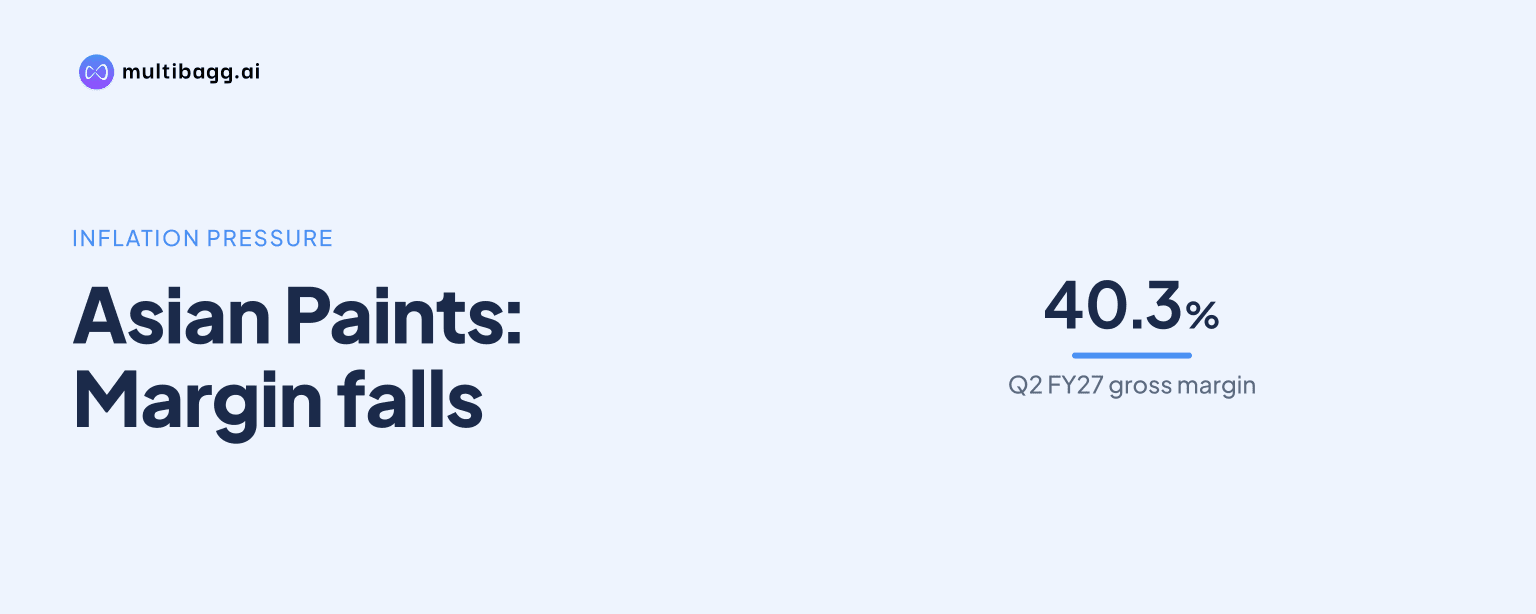
Asian Paints reported a Q2 FY27 standalone gross margin of 40.3%, down 339 basis points year on year, as higher-cost inventory from approximately 25% material inflation in Q1 FY27 moved through costs. Roughly 12% cumulative calibrated pricing partly cushioned the effect, while standalone net sales rose 14.8% to Rs 8,424 crore.
Know Asian Paints inside out
Results, valuation, peers and who's buying, in one view.
Why did Asian Paints’ Q2 gross margin fall?
Asian Paints’ Q2 FY27 standalone gross margin fell because inventory bought after sharp Q1 FY27 inflation entered the cost base during the quarter. Material inflation was approximately 25% in Q1 FY27 and a further approximately 3% in Q2 FY27, while gross margin declined from 43.7% in Q2 FY26 to 40.3% in Q2 FY27.
The 339-basis-point decline in Q2 was steeper than the 128-basis-point decline reported for H1 FY27, when standalone gross margin was 42.1%. This comparison indicates that the second quarter absorbed more of the higher-cost inventory effect, consistent with management’s statement that steep Q1 FY27 inflation flowed through in Q2.
The quarterly trend reversed the FY26 pattern, when material costs were deflationary in every reported quarter. Gross margin rose from 43.2% in Q1 FY26 to 45.6% in Q4 FY26, before declining to 43.8% in Q1 FY27 and then 40.3% in Q2 FY27 as input costs turned upward.
Did Asian Paints’ price increases cover raw-material inflation?
Asian Paints’ roughly 12% cumulative calibrated price interventions only partly offset the inflation impact, according to the presentation. The company took price increases of about 7% in Q1 FY27 and about 5% in Q2 FY27, compared with approximately 25% material inflation in Q1 and approximately 3% in Q2.
The timing gap matters because Q2 FY27 margin reflected purchases made after Q1 FY27’s inflation shock, rather than only the quarter’s approximately 3% increase in materials. Asian Paints said sourcing and formulation efficiencies continued to limit the inflation effect, but the 40.3% margin shows that those measures and pricing did not fully bridge the cost increase during Q2.
Asian Paints implemented a further price increase of approximately 3% in November 2026. The presentation does not quantify the eventual margin benefit from that action, but it identifies calibrated pricing and cost efficiencies as Q3 FY27 priorities while safeguarding demand momentum.
How did margin pressure affect Asian Paints’ standalone earnings?
Asian Paints’ Q2 FY27 standalone sales grew faster than gross contribution, showing the margin effect in the income statement. Net sales increased 14.8% to Rs 8,424 crore, while gross contribution increased 6% to Rs 3,426 crore, with growth led by volume and aided by pricing actions.
Profit before depreciation, interest and tax, or PBDIT, rose 5.9% to Rs 1,440 crore in Q2 FY27, but its margin fell 144 basis points to 17.1%. Asian Paints attributed the partial containment of the gross-margin impact to cost-optimisation initiatives, while profit before tax rose 14% to Rs 1,468 crore.
Profit after tax increased 14.6% to Rs 1,096 crore in Q2 FY27 despite the lower gross margin. For H1 FY27, net sales increased 15.8% to Rs 17,580 crore and PBDIT increased 19.8% to Rs 3,452 crore, lifting the H1 PBDIT margin by 66 basis points to 19.6% even as H1 gross margin declined.
Got a follow-up? Ask IRIS
How does Asian Paints’ standalone result compare with consolidated results?
Asian Paints’ consolidated Q2 FY27 gross margin was 39.6%, 349 basis points below the prior-year quarter and 70 basis points below the standalone margin of 40.3%. Consolidated net sales grew 16.9% to Rs 9,954 crore, exceeding standalone sales growth of 14.8%.
Consolidated gross contribution increased 8% to Rs 3,963 crore, while PBDIT rose 3.6% to Rs 1,557 crore and the PBDIT margin declined 202 basis points to 15.6%. Consolidated profit after tax before minority interest increased 6.6% to Rs 1,085 crore, compared with standalone profit after tax growth of 14.6%.
For H1 FY27, consolidated gross margin was 41.6%, down 124 basis points, while standalone gross margin was 42.1%, down 128 basis points. Consolidated PBDIT margin increased 26 basis points to 18.2%, less than the 66-basis-point increase in standalone PBDIT margin to 19.6% over the same half-year period.
What is Asian Paints planning to do in Q3 FY27?
Asian Paints plans to use calibrated pricing and cost efficiencies in Q3 FY27 to improve margins while protecting demand momentum. Its stated priorities include capitalising on festive and wedding-season demand, at a time when raw-material inflation, supply-chain volatility and competitive intensity continue to weigh on the near-term operating environment.
Asian Paints also plans to sustain spending on innovation and brand building and use its newly commissioned capacity to scale differentiated in-house formulations. The presentation does not provide a numerical margin target for Q3 FY27, but it links capacity, sourcing and formulation measures to its response to the inflation-led pressure seen in the 40.3% Q2 gross margin.
Conclusion
Asian Paints delivered 14.8% standalone sales growth and 14.6% profit-after-tax growth in Q2 FY27, but gross contribution grew 6% as gross margin fell to 40.3%. The comparison with Q2 FY26’s 43.7% margin and Q4 FY26’s 45.6% margin shows how sharply the approximately 25% Q1 FY27 material inflation changed the cost backdrop.
The next disclosed item to watch is the effect of the approximately 3% November 2026 price increase during Q3 FY27. Asian Paints’ Q3 plan combines pricing, cost efficiencies, festive and wedding-season execution, and newly commissioned formulation capacity, but the presentation leaves unresolved how quickly those measures can offset continued raw-material inflation and supply-chain volatility.

