








Asian Paints commissions 150,000-tonne VAE capacity in Q2FY27
MAX Plan at ₹4,999/yr

Find your next multibaggerBe a Pro Investor
Research stocks and track your picks on the go. Download the app.
Key highlights
- Asian Paints commissioned 150,000 tonnes of annual VAE capacity in Q2FY27.
- Asian Paints plans 100,000 tonnes of annual VAM capacity by H1CY28.
- Asian Paints disclosed Rs 3,250 crore of total VAM-VAE project capital expenditure.
- About 18% of Asian Paints revenue in Q2FY27 came from new products.
powered by IRIS
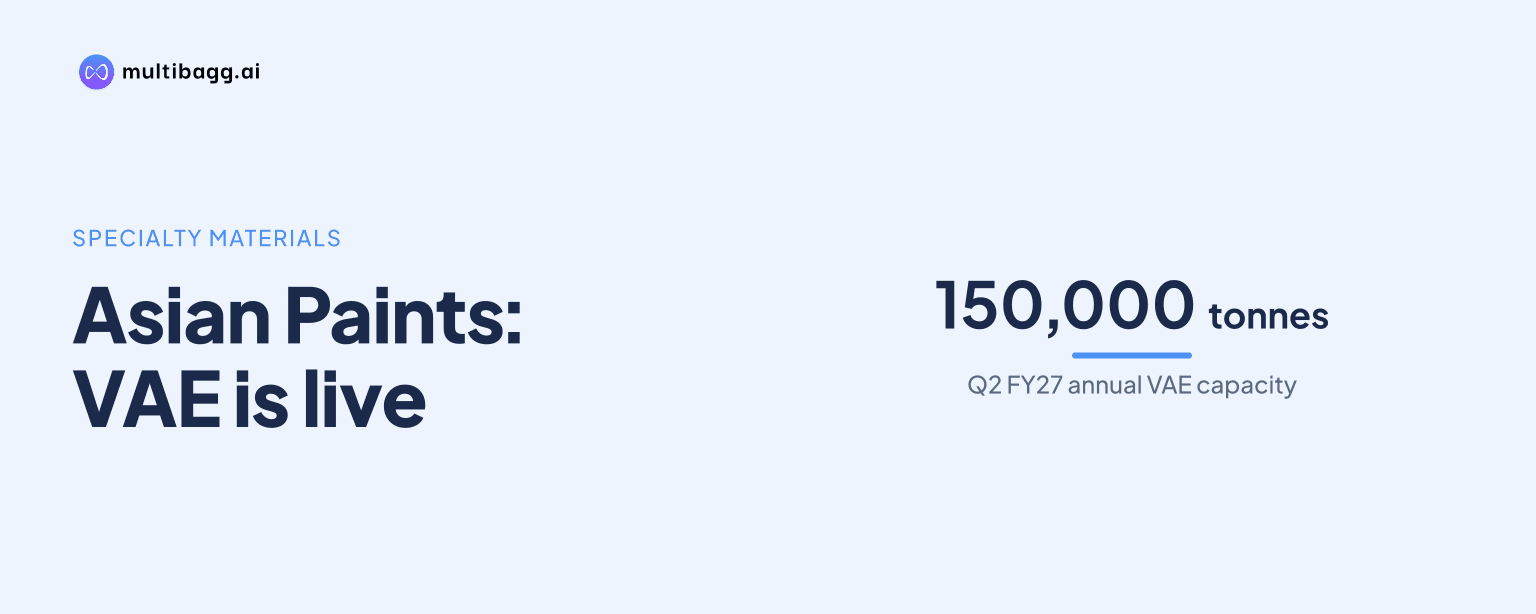
Asian Paints commissioned 150,000 tonnes of annual vinyl acetate ethylene, or VAE, emulsion capacity in Q2FY27, starting Phase 1 of its Rs 3,250 crore VAM-VAE project. Asian Paints says the Dahej facility will support proprietary, next-generation emulsions for a strategic set of existing and new products.
Know Asian Paints inside out
Results, valuation, peers and who's buying, in one view.
What did Asian Paints commission in Q2FY27?
Asian Paints commissioned Phase 1 VAE capacity of 150,000 tonnes a year in Q2FY27 at Dahej. The company describes this capacity as on stream and positions it within its manufacturing and backward-integration programme, alongside product chemistry, retailing and data-led initiatives.
The commissioned VAE facility is the first operating element of a two-phase vinyl acetate monomer, or VAM, and VAE programme. The VAE capacity exceeds the planned Phase 2 VAM capacity by 50,000 tonnes a year, although the two materials serve different points in the integrated system.
Asian Paints disclosed a Phase 1 gross-block addition of about Rs 1,060 crore and total project capital expenditure of Rs 3,250 crore. Gross block is the value of fixed assets before depreciation, and the presentation does not separately disclose Phase 2 spending or a construction-progress measure for the VAM plant.
How will Asian Paints use VAE capacity in products?
Asian Paints says its research and development team will formulate indigenous next-generation VAE emulsions, using green chemistry to create differentiated functional parameters. The company says these emulsions can be used across a strategic set of current and new products, linking the Dahej capacity to formulation rather than only raw-material supply.
New products accounted for about 18% of Asian Paints revenue in Q2FY27, but the presentation does not state how much of that revenue came from VAE-based products. Its decorative-coatings innovation range includes Nilaya Arc, a lime-based finish, Apex Ultima Protek with a 12-year warranty, Royale Glitz Reserv with an eight-year warranty, and SmartCare Infinia with a 25-year warranty.
Asian Paints also lists Apex Ultima Suprema Air-O-Clean, which it says uses photocatalytic technology and meets World Health Organization standards, and ACE Ultraa and Tractor Ultraa, for which it cites 10% higher coverage. Tractor Emulsion and Ace Exterior Emulsion use anti-damp technology in the economy segment and carry a four-year warranty on key performance parameters, but Asian Paints does not identify individual products that will use Dahej VAE output.
What is Asian Paints planning for Phase 2 VAM capacity?
Asian Paints plans to add 100,000 tonnes of annual VAM capacity in Phase 2 by H1CY28. The company calls the combined VAM-VAE arrangement India’s first integrated VAM-VAE ecosystem, while its Q2FY27 disclosure confirms that only the 150,000-tonne VAE element was then on stream.
Management says relevant products should receive a strong margin benefit once Phase 2 is on stream. This is a management expectation tied to the planned VAM capacity, rather than a reported margin outcome from the commissioned Phase 1 asset; Asian Paints gives no savings-per-tonne estimate, margin target or list of affected products.
The distinction between the two phases is material to the disclosed project timetable. Asian Paints has an operating 150,000-tonne VAE plant, but its 100,000-tonne VAM plant remains targeted for H1CY28, with Rs 3,250 crore representing total project capital expenditure rather than a Phase 1-only figure.
Got a follow-up? Ask IRIS
How does the VAM-VAE project fit Asian Paints’ supply chain?
Asian Paints places VAM-VAE integration within a make-and-integrate supply-chain model that also includes 2.29 million kilolitres of decorative-coatings capacity across eight plants. The company says the decorative network is located close to major consumption regions, whereas the Dahej asset is a backward-integrated platform for selected formulation inputs.
Mysuru is the largest decorative-coatings plant at 600,000 kilolitres a year, followed by Rohtak and Khandala at 400,000 kilolitres each. Visakhapatnam has 300,000 kilolitres, Ankleshwar 250,000 kilolitres, Sriperumbudur 140,000 kilolitres, Kasna 120,000 kilolitres and Patancheru 80,000 kilolitres of capacity.
These decorative-coatings figures cannot be directly compared with the 150,000-tonne VAE plant because the units differ. Asian Paints also cites an 800-tonnes-per-day designed clinker capacity at its Fujairah, United Arab Emirates, white-cement plant, which it says secures a key putty input, and industrial-coatings capacity of 32,000 kilolitres at Taloja plus 14,400 tonnes at Sarigam.
How does Asian Paints connect capacity with innovation?
Asian Paints connects the Dahej plant with an innovation platform comprising more than 250 scientists and 181 patents filed through FY26. Its stated mechanism is internally formulated VAE emulsions used in existing and new products, rather than an assertion that manufacturing capacity alone delivers product differentiation.
The VAE project sits alongside consumer-facing formats and services in Asian Paints’ broader presentation. The company operates 74 Beautiful Homes stores across 20 states, while its painting service uses an artificial-intelligence visualizer, artificial-intelligence-led supervision and an artificial-intelligence customer-delight score; these channels are distinct from the 150,000-tonne Dahej asset.
Asian Paints also reports 169,000-plus retail touchpoints across India, including more than 6,000 added in FY26. That distribution scale is separate from VAM-VAE integration, but the company presents retailing, backward integration, product chemistry and data as connected parts of its plan to widen differentiation.
Conclusion
Asian Paints has moved the first stage of its VAM-VAE programme into operation with 150,000 tonnes of annual VAE capacity commissioned in Q2FY27. The project combines a Rs 1,060 crore Phase 1 gross-block addition with internally developed VAE formulations, while new products represented about 18% of revenue in Q2FY27.
The next disclosed milestone is 100,000 tonnes of annual VAM capacity planned by H1CY28. Investors can watch completion against that timetable and any later disclosure on relevant-product margins, because management has linked the margin benefit to Phase 2 rather than quantified an impact from the commissioned VAE plant alone.

