










Astra Microwave demerger terms await final board decision
Key highlights
- Astra Microwave has granted in-principle approval to demerge its space, meteorology and hydrology undertakings.
- Astra Microwave reports Rs 110.6 crore of FY26 space revenue and a Rs 187.1 crore space order book as of March 2026.
- The structure and share exchange ratio remain undecided pending consultant reports and opinions.
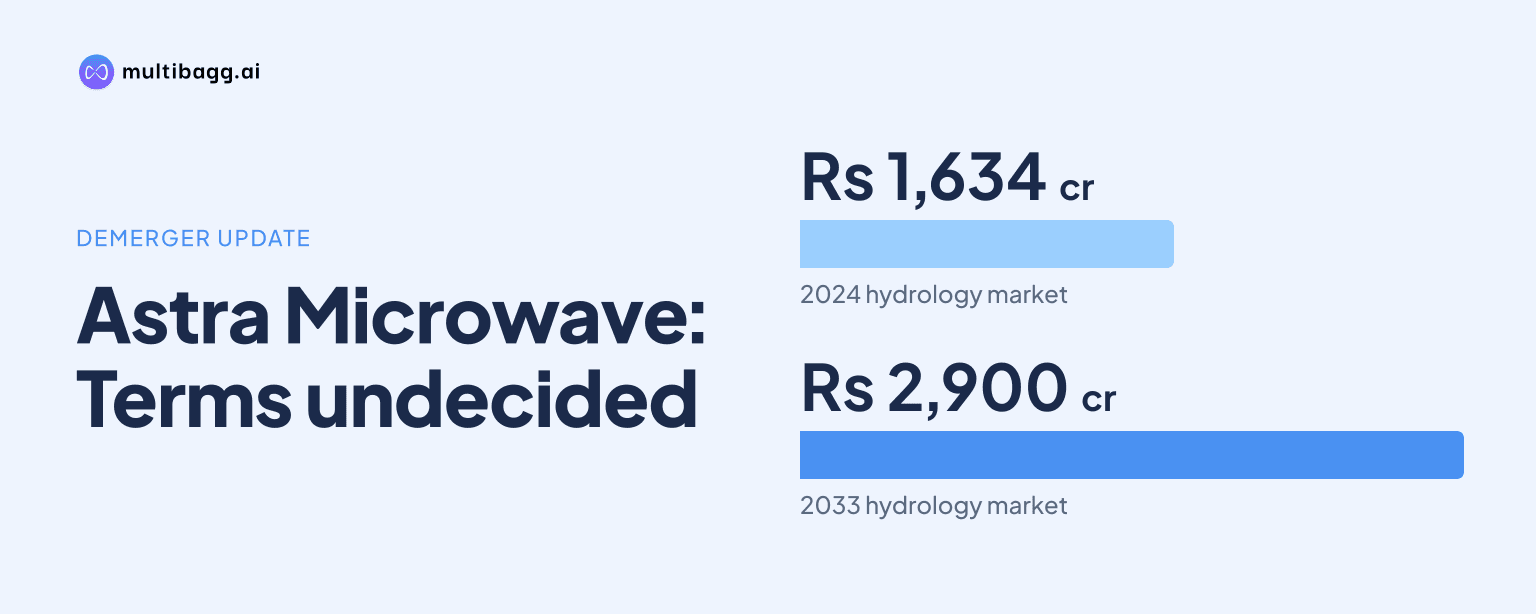
- India’s hydrology market is cited at Rs 1,634 crore in 2024 and about Rs 2,900 crore by 2033.
powered by IRIS
Astra Microwave Products Ltd. has granted in-principle approval to separate its space, meteorology and hydrology undertakings, but the board has yet to decide the structure, share exchange ratio and other terms after consultant reports are received. The presentation reports a Rs 187.1 crore space order book as of March 2026, alongside Rs 110.6 crore of FY26 revenue.
Know Astra Microwave Products inside out
Results, valuation, peers and who's buying, in one view.
What has Astra Microwave approved for demerger?
Astra Microwave has approved in principle the demerger of its space, meteorology and hydrology business undertakings into a separate entity. The proposed company would be dedicated exclusively to these three undertakings, which currently sit within a wider portfolio that also includes radar electronics, electronic warfare and telemetry.
The approval does not complete the transaction. Astra Microwave says the final decision will be taken by its board after receipt of reports and opinions from consultants, including those covering the transaction structure, share exchange ratio and other terms. The presentation gives no completion date, ownership split, effective date or list of assets and liabilities proposed for transfer.
Why does Astra Microwave want a separate entity?
Astra Microwave says a separate company would provide focused management attention and operational efficiency for the space, meteorology and hydrology undertakings. Its stated mechanism is an independent business focused on these sectors rather than a unit managed alongside defence-oriented radar, electronic-warfare and telemetry operations.
Management also cites tailored growth strategies and capital allocation as reasons for the proposal. The three activities address different applications: space electronics supports satellite connectivity, crop monitoring and disaster warnings; meteorology includes aerospace testing and electric-vehicle battery quality control; and hydrology covers irrigation planning, reservoir monitoring and smart water systems.
Astra Microwave further says the proposed transaction is intended to unlock value for shareholders. That is a stated management objective, not a quantified result, because the presentation provides no valuation, transaction cost, expected profit effect, capital requirement or proposed distribution of shares in the separate entity.
What financial information has Astra Microwave disclosed?
Astra Microwave presents Rs 110.6 crore of FY26 revenue, a Rs 187.1 crore order book as of March 2026 and Rs 154.0 crore of order guidance on its space electronics slide. The March 2026 order book was Rs 76.5 crore above the disclosed FY26 revenue, while order guidance was Rs 33.1 crore below the order book.
These figures are disclosed on the space electronics page, not as financial data for the combined businesses proposed for demerger. Astra Microwave does not provide separate revenue, profitability, capital expenditure or order-book figures for meteorology and hydrology, so the presentation does not establish the financial scale of the entire proposed entity.
Astra Microwave separately reports a Rs 2,141 crore standalone order book as of March 2026 for its broader operations. The company does not reconcile that figure with the Rs 187.1 crore space order book or disclose what portion of the Rs 2,141 crore total would remain after the proposed separation.
What does Astra Microwave disclose about the three businesses?
Astra Microwave identifies itself as a supplier to the Indian Space Research Organisation, or ISRO, providing radio-frequency, or RF, components for satellites and launch vehicles. It also says it exports space components to international agencies and imports niche materials for high-precision manufacturing, without providing export revenue, import value or individual customer data.
The space activity spans satellite, agriculture, disaster-management and urban-planning applications. Listed uses include high-speed broadband, tele-education, telemedicine, satellite-imagery-based crop monitoring, cyclone and flood early-warning systems, post-disaster mapping, and geospatial data for infrastructure and land-use planning.
For meteorology, Astra Microwave says it is active in Mission Mausam and links the sector with an “Industry 5.0” push. The presentation lists engine-part calibration and aviation reliability testing in aerospace, electric-vehicle battery quality control in automotive, and medical-device manufacturing in healthcare, but it reports no meteorology-specific sales or orders.
For hydrology, Astra Microwave says India’s market was Rs 1,634 crore in 2024 and is projected to reach about Rs 2,900 crore by 2033. The cited market increase is about Rs 1,266 crore, while the presentation does not state a compound annual growth rate or Astra Microwave’s share. It says the company supplies sensors for hydrological equipment and exports components to Israel and Singapore.
Got a follow-up? Ask IRIS
What market context and support does Astra Microwave cite?
Astra Microwave cites India’s share of the global space economy at about Rs 70,000 crore, against a global market valued at Rs 36,37,290 crore. It says India aims to capture 8% of the global market by 2033, which is a national objective cited in the presentation rather than a sales forecast or market-share target for Astra Microwave.
The presentation also cites a Rs 13,416 crore Budget 2025-26 allocation to the Department of Space. For water-security projects connected to hydrology end markets, it cites a Rs 99,503 crore allocation to the Jal Shakti Ministry in 2025-26. Neither allocation is described as an Astra Microwave order, grant or committed source of company revenue.
The business mix proposed for separation differs from larger defence opportunities presented elsewhere. Astra Microwave estimates the Indian radar market at about Rs 12,200 crore by 2033 and the Indian electronic-warfare market at about Rs 9,500 crore by 2033, while the demerger proposal names only space, meteorology and hydrology.
Telemetry is also not named as part of the proposed transaction. Astra Microwave says it supplies telemetry subsystems for platforms including LCA Tejas and IJT aircraft, but does not disclose whether shared facilities, personnel, intellectual property, customer relationships or manufacturing capacity would be allocated between the continuing company and the new entity.
What remains unresolved before Astra Microwave proceeds?
Astra Microwave has not finalised the demerger structure, share exchange ratio or other transaction terms. These unresolved items will determine the legal form of the separation and how shareholders would hold interests in Astra Microwave and the proposed separate entity after the board receives consultant reports and opinions.
The presentation also does not identify the intended treatment of Astra Space Technologies Private Limited. That wholly owned subsidiary was incorporated on February 17, 2024 to manufacture and integrate satellite equipment, but Astra Microwave does not say whether it will be transferred in the demerger, retained by the existing company or assigned another role.
The lack of combined standalone financial information is another open issue. While the space slide provides FY26 revenue of Rs 110.6 crore and a March 2026 order book of Rs 187.1 crore, readers cannot use the presentation to calculate revenue, margins, assets, liabilities or capital needs for the combined space, meteorology and hydrology perimeter.
Conclusion
Astra Microwave has set out a potential structural separation of its space, meteorology and hydrology operations, with management citing focused oversight, operational efficiency, tailored capital allocation and shareholder value. The available data show identifiable space activity, including Rs 110.6 crore of FY26 revenue and a Rs 187.1 crore order book in March 2026, but do not quantify the proposed entity as a whole.
The next event to watch is the board’s final decision after consultant reports and opinions are received. The eventual transaction structure, share exchange ratio, business perimeter, treatment of Astra Space Technologies Private Limited and standalone financial disclosures will determine how the separation can be assessed.