








AVG Logistics Limited targets 250 EVs after cement start
MAX Plan at ₹4,999/yr

Find your next multibaggerBe a Pro Investor
Research stocks and track your picks on the go. Download the app.
Key highlights
- AVG Logistics deployed 30 heavy EVs on a five-year Assam cement contract that can be extended by three years.
- Each cement-contract EV carries about 38 to 41 tonnes and completes around 50 trips each month, according to management.
- AVG Logistics plans to add around 200 to 250 electric vehicles by March 2027 through owned and leased models.
- Q2 FY27 consolidated profit after tax increased 39.2% year on year to Rs 7.10 crore, while revenue from operations rose 6% to Rs 151.60 crore.
powered by IRIS
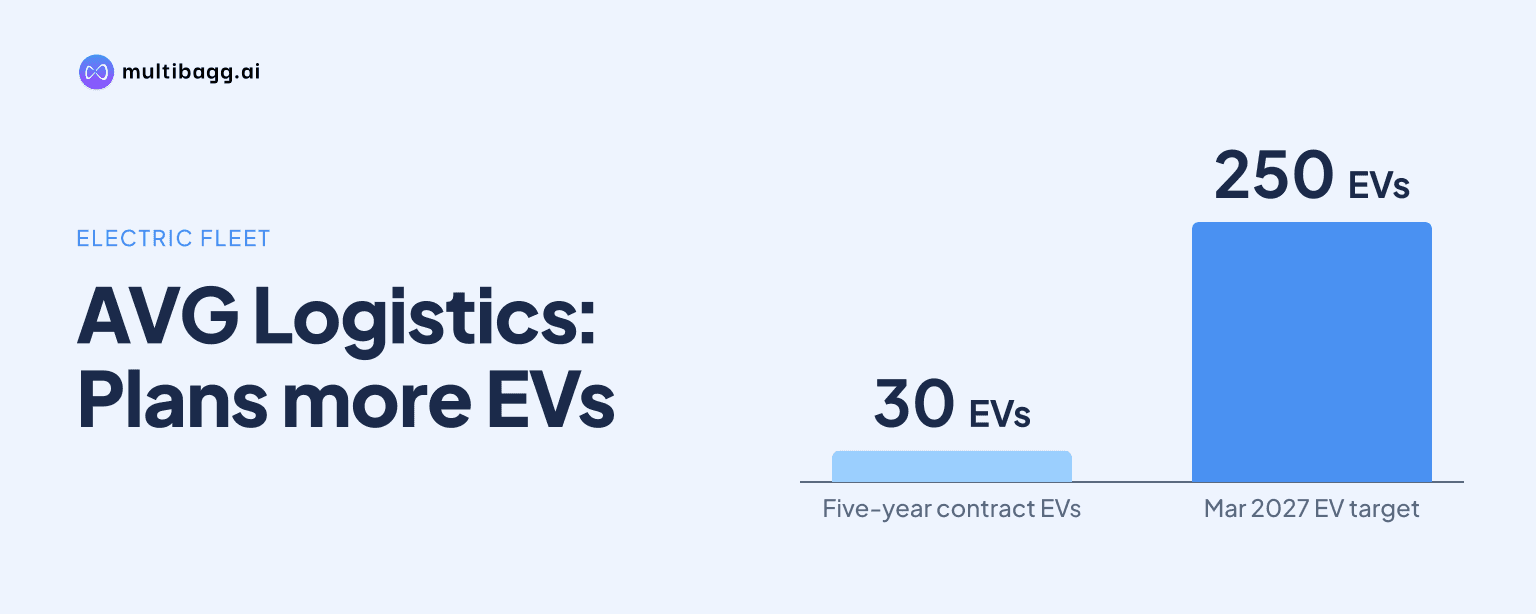
AVG Logistics Limited plans to add around 200 to 250 electric vehicles by March 2027 after putting 30 heavy electric trucks into service on a five-year cement contract in Assam. Management said each truck carries 38 to 41 tonnes and makes about 50 trips a month, linking the rollout to solar-powered charging and operating leases.
Know AVG Logistics inside out
Results, valuation, peers and who's buying, in one view.
How does AVG Logistics' 30-truck cement contract operate?
AVG Logistics' first 30 heavy electric trucks are operating in Assam under a five-year contract signed in August with an unnamed cement company, with an option to extend the agreement by another three years. Each vehicle carries about 38 to 41 tonnes and makes roughly 50 trips a month, according to management.
The arrangement covers more than the provision of vehicles because AVG Logistics is building and running a green-logistics operation for the customer. Management did not disclose the contract value, revenue per truck or earnings contribution, but described the five-year term as a source of recurring revenue. The company said it initially bought five heavy EVs before expanding the operating fleet to 30 vehicles.
AVG Logistics also said it had become the first company in India to deploy a fleet of 55-ton electric trucks. That fleet reference differs from the 38-to-41-tonne loads disclosed for the Assam contract, indicating that the two figures refer to separate measures: a vehicle specification cited by management and the operating load range for this cement route.
Why does AVG Logistics expect EV routes to earn more than diesel?
AVG Logistics expects the cement EV operation to produce better margins than diesel transport because management said the vehicles can make more trips and use solar electricity. It estimated industrial electricity at about Rs 8 to Rs 10 per unit, compared with about Rs 4 to Rs 5 per unit for solar power.
The customer has provided space at the origin and destination points for charging equipment, according to management. AVG Logistics said a charging station costs around Rs 1 crore and that it needs about four to five chargers at each end of the route. Management said an EV can travel about 150 to 160 kilometres on a single charge, but did not disclose the total charging investment or energy consumption for the Assam operation.
Management said cement and steel producers are seeking lower-emission logistics because they have carbon-reduction targets. It also said customer infrastructure and lower-cost solar power can reduce operating costs compared with diesel. Those comments are management's assessment; AVG Logistics did not disclose customer savings, contracted tariff rates or a quantified margin for the cement fleet.
How big is AVG Logistics' electric-fleet expansion plan?
AVG Logistics said it is trying to add around 200 to 250 electric vehicles by March 2027 through a mix of owned and leased vehicles. The planned addition is substantially larger than the 30 heavy EVs already serving the Assam cement contract, although management did not provide a delivery timetable, capital outlay or ownership split.
The EV plan sits alongside compressed natural gas, liquefied natural gas and diesel vehicles rather than replacing the wider fleet immediately. AVG Logistics operates more than 3,000 owned and hired vehicles from 70 branches, supported by about 7.5 lakh square feet of warehousing. Its cold-chain division has more than 400 refrigerated vehicles serving dairy, food and pharmaceutical customers.
Alternative-fuel deployments also extend beyond the cement route. Management estimated that its Haldiram's electric-vehicle contract and a beverage contract using compressed natural gas could together generate about Rs 28 crore to Rs 32 crore of annual revenue once fully operational. That estimate is separate from the undisclosed revenue potential of the 30-truck cement contract.
Got a follow-up? Ask IRIS
How will AVG Logistics fund the EV rollout?
AVG Logistics plans to fund EV additions through a combination of operating leases, debt and equity. Management said non-banking financial companies fund electric vehicles under operating-lease arrangements, while AVG Logistics pays a portion of the revenue earned from customer contracts instead of bearing the full vehicle cost from its own funds.
The funding model is relevant because the company reported consolidated revenue from operations of Rs 151.60 crore in Q2 FY27, up 6% year on year and 14.4% from Rs 132.50 crore in Q1 FY27. Profit after tax rose 39.2% year on year to Rs 7.10 crore, while profit before tax increased 53% to Rs 10.10 crore.
Reported earnings before interest, tax, depreciation and amortisation, or EBITDA, fell 10.3% year on year to Rs 23.60 crore, while EBITDA margin declined to 15.6% from 18.4%. Management attributed much of the movement to an Ind AS lease-accounting change after lease rentals moved into operating expenses at the end of FY26. Depreciation fell to Rs 7 crore from Rs 11.70 crore and finance costs fell to Rs 6.50 crore from Rs 8 crore.
What must happen for AVG Logistics to meet its FY27 plan?
AVG Logistics maintained its objective of about 15% to 20% revenue growth in FY27 despite H1 FY27 consolidated revenue increasing 6% to Rs 284.10 crore. Management said the Haldiram's and Dalmia fleets began only in the final month of Q2, while liquor and beverage contracts should provide fuller contributions from Q3 onward.
Management also said the second half is traditionally stronger than the first half. Its forecast depends on contract execution rather than disclosed new pricing: Haldiram's started in August, Dalmia started in September, and management said further contracts were being implemented in November and December. The company did not quantify the revenue expected from each contract in the second half.
Fuel-price mechanisms remain part of the operating model. AVG Logistics said 75% to 80% of corporate-client business has diesel-price adjustment clauses, with diesel making up around 40% to 45% of transport cost. Management said customer approvals can create a 10-to-15-day delay in rate changes, but said the mechanism avoided a loss from the earlier diesel-price increase.
Conclusion
AVG Logistics is turning its heavy-EV strategy into an operating cement contract with 30 trucks, five-year tenure and disclosed route economics based on solar charging. The company is planning another 200 to 250 electric vehicles by March 2027, while its Q2 FY27 profit after tax rose to Rs 7.10 crore even though reported EBITDA fell under the stated Ind AS lease-accounting change.
The next measures of execution will be the Q3 contribution from the Haldiram's, Dalmia, liquor and beverage contracts, alongside progress toward the March 2027 EV addition plan. Management also targets FY27 revenue growth of about 15% to 20% and a 2030 roadmap of Rs 1,250 crore in revenue and around Rs 120 crore in profit after tax, making fleet deployment and contract ramp-up the disclosed milestones to watch.

