








AVG Logistics Q2 PAT rises 39% despite EBITDA decline
MAX Plan at ₹4,999/yr

Find your next multibaggerBe a Pro Investor
Research stocks and track your picks on the go. Download the app.
Key highlights
- AVG Logistics reported Q2 FY27 consolidated PAT of Rs 7.10 crore, up 39.2% year-on-year.
- Q2 FY27 EBITDA was Rs 23.60 crore, down 10.3%, after lease rentals moved into operating expenses.
- Q2 FY27 PBT rose 53% to Rs 10.10 crore as depreciation and finance costs declined.
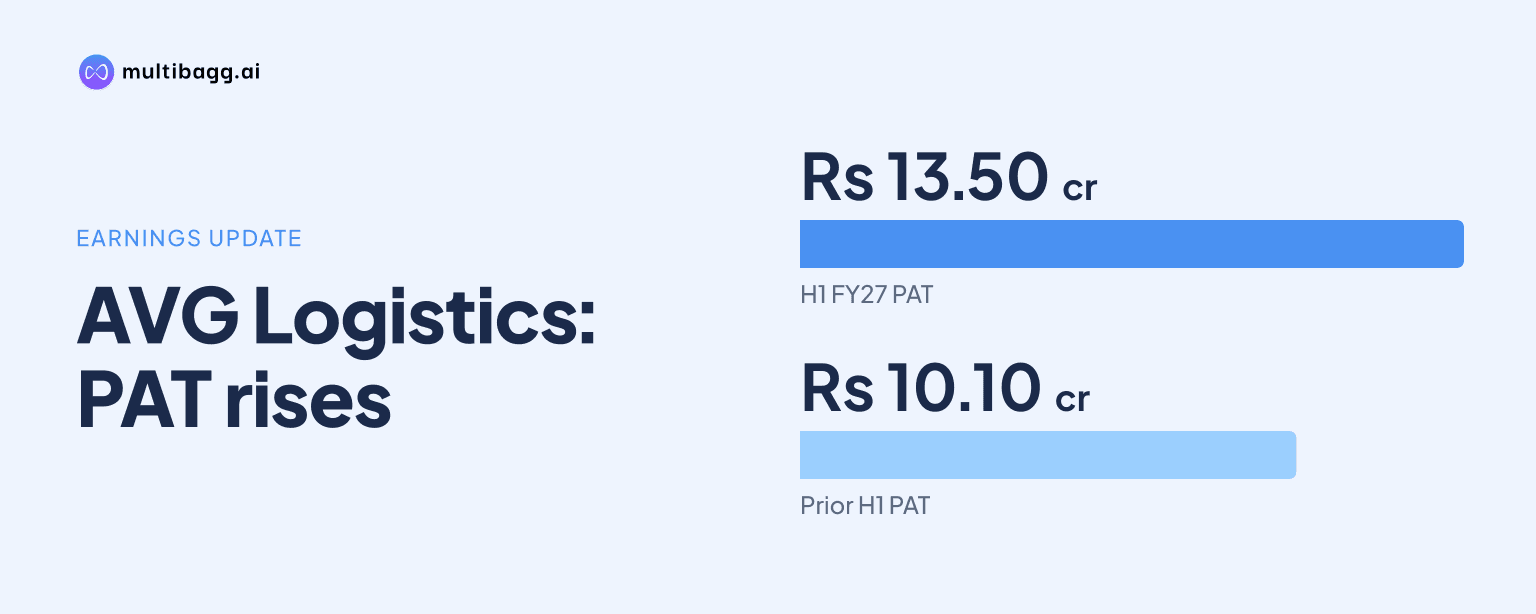
- H1 FY27 PAT increased to Rs 13.50 crore from Rs 10.10 crore, while EBITDA fell 11% to Rs 44.70 crore.
powered by IRIS
AVG Logistics Limited reported consolidated Q2 FY27 profit after tax of Rs 7.10 crore, up 39.2% year-on-year, even as EBITDA declined 10.3% to Rs 23.60 crore. Management attributed the divergence chiefly to a lease-cost reporting change that increased operating expenses but reduced depreciation and finance costs, lifting profit before tax to Rs 10.10 crore.
Know AVG Logistics inside out
Results, valuation, peers and who's buying, in one view.
Why did AVG Logistics' Q2 PAT rise while EBITDA fell?
AVG Logistics' Q2 FY27 PAT rose because lower depreciation and amortisation and finance costs outweighed the decline in reported EBITDA. Consolidated EBITDA fell by Rs 2.70 crore to Rs 23.60 crore from Rs 26.30 crore in Q2 FY26, while its margin declined to 15.6% from 18.4%. Depreciation and amortisation fell to Rs 7 crore from Rs 11.70 crore, and finance costs decreased to Rs 6.50 crore from Rs 8 crore.
PBT, or profit before tax, consequently rose 53% to Rs 10.10 crore in Q2 FY27 from Rs 6.60 crore a year earlier. PAT increased from Rs 5.10 crore to Rs 7.10 crore, and the consolidated PAT margin rose to 4.7% from 3.6%. Revenue from operations grew 6% to Rs 151.60 crore, while total income, including Rs 2.60 crore of other income, increased 6.3% to Rs 154.20 crore.
What lease-accounting change affected AVG Logistics' EBITDA?
AVG Logistics said the year-on-year EBITDA decline primarily reflected a change in lease arrangements at the end of FY26. Management said lease rentals that had previously been recorded within depreciation and finance costs are now recorded in operating expenses under Indian Accounting Standards, or Ind AS. This treatment lowers reported EBITDA while lowering depreciation and interest costs by a similar amount, according to management.
Operating expenses were Rs 117.90 crore in Q2 FY27, compared with Rs 101.70 crore in Q2 FY26. However, employee-benefit expense declined to Rs 6 crore from Rs 6.70 crore, and other expenses declined to Rs 6.80 crore from Rs 10.30 crore. Management said PBT gave a better like-for-like view of the business after the lease-accounting change, rather than presenting this as an operational cost increase.
The distinction is visible in margin movements. Consolidated EBITDA margin fell 280 basis points to 15.6% in Q2 FY27, whereas consolidated PAT margin increased 110 basis points to 4.7%. PAT margin was nonetheless below the 4.9% reported in Q1 FY27, when EBITDA was Rs 21.10 crore and PAT was Rs 6.50 crore.
Did AVG Logistics' first-half results show the same pattern?
AVG Logistics' H1 FY27 results showed the same reported EBITDA-and-profit divergence as Q2. Consolidated revenue from operations rose 6% to Rs 284.10 crore from Rs 268.10 crore in H1 FY26, while total income rose 6.5% to Rs 288.40 crore from Rs 270.70 crore. EBITDA fell 11% to Rs 44.70 crore and EBITDA margin declined to 15.7% from 18.9%.
Depreciation and amortisation decreased by Rs 10.20 crore to Rs 12.70 crore in H1 FY27, while finance costs declined by Rs 1 crore to Rs 13.10 crore. PBT therefore rose 39% to Rs 18.90 crore from Rs 13.60 crore. PAT increased to Rs 13.50 crore from Rs 10.10 crore, and PAT margin improved to 4.8% from 3.8%.
Got a follow-up? Ask IRIS
What operating changes did AVG Logistics cite for profit growth?
AVG Logistics attributed profit growth to higher fleet utilisation, a changed business mix and cost controls. Management said better load planning and fewer empty return trips meant a larger proportion of truck movements carried loads in both directions. It also cited dedicated contracts with Haldiram's, Dalmia and other customers as supporting assured volumes and lowering the cost of each trip.
Fuel was the logistics sector's largest cost during the H1 FY27 period, management said, after conflict in West Asia began at the end of February. AVG Logistics said its fuel-surcharge mechanism and periodic freight-rate revisions limit diesel-price exposure because most of its business is contracted. Management also said a growing share of its fleet uses compressed natural gas, liquefied natural gas and electric power instead of diesel.
The Haldiram's and Dalmia fleets began operations only in the last month of Q2 FY27, limiting their first-half contribution. Management expects fuller contribution from these fleets, as well as liquor and beverage contracts, from Q3 onward. Under an August contract with a cement company in the North East, the first 30 heavy electric trucks entered service in Assam under a five-year term that can be extended by three years.
What does AVG Logistics expect for the second half of FY27?
AVG Logistics management retained its FY27 objective of around 15% to 20% revenue growth despite consolidated revenue growing 6% in H1 FY27. Management said Q3 and Q4 have historically been stronger than the first two quarters, and contracts begun in August and September will contribute for full months from October. This is management's outlook rather than a reported financial result.
Management expects liquor logistics to generate around Rs 24 crore of revenue in FY27 and scale to about Rs 100 crore from the following year as volumes build. It also said the Haldiram's and beverage contracts together could produce annual revenue of roughly Rs 28 crore to Rs 32 crore once fully operational. AVG Logistics plans to add about 200 to 250 electric vehicles by March 2027 through a mix of owned and leased vehicles.
Management separately stated that it expects FY27 PAT of around Rs 34 crore to Rs 35 crore, compared with Rs 26 crore in the prior year. That expectation depends on the rollout of contracts and the contribution of vehicles added during FY27. The call did not provide a consolidated EBITDA target adjusted for the revised lease-cost classification.
Conclusion
AVG Logistics' Q2 and H1 FY27 figures show that reported EBITDA and bottom-line profit moved in opposite directions after lease rentals shifted into operating expenses. Revenue grew 6% in both Q2 and H1, while Q2 PBT rose 53% and PAT rose 39.2%, supported by lower reported depreciation and finance costs as well as management's cited utilisation and contract-mix measures.
The next results should show whether contracts that began in August and September, including Haldiram's, Dalmia, liquor and beverage work, produce the fuller contribution management expects from Q3. Investors can also watch progress toward the planned addition of 200 to 250 electric vehicles by March 2027 and management's stated FY27 revenue-growth objective of around 15% to 20%.

