








AVP cuts FY27 revenue guidance to Rs 600 crore on solar delays
MAX Plan at ₹4,999/yr

Find your next multibaggerBe a Pro Investor
Research stocks and track your picks on the go. Download the app.
Key highlights
- AVP cut FY27 revenue guidance by Rs 100 crore, from Rs 700 crore to Rs 600 crore.
- About Rs 100 crore of ground-mounted solar orders are on hold pending approvals.
- AVP said solar turnkey projects take about 8 months to complete after work starts.
- Management expects second-half order inflow of Rs 500 crore to Rs 1,000 crore.
powered by IRIS
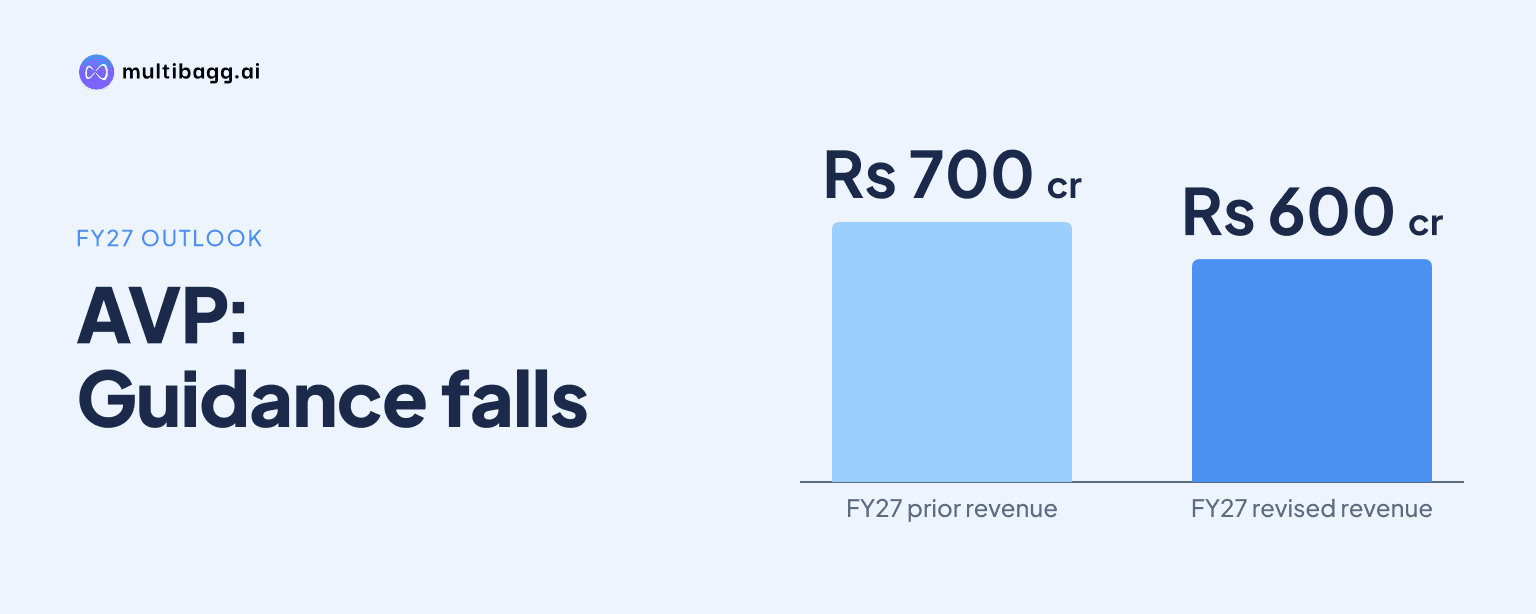
AVP Infracon cut its FY27 revenue guidance to Rs 600 crore from Rs 700 crore because approvals have delayed execution of about Rs 100 crore of ground-mounted solar orders. Management said the projects cannot start without guidelines on approvals, while an estimated eight-month turnkey execution period prevents full completion within the year.
Know AVP Infracon inside out
Results, valuation, peers and who's buying, in one view.
Why did AVP lower its FY27 revenue guidance?
AVP lowered its FY27 revenue target by Rs 100 crore because its ground-mounted solar work is awaiting approvals, rather than because management identified a shortfall in its infrastructure engineering, procurement and construction, or EPC, order book. Management said the new government had not issued guidelines covering how ground-mounted solar would proceed or how approvals would be processed, six months after it took office.
The company has identified land, customers are ready and the solar order book is about Rs 100 crore, according to management. AVP also said it had not accepted two or three additional solar opportunities because letters of acceptance, or LOAs, had not been received amid the approval uncertainty. Management said the issue affected all solar companies, not only AVP.
How much AVP solar work is awaiting approval?
About Rs 100 crore of AVP’s solar order book cannot currently be executed because ground-mounted projects remain on hold pending approvals. Management said the company has prepared the land and other project requirements, but it cannot begin work until the applicable guidelines and approval route are finalised.
The delay has a direct timing consequence: management said a solar turnkey project takes a solid eight months to complete even after work begins. Therefore, even if approvals arrive during FY27, AVP said it would not be able to complete the entire solar order book within the year. The revised Rs 600 crore target reflects that execution constraint.
Is AVP’s Rs 600 crore FY27 target conservative?
Management described the Rs 600 crore FY27 revenue target as “very conservative” and said it hoped to exceed it, but it did not raise formal guidance above that level. The stated approach was to avoid providing a higher number and subsequently cutting it, following the revision from the previous Rs 700 crore forecast.
Management linked its caution to the prior financial March, when it said it could not complete some planned work. It also said AVP had met what it committed for the first half, despite slow receivables and market conditions it associated with war. Those comments are management’s assessment, while the published target remains Rs 600 crore.
What does AVP’s wider order book say about execution?
AVP discussed an order book of approximately Rs 400 crore, of which about Rs 125 crore was from the Tamil Nadu state government and roughly Rs 225 crore from the National Highways Authority of India, or NHAI. The balance included private work, including Reliance and back-to-back arrangements, showing that the delayed Rs 100 crore solar work sits alongside road and other infrastructure contracts.
Most contracts other than state-government work include price variation or escalation mechanisms, according to management. Tamil Nadu state-government contracts also have escalation, but the amount is restricted to 5% of total project cost unless revised administrative sanction is obtained. AVP said contractors had applied for those sanctions and that the government had accepted the need to consider actual price variation amounts.
Got a follow-up? Ask IRIS
What are AVP’s plans for orders outside Tamil Nadu?
Management said AVP expects second-half order inflow of at least Rs 500 crore and up to Rs 1,000 crore, while acknowledging it bids conservatively outside Tamil Nadu. It said it does not plan to enter other state-government markets, but is pursuing NHAI and Ministry of Road Transport and Highways, or MoRTH, projects outside its home state.
For projects outside Tamil Nadu, AVP said it is bidding through joint ventures, or JVs, and is focusing on projects of at least Rs 300 crore to Rs 400 crore. Management said a Rs 50 crore or Rs 100 crore project in another state would not be viable because establishment and overhead costs could affect profit after tax, or PAT, margins. It said larger projects make those costs more absorbable.
Can AVP fund higher revenue if solar approvals arrive?
Management said AVP’s existing working-capital position could support revenue of Rs 800 crore and beyond, and that bank support could enable revenue of Rs 1,000 crore. It described working capital as somewhat stressed and said it was managing tightly, but added that the state-government payment cycle had improved after receivables were stuck for the first three or four months following the new government’s formation.
AVP allotted almost 44 lakh shares at 56 rupees each in October 2026, raising approximately Rs 25 crore, which management said would be deployed entirely in working capital. Management also said it was seeking higher supplier credit limits, discussing bank-limit enhancements and seeking consolidation with larger banks. It said an additional Rs 40 crore to Rs 50 crore of bank limits could help support the higher revenue scale.
Conclusion
AVP’s reduction to Rs 600 crore for FY27 is principally an execution-timing issue in solar: about Rs 100 crore of identified ground-mounted projects cannot begin until approvals are clarified, and each turnkey project takes about eight months. The core order book discussed on the call remained spread across approximately Rs 125 crore of Tamil Nadu government work, around Rs 225 crore of NHAI work and private contracts.
The next issue to watch is whether ground-mounted solar guidelines and approvals allow AVP to start the held projects and accept the two or three additional opportunities awaiting LOAs. Separately, management’s stated second-half order-inflow range of Rs 500 crore to Rs 1,000 crore, planned JV bids for Rs 300 crore to Rs 400 crore projects, and proposed bank-limit enhancements will indicate whether AVP can pursue revenue above its Rs 600 crore target.

