








AVP Infracon directs Rs 25 crore equity raise to working capital
MAX Plan at ₹4,999/yr

Find your next multibaggerBe a Pro Investor
Research stocks and track your picks on the go. Download the app.
Key highlights
- AVP Infracon plans to deploy the entire approximately Rs 25 crore October 2026 equity raise in working capital.
- Management said approximately Rs 25 crore of equity could support another Rs 100 crore of debt.
- AVP Infracon said available funding can support Rs 800 crore of revenue and bank support could enable Rs 1,000 crore.
- Management expects second-half order inflow between Rs 500 crore and Rs 1,000 crore.
powered by IRIS
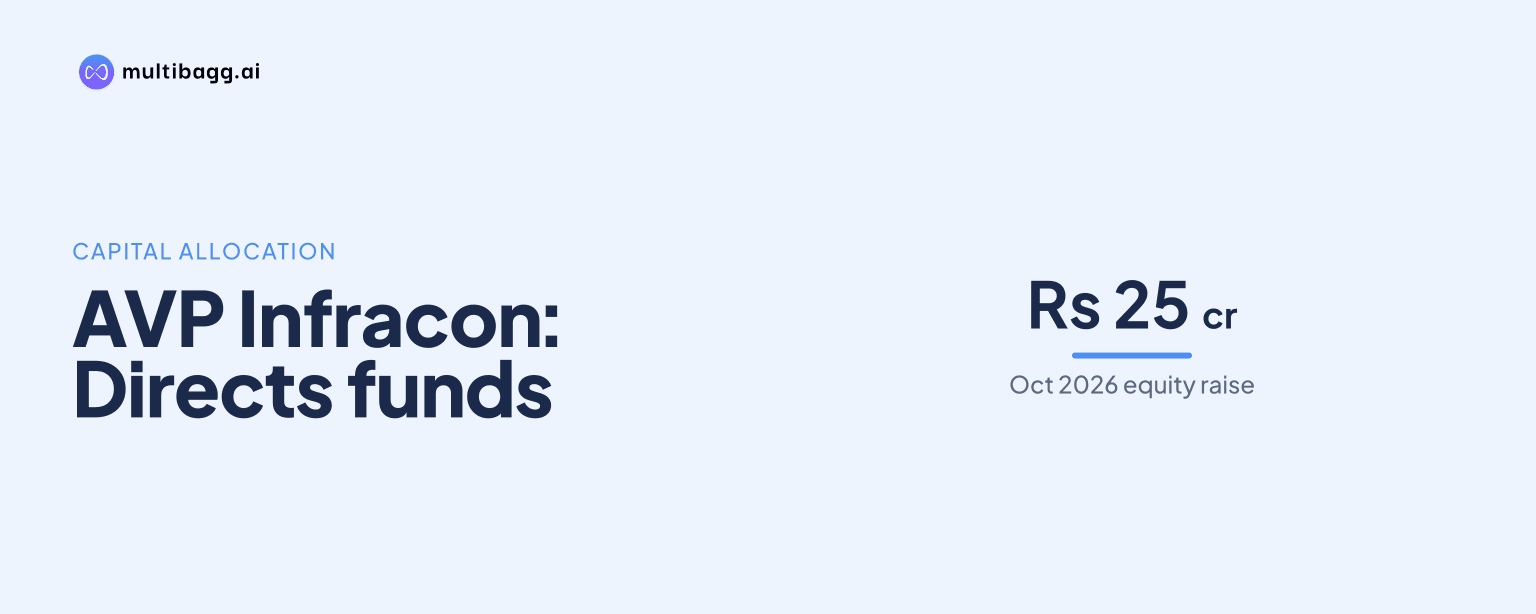
AVP Infracon plans to deploy the approximately Rs 25 crore raised in an October 2026 share allotment entirely in working capital, not debt repayment. Management said the equity could support a further Rs 100 crore of borrowing for project execution, while describing working-capital management as constrained despite phased releases of state-government payments.
Know AVP Infracon inside out
Results, valuation, peers and who's buying, in one view.
Where will AVP Infracon deploy its October 2026 equity proceeds?
AVP Infracon will deploy the entire approximately Rs 25 crore equity proceeds in working capital. Management gave that answer when asked whether the October 2026 funds would be used for working capital, debt reduction or business expansion, saying rising infrastructure activity requires more operating funding.
The allotment comprised almost 44 lakh shares at Rs 56 each, according to the investor’s question, and management confirmed that it raised approximately Rs 25 crore. Management also said the qualified institutional placement, or QIP, was undertaken to support its debt-equity ratio and help it seek higher working-capital limits.
Working capital is required because project execution can involve upfront materials purchases before collections arrive. An investor described government payments as generally taking around 90 days, and management said AVP Infracon was discussing higher credit limits with suppliers while also seeking additional support from banks.
Is AVP Infracon using the equity raise to reduce debt?
No, AVP Infracon said the approximately Rs 25 crore equity raise is not intended to reduce debt. Management said it chose equity for working-capital support instead of borrowing that Rs 25 crore directly, and estimated that the additional equity could allow it to take another Rs 100 crore of debt.
Management said finance costs would not change much from the equity structure itself. However, it said total debt would increase if it takes the further Rs 100 crore, with the intended result being higher revenue and earnings before interest, tax, depreciation and amortisation, or EBITDA.
That approach means the fundraise is designed to add borrowing capacity rather than lower outstanding borrowings. Management said it was seeking a consolidation arrangement with large banks and planned meetings with existing lenders after Diwali to pursue working-capital-limit enhancement.
How much revenue can AVP Infracon support with available funding?
AVP Infracon said its existing funding position can support revenue of Rs 800 crore and beyond. Management added that an extra Rs 40 crore to Rs 50 crore of bank limits, together with available limits, could make Rs 1,000 crore of revenue manageable.
The Rs 1,000 crore capacity is conditional rather than a reported result. When asked whether AVP Infracon could reach that revenue level with the same working capital and profit after tax, or PAT, margin, management said it could do so if it received bank support.
Management said banks had supported AVP Infracon and that it was eligible to seek higher working-capital limits, but it did not disclose sanctioned limits, current utilisation, total debt or approval dates. It also said funds should not be a problem if the planned banking support is obtained.
The company nevertheless described its present funding position as “a bit stressed” and said it was operating hand-to-mouth. Payments on state-government projects had been stuck in the first three to four months, management said, but were subsequently released in phases, shortening pressure on the working-capital cycle.
Got a follow-up? Ask IRIS
What is increasing AVP Infracon's working-capital requirement?
AVP Infracon's working-capital requirement is linked to its plan to execute larger infrastructure projects and potentially expand through joint ventures, or JVs. Management said projects outside Tamil Nadu need to be at least about Rs 300 crore to Rs 400 crore for establishment and overhead costs to be absorbable.
Management said projects worth Rs 50 crore or Rs 100 crore in other states would not be viable because overheads could affect PAT. AVP Infracon therefore said it was bidding conservatively outside Tamil Nadu and only through JVs for higher-value projects.
For these JVs, management described a structure in which AVP Infracon would hold 74% and the partner 26%. The partner would provide higher technical credentials, receive a small royalty, and AVP Infracon would carry out the engineering, procurement and construction, or EPC, work.
The planned funding base also corresponds with expected order activity. Management said second-half order inflow would be at least Rs 500 crore and could reach Rs 1,000 crore, while describing its Rs 600 crore revenue guidance as conservative. These are management expectations, not booked revenue or reported orders.
A separate Rs 100 crore solar order book remains on hold because approvals for ground-mounted solar projects have been delayed, management said. It said land, customers and orders were available, but a solar turnkey project takes about eight months to complete after approval, limiting execution in the current period.
How could additional debt affect AVP Infracon's margins?
AVP Infracon said it aims to maintain a PAT margin of about 10% as it grows, although management said margins could decline by a small amount if revenue moves beyond four figures. It attributed that possibility to a larger number of projects and related administrative requirements, rather than providing a formal margin forecast.
Management said additional debt would be used to increase revenue and EBITDA, which it expects could help absorb financing costs. It acknowledged that debt can create a slight dent in the bottom line, while saying it was working to offset that effect through project selection and funding structures.
One potential funding mechanism is an interest-free mobilisation advance on projects backed by institutions such as the Asian Development Bank or World Bank. Management said a Rs 100 crore project could provide a 10% to 15% advance, or Rs 10 crore to Rs 15 crore, but called such opportunities rare.
AVP Infracon also cited owned equipment as a factor in its cost structure. Management said it uses about 200 equipment units in infrastructure operations and estimated that ownership instead of rental can add at least 2 percentage points to PAT margin; it said utilisation is generally above 90%, subject to repairs and maintenance.
Conclusion
AVP Infracon's October 2026 allotment is a working-capital and borrowing-capacity measure, not a deleveraging plan. Management intends to use the approximately Rs 25 crore of equity to support project funding and potentially another Rs 100 crore of debt, while linking the additional borrowing to revenue and EBITDA growth.
The next points to watch are AVP Infracon's planned bank meetings after Diwali, the outcome of its request for enhanced limits, and progress toward its stated Rs 500 crore to Rs 1,000 crore second-half order-inflow range. Approval timing for the Rs 100 crore solar order book and the continued phased release of state-government payments will also affect how quickly the company can ease its stated working-capital pressure.

