










Awfis occupancy reaches 76.2% in Q2 FY27 as lock-ins hit 27 months
Key highlights
- Awfis blended occupancy reached 76.2% in Q2 FY27, up 230 basis points year on year.
- Awfis total seats rose 11.5% year on year to 164,000 in Q2 FY27.
- Awfis overall weighted average client lock-in increased by four months year on year to 27 months in September 2026.
- Awfis sold more than 25,000 seats in H1 FY27 and added approximately 12,000 gross seats.
powered by IRIS
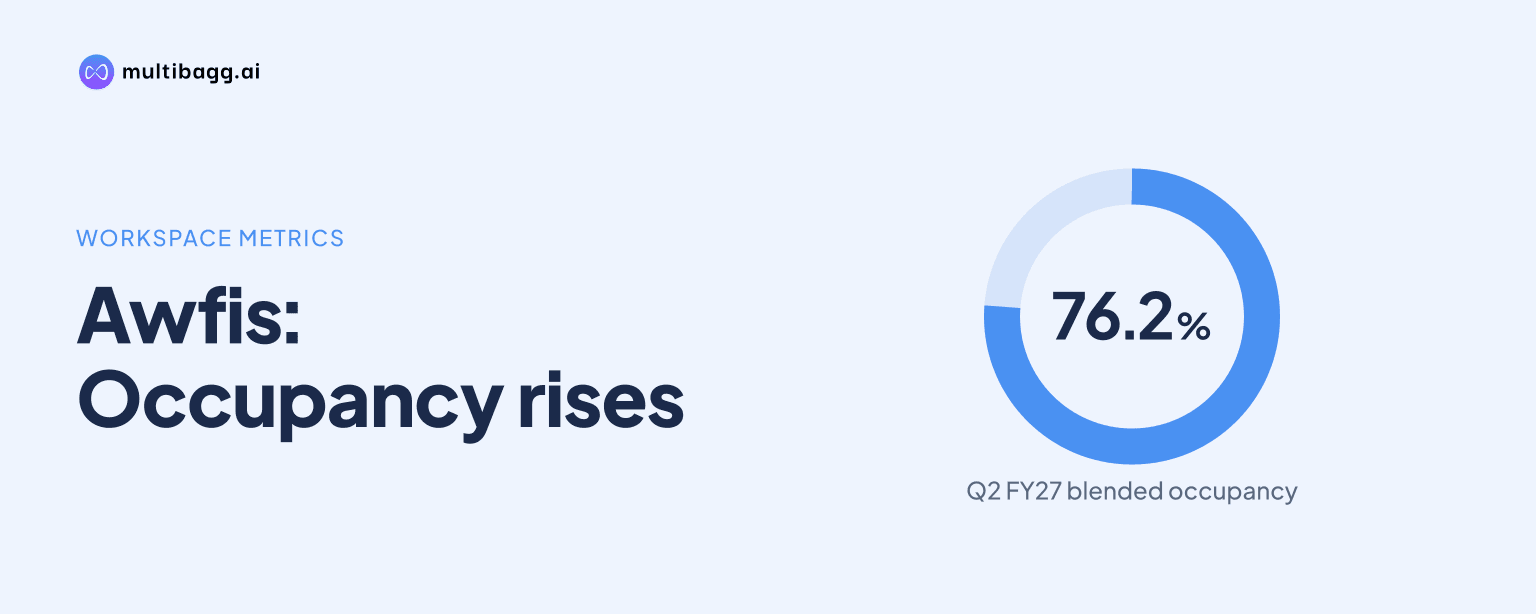
Awfis reached 76.2% blended occupancy in Q2 FY27, up 230 basis points year on year, while its overall weighted average client lock-in increased by four months to 27 months in September 2026. Total seats rose 11.5% year on year to 164,000, indicating higher utilisation alongside network expansion.
Know AWFIS Space Solutions inside out
Results, valuation, peers and who's buying, in one view.
How did Awfis occupancy change in Q2 FY27?
Awfis reported blended occupancy of 76.2% in Q2 FY27, compared with 73.9% in Q2 FY26 and 75.7% in Q1 FY27. The result was a 230-basis-point year-on-year increase and a 50-basis-point quarter-on-quarter increase. One basis point equals one-hundredth of a percentage point.
Occupancy at Awfis centres operating for more than 12 months was 84.1% in Q2 FY27, above the blended portfolio level. This mature-centre measure rose from 83.7% in Q2 FY26 and 83.3% in Q1 FY27, increasing 40 basis points year on year and 80 basis points sequentially.
The difference between mature-centre occupancy and blended occupancy was 7.9 percentage points in Q2 FY27. Awfis had 244 operational centres and more than 164,000 operational seats, while its total-supply measure also includes centres under fit-out, meaning recently added capacity can still be in its occupancy ramp-up period.
Did Awfis demand keep pace with seat additions?
Awfis total seats increased to 164,000 in Q2 FY27 from 147,000 in Q2 FY26 and 159,000 in Q1 FY27. That equated to net growth of 17,000 seats, or 11.5%, year on year, and 5,000 seats, or 3.1%, quarter on quarter, while blended occupancy also rose.
Awfis said it sold more than 25,000 seats in H1 FY27, against approximately 12,000 gross seats added during the same half-year. Seat sales and gross additions are different measures, but management said demand was building ahead of new capacity.
The company launched six centres and added about 7,000 gross seats in Q2 FY27. During H1 FY27, it launched 13 centres and added about 12,000 gross seats, while exiting approximately 2,200 seats across four centres in Q2 FY27.
Awfis had signed supply of 270 centres, 188,000 seats and 9.4 million square feet as of September 30, 2026. Its total supply, defined as operational and under-fit-out locations, was 254 centres, 174,000 seats and 8.7 million square feet, leaving signed locations beyond those two categories.
Why did Awfis client lock-ins become longer?
Awfis reported an overall weighted average total client tenure of 38 months in September 2026, up two months year on year. Its overall weighted average lock-in tenure was 27 months, up four months, following what management described as a year-long deliberate push for longer tenures and lock-ins.
For clients occupying more than 100 seats, total tenure was 49 months, two months higher year on year, while lock-in tenure was 33 months, up three months. Awfis said longer lock-ins translate into higher contracted revenue and steadier occupancy.
Awfis also reported that 77% of clients by tenure had relationships lasting at least 24 months in September 2026. A further 18% were in the 12-to-23-month range, while 3% were in the six-to-11-month group and 2% had tenures of five months or less.
Got a follow-up? Ask IRIS
Which client groups underpin Awfis occupancy?
Enterprise and multinational corporation clients accounted for 64% of Awfis client mix in September 2026. Small and medium enterprises accounted for 25%, start-ups represented 10%, and the remaining 1% was classified as others; management described enterprise and multinational clients as its revenue anchor because of larger ticket sizes and longer lock-ins.
Large accounts also represented a substantial share of seats. Clients with 500 or more seats accounted for 37% of Awfis seats, while those with 201 to 500 seats accounted for 17%, taking the two largest cohorts to 54% combined. Clients with 101 to 200 seats represented 11%.
Technology made up 39% of Awfis client distribution by industry in September 2026, followed by professional services at 20%, manufacturing at 13% and banking, financial services and insurance at 12%. Healthcare and life sciences accounted for 7%, while other industries contributed 9%; management said sectors it classifies as resilient represented more than 40%.
India-based clients represented 51% of the domicile mix, while North America represented 30% and Europe 14%. Awfis said its India base supports faster conversions and shorter ramp cycles, whereas North American and European headquarters, together at 44%, bring structured mandates, better tenures and realisations, and higher allied-service revenue.
What supply and premium mix will Awfis manage next?
Awfis said 57% of its centres were under the managed aggregation model as of September 30, 2026, with fit-out capital expenditure funded by landlords. Its partial managed-office model had approximately 50% enterprise pre-commitment, with the remaining capacity balanced by coworking demand, which management said supports faster occupancy and revenue visibility.
The company had 39 premium centres in Q2 FY27, comprising 29 Gold and 10 Elite sites. Premium seats rose 58% year on year to 33,111 from 20,928 in Q2 FY26, with Elite seats rising 111% to 13,010 and Gold seats rising 36% to 20,101.
Awfis said incremental premium seats were being signed at approximately 35% higher pricing than flagship products. The presentation did not disclose average realised prices, but management said the growing premium contribution was improving portfolio mix and increasing average seat realisations.
A signed Fortune 500 global capability centre deal in Chennai covers more than 1,000 full-time employees, with phase one scheduled to start in Q4 FY27. Awfis reported 105 or more global capability centre clients within its 50-plus-seat client base in Q2 FY27, which contributed 24% of rental revenue across nine Indian cities.
Conclusion
Awfis increased occupancy while expanding capacity in Q2 FY27: total seats rose 11.5% year on year to 164,000, blended occupancy reached 76.2%, and centres operating for more than 12 months reached 84.1%. The extension of overall lock-ins to 27 months and the 64% enterprise and multinational client mix provide the contractual and client-profile context for those operating figures.
The next measure to watch is the absorption of signed supply of 188,000 seats relative to 164,000 operational seats as of September 30, 2026. Management’s disclosed milestones include the Q4 FY27 phase-one start of the Chennai Fortune 500 global capability centre mandate and the pace of centre launches, seat additions and sales through the remaining FY27 period.