










Awfis premium seats rose 58% with 35% higher pricing for new signings
Key highlights
- Awfis Gold and Elite seats increased 58% year on year to 33,111 in Q2 FY27.
- Elite seats rose 111% to 13,010, while Gold seats increased 36% to 20,101.
- Awfis signed incremental premium seats at about 35% higher pricing than flagship products.
- Premium centres increased by 13 to 39, comprising 29 Gold and 10 Elite centres.
powered by IRIS
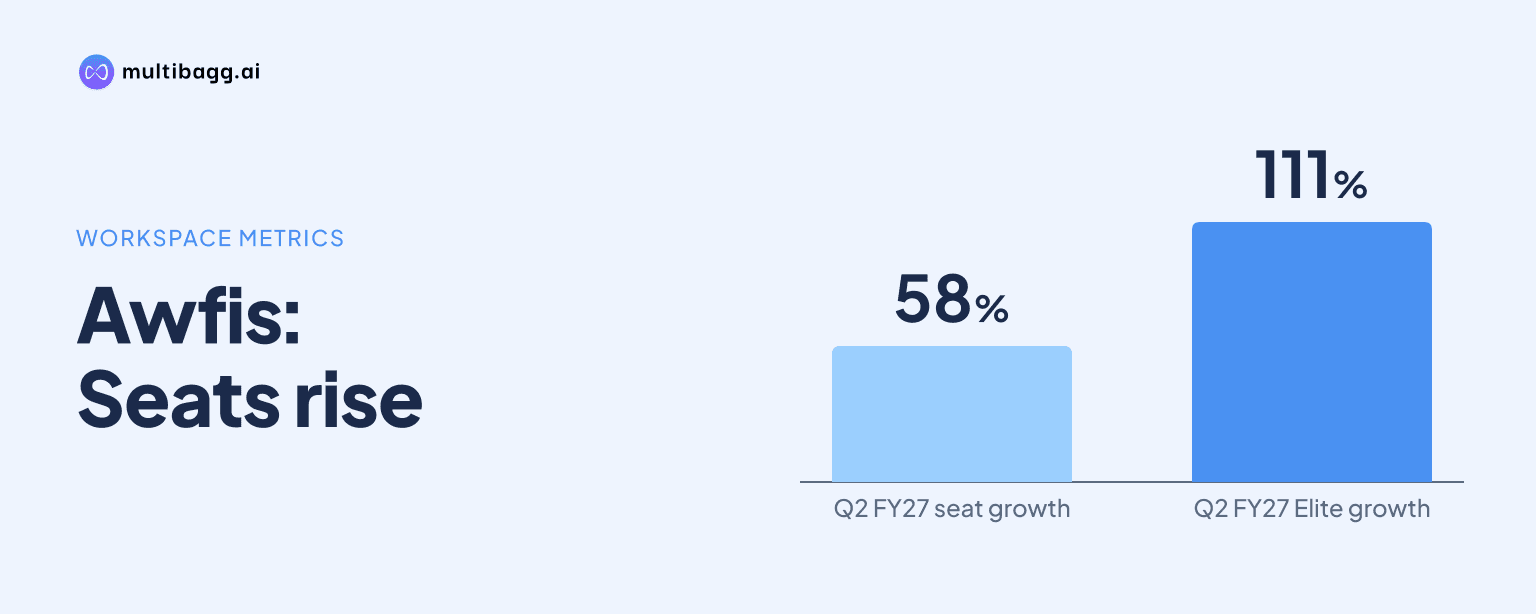
Awfis increased its Gold and Elite premium-seat portfolio by 58% year on year to 33,111 seats in Q2 FY27, while incremental premium seats were signed at about 35% higher pricing than flagship products. The portfolio added 13 centres over the year, with Elite seats rising 111% to 13,010.
Know AWFIS Space Solutions inside out
Results, valuation, peers and who's buying, in one view.
How much did Awfis's premium portfolio grow?
Awfis's premium portfolio grew by 12,183 seats, or 58% year on year, from 20,928 seats in Q2 FY26 to 33,111 seats in Q2 FY27. The portfolio comprised Gold and Elite formats across 39 premium centres as of September 30, 2026. The 58% seat increase was faster than the 50% rise in premium-centre count, from 26 to 39 centres.
Gold remained the larger premium format, with 20,101 seats in Q2 FY27, up 36% from 14,753 a year earlier. Elite grew faster, rising 111% from 6,175 seats to 13,010 seats. Elite therefore accounted for 6,835 of the 12,183 premium seats added over the year, despite beginning Q2 FY26 with fewer than half of Gold's 14,753-seat base.
The differing growth rates changed the mix of the 33,111-seat premium portfolio. Gold accounted for 14,753 of 20,928 seats in Q2 FY26 and 20,101 of 33,111 seats in Q2 FY27, while Elite grew from 6,175 to 13,010 seats. The presentation identifies Gold and Elite as the two premium formats but does not provide separate occupancy, revenue or margin data for either one.
What changed in Awfis's Gold and Elite centre network?
Awfis expanded its premium-centre network by 13 centres, or 50%, from 26 in Q2 FY26 to 39 in Q2 FY27. Gold centres increased by eight to 29, representing 38% growth, while Elite centres doubled from five to 10. The Q2 FY27 network therefore contained 29 Gold centres with 20,101 seats and 10 Elite centres with 13,010 seats.
The reported capacity was larger per Elite centre than per Gold centre in Q2 FY27. Elite had 13,010 seats across 10 centres, compared with 20,101 seats across 29 Gold centres. Awfis does not disclose individual centre locations, seat occupancy, revenue or the size of each centre, so this comparison describes reported portfolio capacity rather than centre-level financial performance.
The premium expansion took place within a wider supply pipeline as of September 30, 2026. Awfis reported 270 signed centres and 188,000 signed seats, including operational locations, sites under fit-out and centres with signed letters of intent. Total supply, which excludes centres with signed letters of intent, was 254 centres and 174,000 seats, while operational capacity was 244 centres and more than 164,000 seats.
Got a follow-up? Ask IRIS
Why are Awfis's new premium seats priced higher?
Awfis said incremental premium seats were being signed at about 35% higher pricing than its flagship products, citing enterprise demand for Grade A+ locations, elevated design and hospitality-led services. This is a comparison for newly signed premium seats, not a disclosure of an absolute price per seat or a company-wide increase in prices.
Management said growing premium offerings were improving portfolio mix and driving higher average seat realisations. The disclosed mechanism is mix: a greater contribution from Gold and Elite seats signed at higher relative prices can raise average realisations. Awfis did not quantify the premium formats' revenue contribution, their average realised price, or the resulting change in consolidated average seat realisation.
Awfis also said 100% of new supply was in Grade A or Grade A+ assets in high-demand micro-markets. Separately, 57% of centres were under management agreements, where landlords funded fit-out capital expenditure. The presentation does not state how many Gold or Elite centres use management agreements, or the fit-out cost for a premium seat.
How does premiumisation compare with Awfis's overall growth?
Awfis's premium-seat portfolio grew 58% year on year to 33,111 seats in Q2 FY27, compared with 11.5% growth in total seats to 164,000. Total seats increased by 17,000 from 147,000 in Q2 FY26, while premium capacity rose by 12,183 seats from 20,928. The premium formats therefore expanded faster than the overall seat base during the reported year.
Blended occupancy reached 76.2% in Q2 FY27, up from 73.9% in Q2 FY26 and 75.7% in Q1 FY27. That was a 230-basis-point year-on-year increase and a 50-basis-point quarter-on-quarter increase, where one basis point equals one-hundredth of a percentage point. Centres operating for more than 12 months had occupancy of 84.1%, compared with 83.7% in Q2 FY26.
Awfis reported selling more than 25,000 seats in H1 FY27, though it did not split those sales between premium and flagship formats. Enterprise and multinational clients represented 64% of client mix as of September 2026, while technology accounted for 39% of clients by industry. These portfolio-wide measures provide demand context but do not establish Gold or Elite-specific occupancy or sales performance.
Conclusion
Awfis's disclosure shows a shift toward premium workspace capacity, with Gold and Elite seats increasing by 12,183 to 33,111 in Q2 FY27 and Elite growing 111%, faster than Gold's 36% increase. Management links the approximately 35% higher pricing on incremental premium signings to Grade A+ locations, design and hospitality-led services, but has not disclosed premium-format revenue, margins, occupancy or retention.
The next point to watch is the conversion of Awfis's 188,000 signed seats into its more immediate 174,000-seat total supply and more than 164,000-seat operational capacity, as reported on September 30, 2026. It will also be relevant whether premium seats continue to outpace overall seat growth while the portfolio maintains or improves on Q2 FY27 blended occupancy of 76.2%.