










AWL targets nearly Rs 2,600 crore EBITDA on FY27 revenue
Key highlights
- AWL expects FY27 revenue close to Rs 85,000 crore and EBITDA close to Rs 2,600 crore.
- H1 FY27 normalized operating EBITDA rose 25% year on year to Rs 1,378 crore on revenue of Rs 42,250 crore.
- Food and FMCG revenue increased 32% year on year to Rs 2,216 crore in Q2 FY27, with a 3.2% EBITDA margin.
- AWL said inventory rose by Rs 6,000 crore because of sunflower supply disruption and sluggish September demand.
powered by IRIS
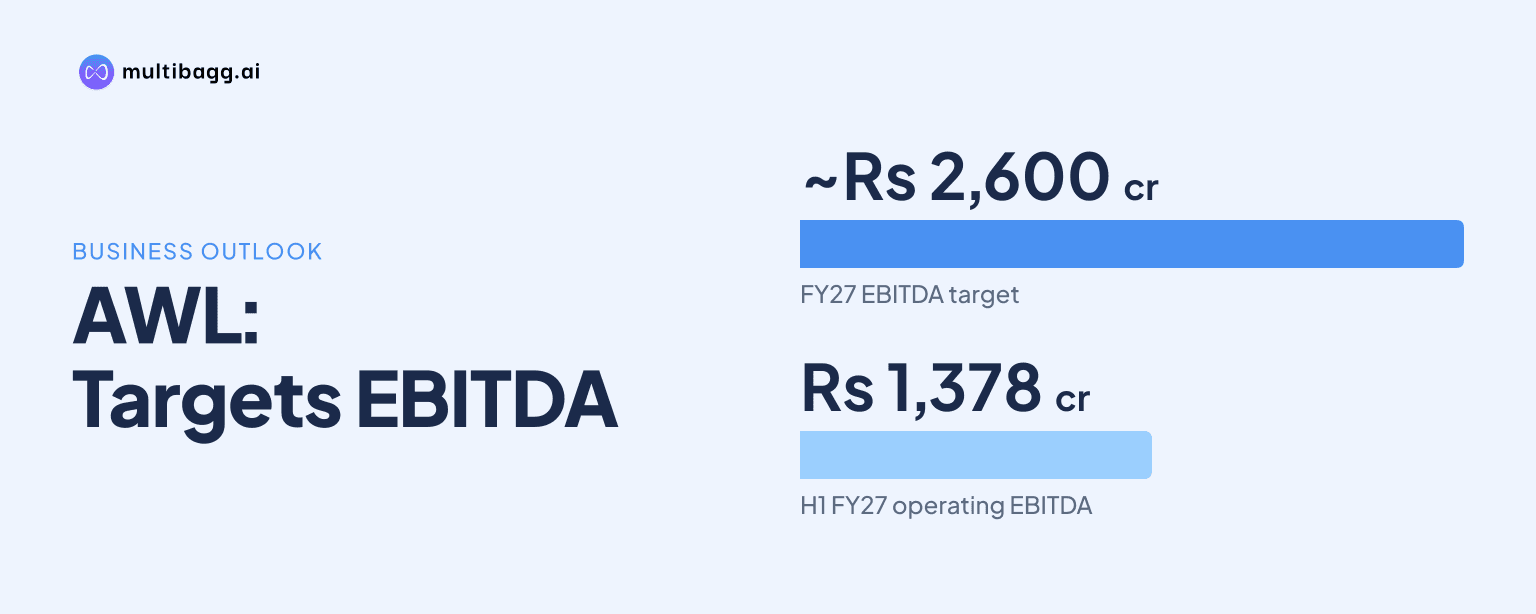
AWL Agri Business Limited said it could finish FY27 with revenue close to Rs 85,000 crore and earnings before interest, tax, depreciation and amortisation, or EBITDA, near Rs 2,600 crore, implying a margin close to 3%. The outlook follows H1 FY27 normalized operating EBITDA of Rs 1,378 crore on revenue of Rs 42,250 crore.
Know AWL Agri Business inside out
Results, valuation, peers and who's buying, in one view.
What is AWL's FY27 revenue and EBITDA outlook?
AWL expects revenue close to Rs 85,000 crore and EBITDA close to Rs 2,600 crore in FY27 if its current revenue run rate continues. Managing Director and Chief Executive Officer Shrikant Kanhere gave the estimate in response to a question on edible-oil profitability and clarified that it applied to the overall company, rather than to the edible-oils segment alone.
Management said the indicated full-year EBITDA margin would be close to 3%, compared with a current company-level margin of 2.6%. AWL evaluates edible-oil profitability mainly in EBITDA per metric ton, while it uses percentage margins for food and fast-moving consumer goods, or FMCG. The company therefore did not provide a single percentage-margin target for each business segment.
The outlook is based on momentum in H1 FY27, when consolidated revenue rose 22% year on year to Rs 42,250 crore and underlying volume grew 11%. In Q2 FY27, revenue rose 26% to Rs 22,202 crore and volume increased 14%, placing quarterly revenue above the average needed in the second half to approach the Rs 85,000 crore full-year figure.
How does AWL's outlook compare with its first-half results?
AWL would need about Rs 1,222 crore of EBITDA in H2 FY27 to reach nearly Rs 2,600 crore for the full year, based on its reported H1 FY27 normalized operating EBITDA of Rs 1,378 crore. That arithmetic is below the first-half EBITDA level, although management did not give separate Q3 or Q4 EBITDA guidance.
Q2 FY27 normalized operating EBITDA increased 11% year on year, below the quarter's 26% revenue growth, while H1 EBITDA rose 25%, ahead of H1 revenue growth of 22%. AWL said mark-to-market gains and losses can move between quarters because results are reported at fixed quarterly or half-year cut-off dates, making longer multi-quarter comparisons more representative, in management's view.
AWL calculates normalized gross profit and normalized EBITDA after including commodity-derivative gains and losses used to hedge raw-material exposures. Under Indian Accounting Standards, those gains and losses are classified in other income or other expenses, but AWL said they form part of underlying operating profitability. This treatment is relevant when comparing the Rs 623 crore Q2 normalized EBITDA with management's full-year EBITDA indication.
Got a follow-up? Ask IRIS
Which businesses are expected to support AWL's FY27 earnings?
Food and FMCG is expected to provide growth while operating within its FY27 EBITDA-margin range of 3% to 4%. The segment's Q2 FY27 revenue rose 32% year on year to Rs 2,216 crore and its EBITDA margin was 3.2%. Management said operating leverage, product mix and distribution efficiency should support profitability as its packaged-food portfolio expands.
Within food, Fortune pulses grew more than 40% year on year and exceeded Rs 100 crore in Q2 revenue. AWL said its health and convenience portfolio generated more than Rs 1,400 crore of revenue over the last 12 months, while its hotels, restaurants and catering business generated more than Rs 800 crore over the same period after growing 22%.
Edible oils recorded Q2 FY27 volume growth of 5% and EBITDA of about Rs 4,100 per metric ton. That result was within AWL's stated range of Rs 4,000 to Rs 4,500 per metric ton. Management reiterated its expectation of mid-single-digit volume growth, gradual market-share improvement and EBITDA within that range for the segment during FY27.
Industry Essentials reported EBITDA of Rs 4,300 per metric ton in Q2 FY27, above management's operating range of Rs 3,000 to Rs 3,500 per metric ton. Oleochemicals and specialty chemicals represented about 45% of segment revenue. However, management said the segment's 26% growth was not sustainable because sales of de-oiled mustard and soybean cakes depend on parity conditions; it expects high-single-digit to low-double-digit growth in H2.
What may affect AWL's second-half FY27 delivery?
AWL expects full-year volume growth of about 8% to 9%, compared with 11% in H1 FY27, as management sees some risk to rural demand. Management said urban growth exceeded rural growth in Q2 and H1, though not by a large margin. It cited a nationwide rainfall deficit of 12% to 13%, with deficits above 30% in some territories, as a potential factor affecting Kharif harvests and Rabi sowing.
Management also identified headline consumer-price inflation near 6% and food inflation of about 7% to 7.5% as possible constraints on demand. It said the festive period could offset some of that pressure and that it hoped to maintain mid-single-digit to high-single-digit volume growth in H2. These are management assessments rather than a revision to the revenue or EBITDA outlook.
Working capital is another variable. AWL said inventory increased by Rs 6,000 crore, rather than Rs 600 crore, after sluggish September demand and additional sunflower inventory held amid supply-chain disruption. The inventory was funded through working-capital lines, contributing to negative H1 operating cash flow and higher finance costs, which management said it could largely recover through pricing.
AWL expects inventory to normalize on an annualized basis during the upcoming OND period. Management said the September implementation of standardized pack sizes should support branded companies by reducing grammage-based price competition. It also said the edible-oil import-duty reduction may have some effect but should not materially affect profitability because of AWL's brand and pricing position.
Conclusion
AWL's indication of nearly Rs 2,600 crore of FY27 EBITDA on revenue close to Rs 85,000 crore points to a company-level margin near 3%. H1 FY27 delivered Rs 1,378 crore of normalized operating EBITDA, while food and FMCG revenue grew 32% in Q2 and Industry Essentials generated Rs 4,300 of EBITDA per metric ton.
The next indicators are whether AWL delivers its planned 8% to 9% full-year volume growth and reduces the Rs 6,000 crore inventory build during the upcoming OND period. Management's outlook also depends on rural demand, crop effects from rainfall deficits, food inflation and food and FMCG margins remaining within the FY27 range of 3% to 4%.