










AWL says Industry Essentials growth should normalize to 10%-11%
Key highlights
- AWL said Industry Essentials’ 26% Q2 FY27 growth was a one-off and expects about 10%-11% growth in coming quarters.
- Industry Essentials EBITDA was Rs 4,300 per metric ton in Q2 FY27, above AWL’s Rs 3,000 to Rs 3,500 guidance range.
- Oleochemicals and specialty chemicals contributed about 45% of Industry Essentials revenue in Q2 FY27.
- AWL reported Q2 FY27 consolidated revenue of Rs 22,202 crore, up 26%, with underlying volume growth of 14%.
powered by IRIS
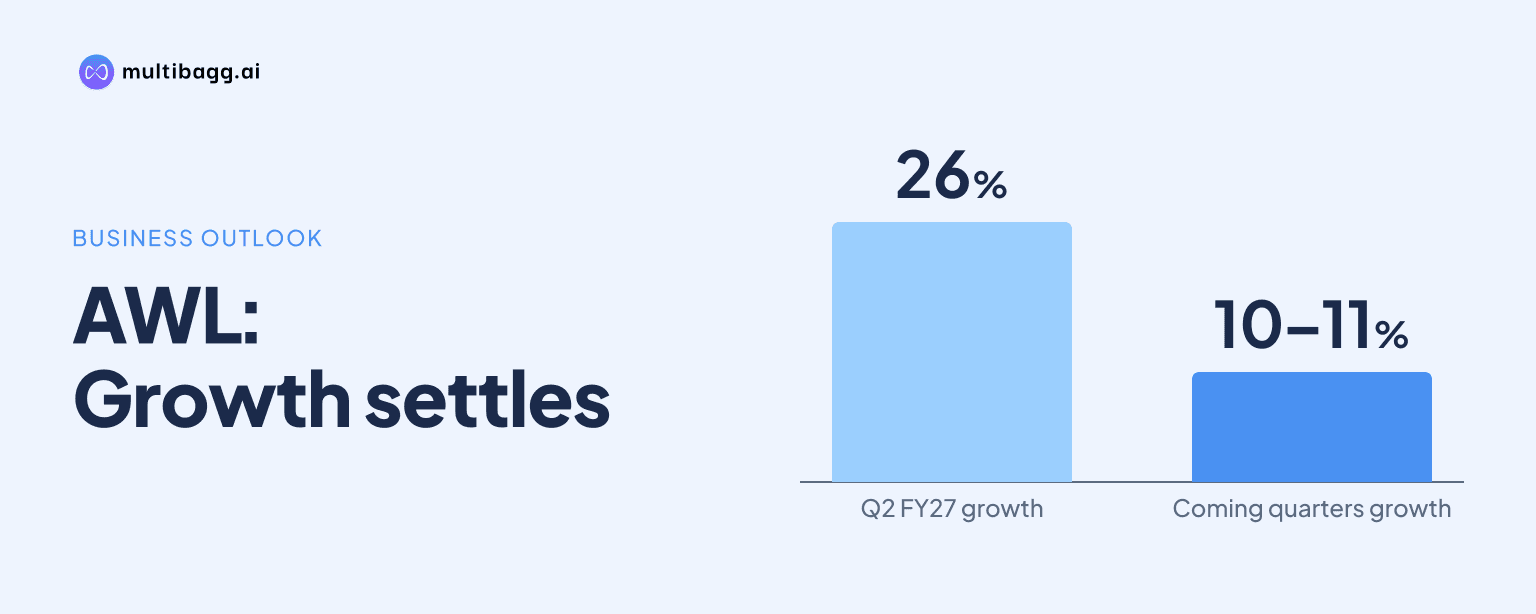
AWL Agri Business Limited said Industry Essentials’ 26% growth in Q2 FY27 was a one-off caused by favourable mustard and soybean de-oiled-cake parity, and management expects growth of about 10%-11% in coming quarters instead. The segment reported 25% volume growth and EBITDA of Rs 4,300 per metric ton in the quarter.
Know AWL Agri Business inside out
Results, valuation, peers and who's buying, in one view.
What did AWL say about Industry Essentials growth?
AWL said the 26% growth in Industry Essentials during Q2 FY27 is not sustainable. Managing Director and Chief Executive Officer Shrikant Kanhere said the company’s normal expectation for the segment remains high-single-digit to low-double-digit growth, which it expects to continue in H2 FY27. He specified a likely rate of about 10%-11% for coming quarters.
The expected 10%-11% pace is materially below Q2 FY27’s 26% growth rate because the exceptional condition occurred in one quarter rather than throughout the year. Management said full-year blended growth should therefore not be assessed against 26%. This is management’s outlook for the segment, rather than a separately disclosed numerical revenue target.
Why did Industry Essentials grow 26% in Q2 FY27?
AWL attributed the unusually high growth rate to temporary parity in mustard and soybean de-oiled cakes, also called DOC. Management said Industry Essentials has three parts: oleochemicals, castor, and DOC from mustard and soybean. Activity in DOC depends on whether favourable parity is available, making the business dynamic from quarter to quarter.
Management said the required parity was available in Q2 FY27, allowing AWL to undertake DOC activity and lifting underlying segment growth to 26%. It also said the company does not undertake this activity when parity is unavailable. That mechanism is why management described the Q2 FY27 result as a one-off rather than a new underlying growth rate.
Industry Essentials also delivered 25% volume growth in Q2 FY27, compared with a 5% volume increase in AWL’s edible-oils business. The comparison indicates that conditions affecting Industry Essentials were different from those in the group’s larger commodity-linked oil business. AWL did not disclose separate revenue or volume figures for DOC, castor and oleochemicals.
How is AWL changing the Industry Essentials product mix?
AWL said oleochemicals and specialty chemicals contributed about 45% of Industry Essentials revenue in Q2 FY27. Management identified these value-added products as a support for segment profitability, distinct from the DOC parity that contributed to the quarter’s elevated growth rate.
Industry Essentials generated EBITDA of Rs 4,300 per metric ton in Q2 FY27, above management’s guidance range of Rs 3,000 to Rs 3,500 per metric ton. Management attributed the higher profitability to improved product mix and the rising contribution from oleochemicals and specialty chemicals. It did not attribute the entire margin outcome to DOC parity.
AWL’s stated plan is to expand its specialty-chemicals portfolio through backward integration, manufacturing scale, and Wilmar Group research and development and formulation capabilities. Management said an increasing contribution from oleochemicals and specialty chemicals should support Industry Essentials profitability while it works towards its guided operating parameters. No separate margin target for these businesses was disclosed.
Got a follow-up? Ask IRIS
How did AWL perform in Q2 FY27 and H1 FY27?
AWL reported consolidated Q2 FY27 revenue of Rs 22,202 crore, up 26% year on year, supported by 14% underlying volume growth. Normalised operating EBITDA increased 11% to Rs 623 crore. AWL said its normalised profitability measure includes gains and losses on commodity derivatives used to hedge raw-material exposures.
Quarterly profit before tax rose 4% year on year to Rs 344 crore, while profit after tax fell 2% to Rs 239 crore. Management said the profit-after-tax decline primarily reflected minimum corporate tax calculated on the Bangladesh subsidiary’s revenue under local regulations. Revenue growth therefore did not translate proportionately into profit after tax during Q2 FY27.
For H1 FY27, revenue rose 22% to Rs 42,250 crore and underlying volume grew 11%. Normalised operating EBITDA increased 25% to Rs 1,378 crore, while profit before tax rose 27% to Rs 822 crore and profit after tax increased 22% to Rs 591 crore. Management said mark-to-market gains and losses can move between quarters, making longer reporting periods more representative of performance.
Food and fast-moving consumer goods revenue grew 32% year on year to Rs 2,216 crore in Q2 FY27, with an EBITDA margin of 3.2%. In contrast, edible-oils volume rose 5% and Industry Essentials volume grew 25%. The differences show that AWL’s reported group revenue growth of 26% was supported by businesses with different volume and profitability drivers.
What could affect AWL’s H2 FY27 growth?
AWL expects overall company volume growth in H2 FY27 to be in the mid- to high-single digits after delivering 11% volume growth in H1 FY27. Management said full-year volume growth could be about 8%-9%. For Industry Essentials, the availability of mustard and soybean DOC parity remains a key variable because it drove the 26% Q2 FY27 outcome.
Management also cited rural demand and agricultural conditions as uncertainties. It said urban growth exceeded rural growth in Q2 and H1, although the gap was not large. It referred to an overall rainfall deficit of 12%-13%, deficits exceeding 30% in some territories, and food inflation of about 7%-7.5% as factors that could slow demand if they persist.
AWL said inventories increased by Rs 6,000 crore after a sluggish September and additional sunflower inventory built amid supply-chain disruption. The inventory was funded through working-capital lines and contributed to negative operating cash flow in H1 FY27. Management expects inventory levels to normalise in the October-November-December quarter and said higher finance costs are generally recovered through pricing.
Conclusion
AWL’s central message is that Industry Essentials’ 26% Q2 FY27 growth was exceptional because of temporary mustard and soybean DOC parity. Management instead expects about 10%-11% growth in coming quarters, while oleochemicals and specialty chemicals, which made up about 45% of segment revenue, are intended to provide a more durable profitability contribution.
The next disclosures to watch are whether H2 FY27 Industry Essentials growth returns to the high-single-digit to low-double-digit range, whether DOC parity remains available, and whether the Rs 6,000 crore inventory build declines in the October-November-December quarter. Management also expects full-year company volume growth of about 8%-9% after H1 FY27 growth of 11%.