










AWL Plans Tops East, Central Push After 25%-Plus North Growth
Key highlights
- AWL said GD Foods has grown by more than 25% while maintaining acquisition-era margins.
- AWL is targeting eastern and central India for Tops over the next one to one-and-a-half years.
- AWL’s food business recorded 32% growth in the quarter and 27% revenue growth in the first half.
- General trade accounts for 75% of AWL food and FMCG sales, while alternate channels contribute 25%.
powered by IRIS
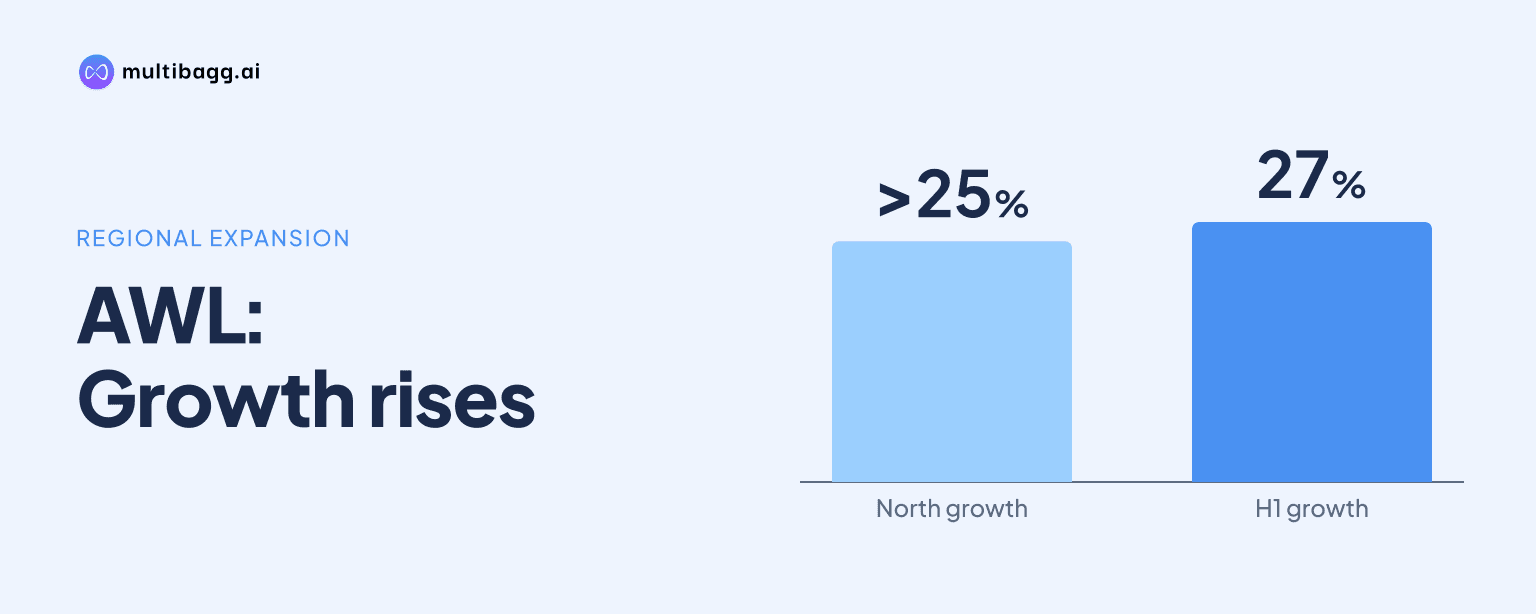
AWL plans to take Tops into eastern and central India over the next one to one-and-a-half years, after management said the acquired GD Foods business grew by more than 25% in its northern base and maintained its acquisition-era margins during the integration. North India will remain a priority before a later move west or south.
Know AWL Agri Business inside out
Results, valuation, peers and who's buying, in one view.
Where will AWL expand Tops after North India?
AWL will target eastern and central India for Tops over the next one to one-and-a-half years, while continuing to expand the brand in North India. Management said work has started on the two new territories after AWL first used its existing northern distribution network to strengthen GD Foods, which owns the Tops brand.
The rollout is phased rather than nationwide. AWL said GD Foods was predominantly present in North India when it was acquired more than a year ago, and AWL was already strong in that region. Management therefore chose to build the acquired brand further through AWL’s northern network before extending distribution into other markets.
North India remains an active part of the plan, not merely the starting point. Management said the region is still not fully covered and has substantial remaining scope for Tops. The eastern and central markets will be added alongside this continuing northern work, rather than replacing the original distribution focus.
AWL has placed western and southern India later in the sequence. Management said it may consider those regions only after operations in eastern and central India have stabilised. The disclosed plan therefore has three stages: further northern penetration, entry into east and central India, and potential consideration of west and south after the intervening markets are established.
What has AWL achieved with GD Foods so far?
AWL said GD Foods has delivered growth of more than 25% and retained the margins that existed at the time of acquisition. Management made that assessment more than a year after AWL acquired the business and said its use of AWL’s distribution infrastructure in North India had generated significantly good growth.
The margin disclosure is limited in scope but relevant to the expansion plan. AWL did not provide a separate revenue number, operating-profit figure or margin percentage for GD Foods. It said only that the business had grown by more than 25% while maintaining the margins in place when AWL bought it.
The acquired brand is being developed within a wider food-growth strategy. Management said AWL’s food business grew 32% in the quarter discussed on the call. In the first half, food volume grew 24% and food revenue rose 27%, indicating that revenue growth was 3 percentage points higher than volume growth during that period.
Management said food revenue growth of 25%-plus should continue and described food as a double-digit-growth business. GD Foods’ more-than-25% growth is therefore broadly aligned with the growth level management expects from AWL’s wider food operation, though the company did not disclose Tops’ contribution to food revenue or its share of the acquired business.
Got a follow-up? Ask IRIS
Which sales channels are supporting AWL’s food expansion?
AWL said general trade contributes 75% of food and fast-moving consumer goods (FMCG) sales, while alternate channels account for 25%. Management said alternate channels are expanding faster than general trade, even though general trade is also growing, and identified modern trade, e-commerce and quick-commerce as relevant outlets for packaged food.
The 75%-25% split applies to AWL’s overall food and FMCG business, not specifically to Tops or GD Foods. Management did not disclose a channel mix for the acquired brand. That distinction matters because the east and central India plan is a Tops distribution strategy, whereas the stated sales-channel figures cover the broader food and FMCG portfolio.
AWL said it is investing heavily in modern trade, e-commerce and quick-commerce because packaged food is prevalent in these channels. It is also investing in urban towns, where management said such products are purchased more. Those investments are the channel mechanisms AWL cited for supporting food growth as it broadens Tops beyond its established northern market.
Profitability is currently more or less similar between general trade and alternate channels, according to management. AWL said alternate channels can be more profitable, but spending on promotions, schemes, searches and fill rates reduces the difference. Faster alternate-channel growth therefore does not, on management’s description, translate directly into a higher current channel-profit outcome.
What does AWL’s broader structure mean for the expansion?
AWL said it has no plan to demerge its industry essentials or oleochemicals business. Management described oleochemicals as a significant part of the company and a forward integration of palm refining, particularly within the palm value chain. The statement indicates that the Tops expansion is being pursued within AWL’s existing integrated portfolio rather than through a separation of its other operations.
Management also clarified its treatment of Rs 8,500 crore of trade credit used for imports. AWL said the amount should not be included in net debt because it is supplier credit through non-funded working-capital facilities, principally letters of credit. Funds become committed when AWL makes payment, rather than when the letter of credit is issued.
The Rs 8,500 crore clarification did not include AWL’s reported net-debt figure or a dedicated funding plan for the east and central India rollout. It does, however, distinguish management’s view of non-funded import trade credit from fund-based borrowing. No separate investment amount, distribution cost or profitability target was disclosed for Tops’ planned entry into the two territories.
Management also discussed commodity conditions relevant to the food portfolio. It said palm oil could face near-term price bullishness linked to El Nino-related production concerns in Indonesia, although it did not expect a very high increase based on the market commentary it cited. On wheat, management said prices were rising but declined to forecast production or pricing before rabi sowing and soil-moisture data were clearer.
Conclusion
AWL’s disclosed Tops strategy is to extend a GD Foods business growing at more than 25% from its northern base into eastern and central India, while maintaining the margins management says were present at acquisition. The approach links brand expansion to AWL’s existing distribution, a food business that recorded 32% quarterly growth, and alternate channels that account for 25% of food and FMCG sales.
The next point to watch is progress in the eastern and central territories during the stated one to one-and-a-half-year window, including whether management provides separate sales or margin disclosures for Tops. AWL has also said North India remains incomplete, while any move into western and southern India depends on the new markets first becoming stabilised.