










AWL says Rs 6,000 crore inventory build will normalise soon
Key highlights
- AWL said inventories rose by Rs 6,000 crore in H1 FY27, rather than Rs 600 crore.
- AWL expects the sunflower-related inventory build to normalise during the October-December quarter.
- Q2 FY27 consolidated revenue grew 26% year on year to Rs 22,202 crore, while normalized operating EBITDA rose 11% to Rs 623 crore.
- AWL reported H1 FY27 underlying volume growth of 11% and expects about 8% to 9% growth for the full year.
powered by IRIS
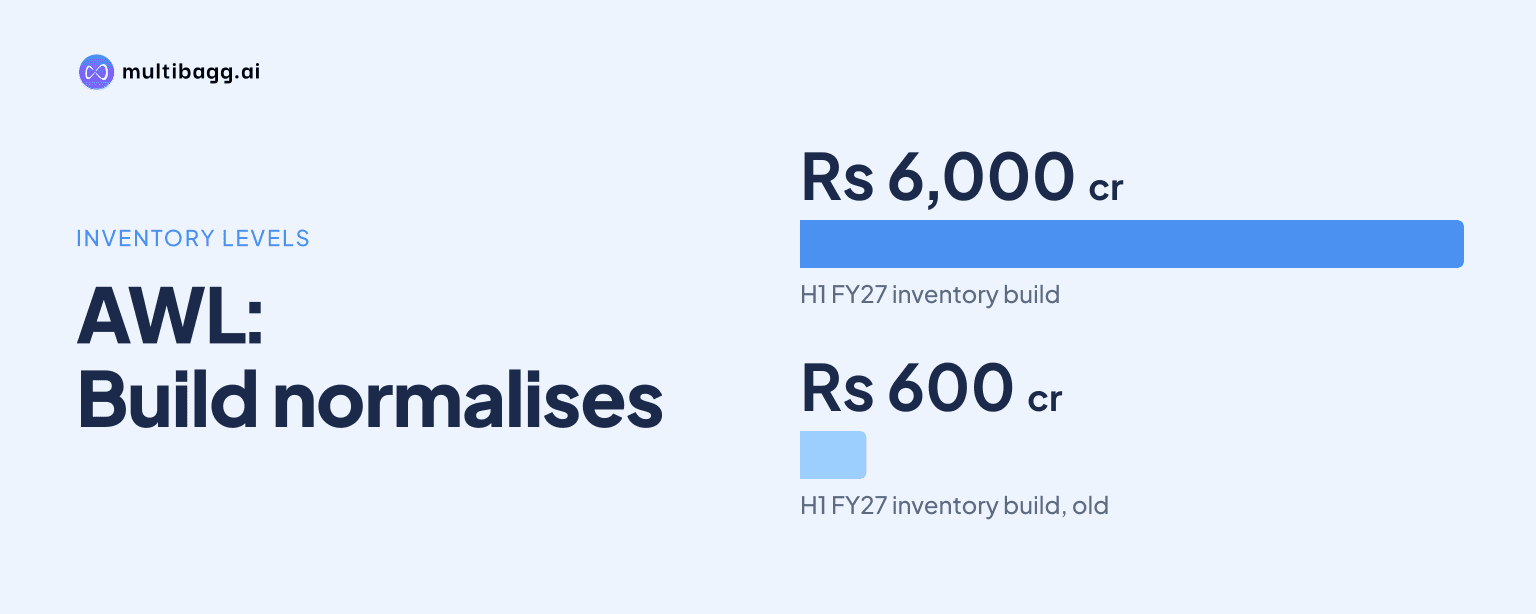
AWL Agri Business Limited says the Rs 6,000 crore inventory build that made first-half FY27 operating cash flow negative should normalise during the October-December quarter, after sunflower supply-chain disruption and a sluggish September increased stock. Management said working-capital lines funded the additional inventory and raised finance costs.
Know AWL Agri Business inside out
Results, valuation, peers and who's buying, in one view.
Why did AWL build Rs 6,000 crore of inventory?
AWL built additional inventory because sunflower supply chains were disrupted and it wanted to avoid running out of the category, where management said it has a strong brand position. A sluggish September was the other reason cited for the increase. Management corrected an analyst's reference to Rs 600 crore, saying inventories had instead risen by Rs 6,000 crore.
The decision came in Q2 FY27, when the edible-oils business delivered 5% volume growth despite what management called a challenging operating environment. AWL said it maintained market share through domestic oils, particularly mustard, groundnut and cottonseed oil. Management presented the larger sunflower position as a product-availability measure rather than a change in its edible-oil operating approach.
AWL's consolidated revenue increased 26% year on year to Rs 22,202 crore in Q2 FY27, with underlying volume growth of 14%. Normalized operating earnings before interest, tax, depreciation and amortisation, or EBITDA, rose 11% to Rs 623 crore. The company did not disclose sunflower inventory volumes, the cost of the stock, or sunflower's share of the Rs 6,000 crore inventory rise.
How did AWL fund the additional inventory?
AWL funded the Rs 6,000 crore inventory build through working-capital lines, which management said caused negative operating cash flow in H1 FY27. It said the facilities were funded lines, so the related borrowing appeared in the financing part of the cash-flow presentation while the higher inventory reduced cash flow from operations.
The call did not disclose the absolute H1 FY27 operating cash-flow deficit, total working-capital borrowings or interest rates on the facilities. Management nevertheless linked the higher finance cost directly to inventory funding. It described the cash-flow effect as associated with stock accumulation and financing presentation, rather than as a separately disclosed reduction in normalized operating EBITDA.
Management said AWL generally recovers most higher finance costs through pricing and that profitability had not been affected “as such.” That was management's assessment, not a separate reported profitability measure. In Q2 FY27, profit before tax increased 4% year on year to Rs 344 crore, while profit after tax fell 2% to Rs 239 crore, primarily due to minimum corporate tax on revenue at the Bangladesh subsidiary.
Got a follow-up? Ask IRIS
When will AWL's inventory return to normal levels?
AWL expects inventory to return to a normalised level in the upcoming October-December quarter, with management agreeing that this should happen on an annualised basis. The company did not provide a closing inventory target, a planned monthly reduction, or a separate forecast for sunflower stock during that period.
The expected reduction follows H1 FY27 consolidated revenue growth of 22% to Rs 42,250 crore and underlying volume growth of 11%. Management said it expects full-year volume growth of about 8% to 9%, implying slower growth in the second half than in H1. It cited the festive period and demand for daily-essential food products as support for that outlook.
Management also identified demand risks for the second half. It said rural growth trailed urban growth in Q2 FY27 and H1 FY27, although the difference was not large. It cited an overall rainfall deficit of 12% to 13%, deficits exceeding 30% in some territories, and food inflation of about 7% to 7.5%; it said effects on kharif crops or rabi sowing could slow demand, while festive demand could offset some pressure.
What could the inventory build mean for AWL's margins and earnings?
AWL said the inventory-related increase in finance cost should mostly be recovered through pricing, and management expects second-half performance to be similar to H1 FY27. In edible oils, AWL retained its guidance of Rs 4,000 to Rs 4,500 EBITDA per metric tonne, compared with approximately Rs 4,100 per metric tonne reported in Q2 FY27. It did not provide a margin forecast specifically for sunflower inventory.
At the group level, management said a revenue run rate of Rs 42,000 crore could put AWL near Rs 85,000 crore of full-year revenue if sustained. It said full-year EBITDA could be close to Rs 2,600 crore, or about 3% of revenue. These are management expectations and depend on commodity pricing, demand and the planned normalisation of working capital.
Other segments provided a different earnings backdrop in Q2 FY27. Food and fast-moving consumer goods, or FMCG, revenue rose 32% year on year to Rs 2,216 crore, with an EBITDA margin of 3.2%. Industry Essentials reported EBITDA of Rs 4,300 per metric tonne, above its Rs 3,000 to Rs 3,500 guidance range, supported by oleochemicals and specialty chemicals, which accounted for about 45% of segment revenue.
Conclusion
The Rs 6,000 crore inventory increase is AWL's stated explanation for negative H1 FY27 operating cash flow and higher finance costs. Management attributed the build to sunflower supply disruption and sluggish September demand, funded it with working-capital lines, and said pricing should recover most financing costs. The stock increase occurred while Q2 FY27 revenue rose 26% to Rs 22,202 crore.
The next disclosed milestone is the October-December quarter, when management expects inventory to normalise. Investors can track whether AWL delivers its full-year volume-growth expectation of 8% to 9%, maintains edible-oil EBITDA within Rs 4,000 to Rs 4,500 per metric tonne, and manages the rural-demand and crop risks it associated with rainfall deficits and food inflation.