










Baheti raises FY28 revenue target above Rs 1,300 crore
Key highlights
- Baheti raised FY28 revenue guidance from Rs 1,100 crore to more than Rs 1,300 crore.
- Baheti reported FY26 production capacity of 38,000 MT and utilisation of 60.46%.
- Baheti targets 80%-90% capacity utilisation by FY28.
- Baheti expects five new electric furnaces to reach complete utilisation by the end of FY27.
powered by IRIS
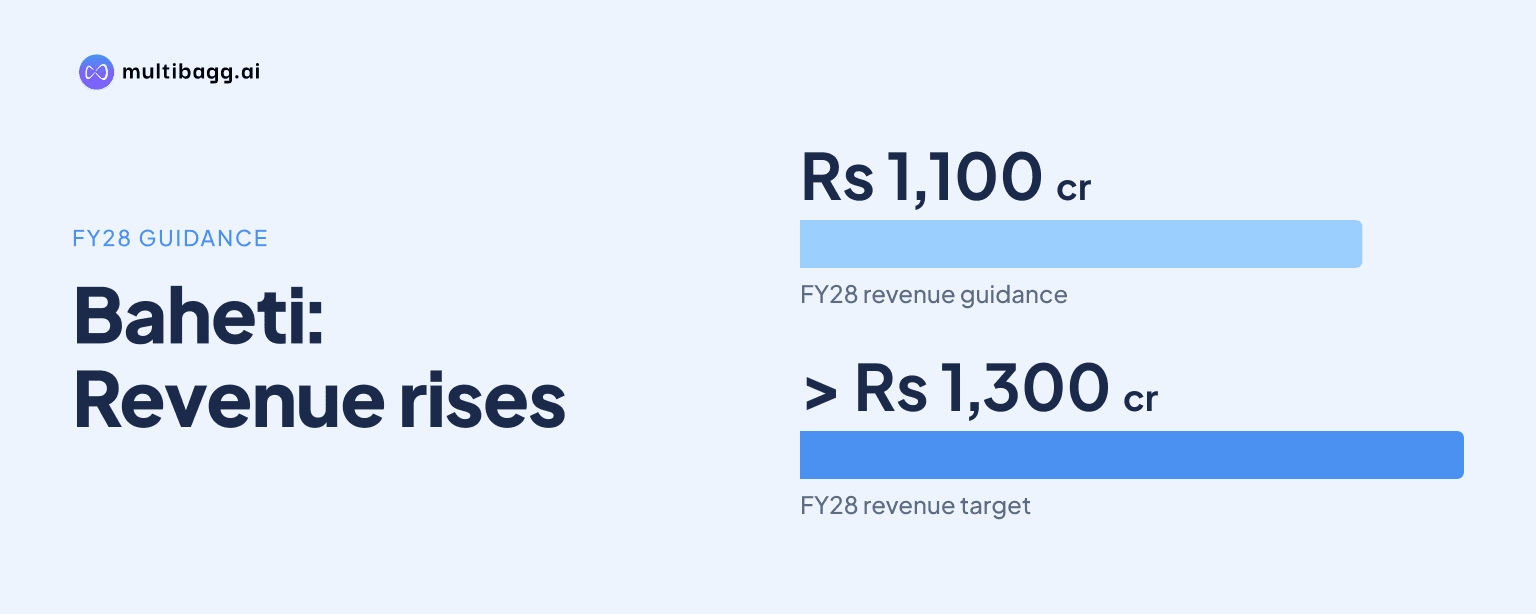
Baheti Recycling Industries Limited has raised its FY28 revenue guidance to more than Rs 1,300 crore from Rs 1,100 crore, citing improved business visibility and opportunities across existing and upcoming products. The plan rests on 38,000 metric tonnes of FY26 capacity, new furnaces and a target to lift utilisation from 60.46% to 80%-90% by FY28.
Know Baheti Recycling Industries inside out
Results, valuation, peers and who's buying, in one view.
Why did Baheti raise its FY28 revenue target?
Baheti raised its FY28 revenue target because management cited improved business visibility and opportunities across its existing and upcoming product segments. The revised guidance is more than Rs 1,300 crore, versus the previous Rs 1,100 crore target, an increase of at least Rs 200 crore, while management said its existing margin trajectory would be maintained.
The revised number is management guidance rather than reported revenue. Baheti’s FY28 plan includes diversifying its core portfolio through new products and verticals, scaling cash flows through operational efficiency, deploying new machinery and seeking consistent inflows of orders in sustainable high-margin business.
Baheti’s timeline says it crossed the Rs 700 crore revenue milestone in 2026. However, the presentation does not provide a revenue bridge from that 2026 milestone to the FY28 target, or identify the expected revenue contribution from automotive, aluminium wire rods, aerospace or other new applications.
What furnace expansion supports Baheti’s FY28 plan?
Baheti’s expansion plan combines new furnace equipment with replacement of pit furnaces, taking stated production capacity to 38,000 MT in FY26. Its manufacturing facility is in Dahegam, Gujarat, on 5 acres of land, including 2.5 acres designated for incoming new capacity.
The FY26 machinery base includes eight furnaces of 300 kilograms each and seven electric furnaces of 700 kilograms each. Baheti commissioned two new pairs of tilting and rotary furnaces, or TRF, in FY26, with each pair described as having 40 MT per day of installed capacity, while discarding its pit furnaces.
Baheti also identified five new electric furnaces for complete utilisation by the end of FY27. The presentation says the new 700-kilogram electric furnaces replace pit furnaces and bring total capacity to 38,000 MT, but it does not separately quantify the capacity addition attributable to the TRF pairs and the electric furnaces.
Management says the modern machinery is intended to optimise the use of power, labour and fuel. The presentation states capital expenditure of Rs 10 crore “per furnace per paid”, but does not clearly define that wording or disclose total spending on all FY26 and FY27 furnace additions.
How much does Baheti need to increase utilisation?
Baheti needs to increase capacity utilisation from 60.46% in FY26 to a management target of 80%-90% by FY28. On the stated FY26 capacity base of 38,000 MT, the target calls for materially higher use of the upgraded manufacturing assets, although the presentation does not disclose actual production tonnage.
The sequence of targets is clear: the five new electric furnaces are expected to be under complete utilisation by the end of FY27, followed by the 80%-90% overall utilisation objective in FY28. Management attributes the intended improvement to modern tilting rotary furnaces and advanced thermal technology, which it says can reduce downtime and labour dependency.
Baheti also targets asset turnover of 8-9 times in its growth-drivers plan. A separate illustration describes Rs 25 crore of machinery and land supporting a Rs 200 crore annual revenue target at an average annualised aluminium selling price, equivalent to 8 times asset turnover; these are management targets and illustrative assumptions, not reported performance.
Got a follow-up? Ask IRIS
Which products and markets are in Baheti’s growth plan?
Baheti’s growth plan includes higher-margin specialty products, automotive expansion, aluminium wire rods and new industrial applications. Management says greater production of specialty products should improve utilisation and earnings before interest, tax, depreciation and amortisation, or EBITDA, per tonne, but it does not disclose either the current specialty-product share or a target share.
The application roadmap broadened from steel, automobile, auto ancillary, engineering and electrical components in FY22-23 to add transmission and power in FY23-24, pistons in FY24-25, aerospace in FY25-26, and cables and wires in FY26-27. Baheti says it is pursuing aerospace certifications and regulatory approvals through compliance and due-diligence processes, making progress in that segment conditional on those processes.
Baheti says it is positioned to set up aluminium wire-rod capacity in FY27. The presentation does not disclose an investment amount, planned output, commissioning date or expected revenue for the wire-rod plan, although the timing coincides with the addition of cables and wires to the FY26-27 application list.
In automotive, Baheti says its IATF 16949 certification enables direct supply to Tier-1 manufacturers. The presentation lists customers including CIE Automotive, Uno Minda, Bosch, TVS, Royal Enfield and Bajaj, but does not provide customer-wise sales, order values or revenue concentration.
How does Baheti plan to turn capacity into revenue?
Baheti plans to translate capacity into revenue through higher asset utilisation, new product verticals, automotive market-share expansion and entry into new industries. Management’s FY28 plan also refers to regional and international market expansion and diversification of the customer base across industries.
The company identifies extended producer responsibility, or EPR, regulations as a structural driver of recycling demand because producers are required to recycle and manage product waste. Baheti’s process involves sorting, cleaning and remelting aluminium scrap before refining, alloying and casting recycled aluminium ingots for die casting, automotive components, electric-vehicle parts and engineering products.
Baheti also says owned freehold land supports capacity expansion without additional land-acquisition costs. This claim relates to the 5-acre Dahegam site and its 2.5 acres of incoming capacity, though the presentation gives no development timetable beyond FY27 or incremental capital expenditure estimate for that land.
Conclusion
Baheti’s revised FY28 guidance of more than Rs 1,300 crore is linked to a defined operating programme: 38,000 MT of FY26 production capacity, replacement of pit furnaces, additional electric furnaces, higher utilisation and a broader product and end-market mix. The increase of at least Rs 200 crore over its earlier target depends on execution across those elements rather than on a disclosed segment-by-segment revenue bridge.
The next disclosed milestones are complete utilisation of five new electric furnaces by the end of FY27, the planned set-up of aluminium wire-rod capacity in FY27, and progress on aerospace certifications and approvals. Management’s FY28 utilisation target of 80%-90% will be the operational measure alongside the revenue ambition and its stated margin trajectory.