










Bank of Baroda Q2 FY27 Profit Rises 35.8% to ₹6,532 Crore
Key highlights
- Bank of Baroda's Q2 FY27 net profit rose 35.81% year-on-year to ₹6,531.54 crore.
- Quarterly operating profit increased 50.9% year-on-year to ₹11,430 crore.
- Global business reached ₹32,58,000 crore on 30 September 2026, up 17.2% year-on-year.
- Domestic credit-deposit ratio was 80.08%, down 323 basis points year-on-year.
powered by IRIS
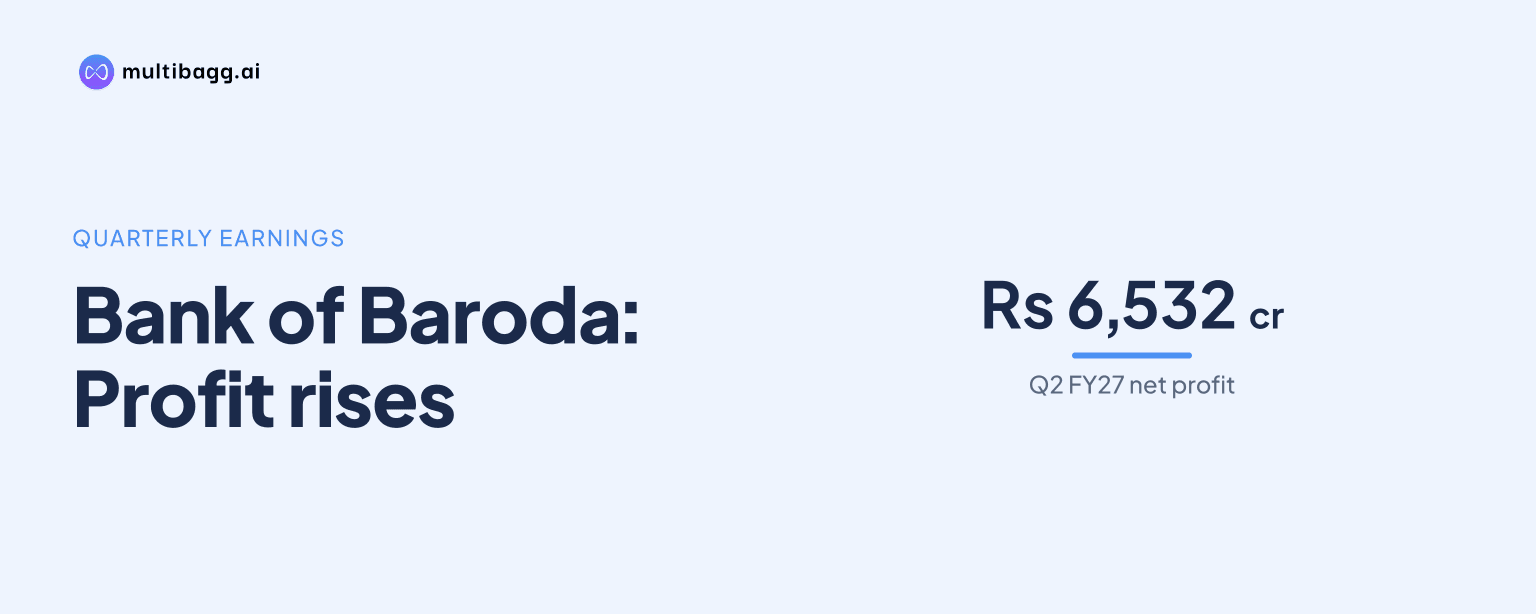
Bank of Baroda reported a record net profit of ₹6,532 crore for Q2 FY27, up 35.8% year-on-year, while operating profit rose 50.9% to ₹11,430 crore. The September-quarter performance matters because it combined higher profitability with 17.2% growth in global business and continued expansion in retail, agriculture and MSME lending.
Know Bank of Baroda inside out
Results, valuation, peers and who's buying, in one view.
What did Bank of Baroda report for Q2 FY27?
Bank of Baroda reported standalone revenue of ₹41,966.05 crore for the quarter ended 30 September 2026, up 19.81% from ₹35,025.76 crore a year earlier. Net profit increased to ₹6,531.54 crore from ₹4,809.39 crore in Q2 FY26, a year-on-year rise of 35.81%. The bank described quarterly profit and operating profit as record levels.
Operating profit rose to ₹11,430 crore, representing growth of 50.9% from the corresponding quarter of the previous year. Net interest income was ₹13,026 crore, up 9.0% year-on-year. The difference between the growth rates in operating profit and net interest income shows that the quarter's profitability improvement was not limited to interest income alone.
The results were discussed at Bank of Baroda's media and analyst meetings held on 30 October 2026. The bank subsequently made audio and video recordings available on its website, following its disclosure to BSE Limited and the National Stock Exchange of India Limited.
How fast did Bank of Baroda's business and loans grow?
Bank of Baroda's global business stood at ₹32,58,000 crore at the end of Q2 FY27, crossing the ₹32,00,000 crore milestone and growing 17.2% year-on-year. Global advances expanded 18.3%, with domestic advances increasing 13.5% and international advances rising 39.7%.
The bank continued to emphasise RAM lending, which includes retail, agriculture and MSME segments. Its organic retail book grew 18.6%, agriculture advances increased 19.0%, and organic MSME advances rose 21.3%. These growth rates were above the increase reported for domestic advances overall.
Deposit and funding metrics were also part of the update. The domestic credit-deposit ratio fell by 323 basis points year-on-year to 80.08% as of 30 September 2026. The domestic CASA ratio, which measures current and savings account deposits as a share of domestic deposits, stood at 36.37%.
Got a follow-up? Ask IRIS
What do the provisioning and return metrics show?
Bank of Baroda said it made prudent provisions to strengthen its balance sheet. Credit cost for Q2 FY27 was 55 basis points, while the credit cost for the first half was 42 basis points. Management said quarterly credit cost would have been 18 basis points without prudential provisioning.
This disclosure is relevant because the reported quarterly credit cost includes additional prudential provisions rather than only the underlying credit-cost measure cited by management. The supplied earnings material does not provide gross or net non-performing asset ratios, so the credit-cost figures should be considered alongside the bank's stated provisioning approach rather than as a complete asset-quality assessment.
Return on equity was 19.28% in Q2 FY27, an increase of 363 basis points from a year earlier. For the first half of FY27, operating profit was ₹19,557 crore, up 23.7% year-on-year. Together, these measures indicate that the bank reported stronger profitability through the first six months of the financial year.
Why do Bank of Baroda's Q2 FY27 results matter to investors?
The Q2 FY27 update matters because Bank of Baroda paired a 35.8% rise in net profit with double-digit expansion in global business and advances. As a state-run lender identified in the supplied material as the second-largest public sector bank in India by business size, its credit growth and deposit metrics are relevant to the broader public-sector banking segment.
The expansion in retail, agriculture and MSME loans points to broad-based growth within the domestic lending book. International advances grew faster than domestic advances, although the supplied information does not disclose the underlying absolute loan balances or contribution of each segment to profit.
For investors, the domestic credit-deposit ratio of 80.08% and CASA ratio of 36.37% provide context on funding and loan deployment. The bank's revenue, profit, operating-profit, credit-cost and return-on-equity figures offer a set of quarterly indicators, but no forward guidance, loan-growth target or earnings forecast was disclosed in the provided material.
Conclusion
Bank of Baroda's Q2 FY27 performance was marked by record net profit of ₹6,532 crore, a 50.9% increase in operating profit and 17.2% growth in global business to ₹32,58,000 crore. Growth across retail, agriculture and MSME lending supported the business update, while prudential provisioning lifted the reported quarterly credit cost to 55 basis points.
The next disclosed reference point is the bank's subsequent financial reporting, where investors can assess whether loan growth, funding metrics, provisioning and returns remain consistent with the September-quarter figures. Stakeholders can also review the 30 October 2026 analyst and media meet recordings hosted by the bank for management's discussion of the Q2 FY27 results.