







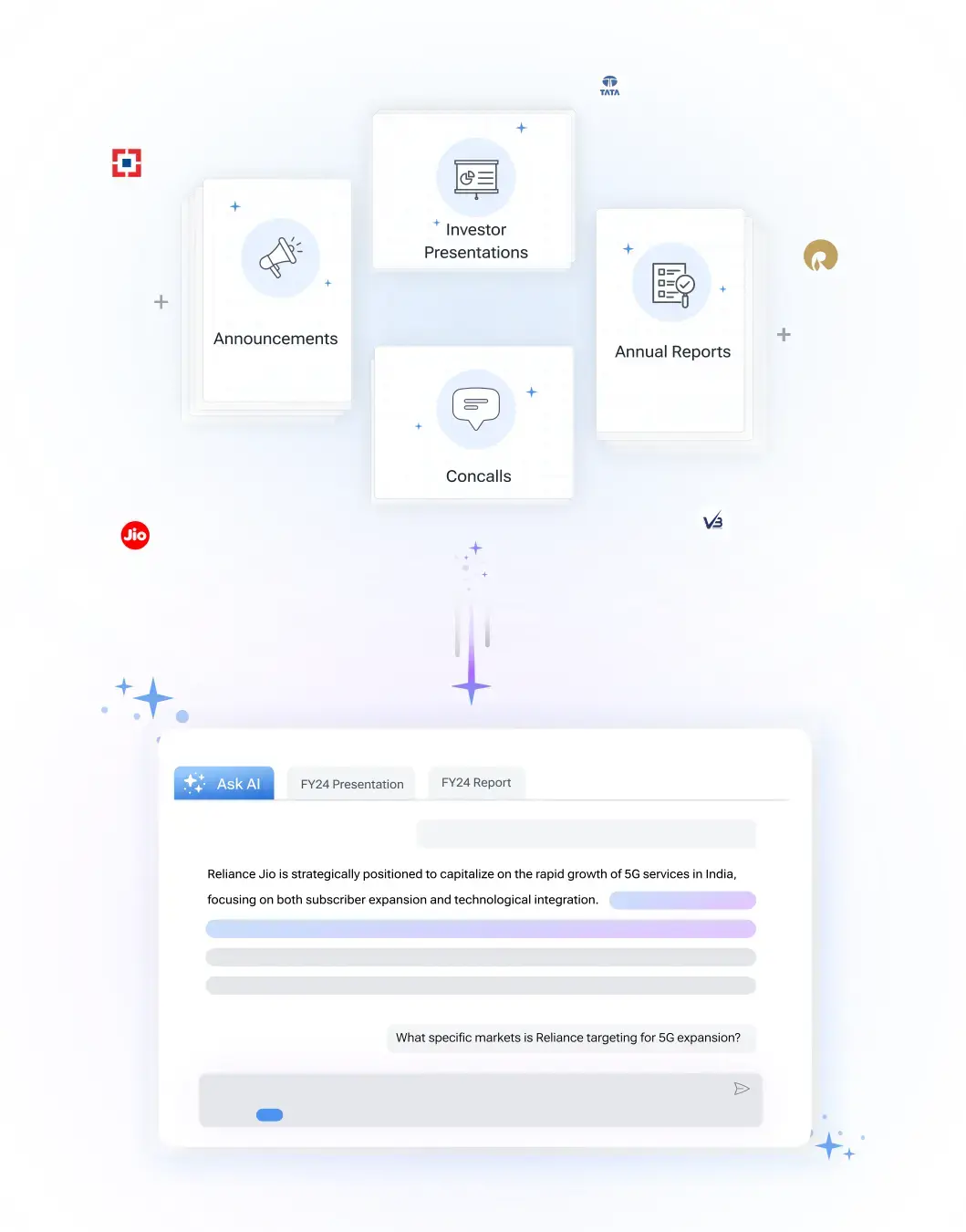






Get instant AI-powered insights about company performance, financials, and strategy. Ask questions about trends, competition, and developments while receiving responses backed by official documents and market data, with clear attribution to source documents.


Investor Presentation
Q3 FY26
Investor Presentation
Q2 FY26
Investor Presentation
Q1 FY26
Investor Presentation
Q4 FY25
Available on Pro Plan
Unlock reports, presentations, and AI-powered insights.
Investor Presentation
Q3 FY25
Available on Pro Plan
Unlock reports, presentations, and AI-powered insights.
Investor Presentation
Q2 FY25
Available on Pro Plan
Unlock reports, presentations, and AI-powered insights.
Investor Presentation
Q1 FY25
Available on Pro Plan
Unlock reports, presentations, and AI-powered insights.
Investor Presentation
Q4 FY24
Banks
Banks - Public Sector
1,49,530 Cr
Moderate Risk
7.7
9.9
1.2
0.9
313.30
190.70
Sales CAGR
1Y
8.08%
3Y
20.23%
5Y
9.83%
10Y
11.92%
Profit CAGR
1Y
11.13%
3Y
39.12%
5Y
104.60%
10Y
—
ROE
TTM
11.65%
3Y
14.65%
5Y
11.69%
10Y
7.50%
ROCE
TTM
5.45%
3Y
10.36%
5Y
10.16%
10Y
10.48%
Bank of Baroda (BANKBARODA) is currently trading at 289.15 per share. Stock prices fluctuate during market hours on NSE and BSE based on demand, company updates, and overall market conditions. Refer to the live price chart above for the most recent price movement.
Bank of Baroda is one of the leading public sector banks in India, offering a wide range of banking solutions including personal, business, corporate, and international banking services. It also has a notable presence in rural banking and various financial products. For Q3FY26, the bank recorded a growth of 14.7% in global advances and a 10.3% increase in deposits. Despite a slight dip in Net Interest Margin (NIM) to 2.79%, the bank managed a commendable net profit growth of 4.5% year-over-year, highlighting efficient cost management. Domestic CASA growth stood at 8.6%, marking one of the best performances in recent quarters. The bank's CASA ratio was 38.45%, with competitive performance among its peers, reflecting strong customer trust and efficient deposit mobilization strategies. The bank's asset quality has shown robust improvements, with Gross NPA ratio declining to 2.04% and Net NPA ratio improving to 0.57%. This improvement aligns with the bank's strategic focus on sustainable growth and prudent credit management. The bank's capital adequacy remains strong with a CET-1 of 12.45% and CRAR at 15.29%, indicating a stable financial footing for future growth and resilience against potential market volatilities.
Over the past 52 weeks, Bank of Baroda has traded between a low of ₹190.70 and a high of ₹313.30. The 52-week high and low indicate the stock’s price range over the last year and help investors understand its volatility and recent trading levels.
Bank of Baroda has a market capitalization of approximately 1,49,529.94. Market capitalization represents the total value of a company’s outstanding shares and helps investors understand its size, stability, and relative risk compared to other listed companies.
Bank of Baroda’s investment profile depends on its business fundamentals, valuation, and long-term outlook. The stock currently trades at a PE ratio of 7.68 and operates in the Banks sector. Investors typically assess financial performance, growth prospects, and individual risk tolerance before making investment decisions.
You can buy shares of Bank of Baroda (BANKBARODA) through any SEBI-registered stockbroker in India. A demat and trading account are required to place buy or sell orders on stock exchanges such as NSE or BSE. Shares are credited to the demat account as per the exchange settlement cycle.
Based on its market capitalization of 1,49,529.94 Cr, Bank of Baroda is classified as a Large Cap stock. Large-cap stocks are generally more stable, while mid-cap and small-cap stocks tend to offer higher growth potential along with higher price volatility.
Bank of Baroda operates in the Banks sector. Sector classification matters because companies in the same sector are often affected by similar economic conditions, regulatory changes, and competitive dynamics, which can influence overall stock performance.
The Price-to-Earnings (PE) ratio of Bank of Baroda is 7.68. The PE ratio compares a company’s share price to its earnings and is commonly used to assess valuation. Comparing the PE ratio with sector peers and historical levels provides better context.
Bank of Baroda pays dividends with a current dividend yield of 2.89%. Dividend-paying stocks may provide periodic income in addition to potential long-term capital appreciation.
Key risks associated with Bank of Baroda include sector-specific challenges in the Banks industry, regulatory changes, competitive pressures, company-level financial performance, overall market volatility, and broader macroeconomic factors that can impact stock prices.
Bearish
3
Neutral
8
Bullish
3
Bearish
22
Neutral
8
Bullish
16
Bearish
19
Neutral
0
Bullish
13
Discover detailed, AI-driven financial summaries that break down key metrics, trends, and insights—empowering you to make smarter investment decisions.
View Standalone
View Standalone
View Standalone
View Standalone
View Standalone
View Standalone
View Standalone
View Standalone

Market Cap
₹ 1,49,530 Cr
P/E
7.68
Performance
STEADY PERFORMER
Valuation
REASONABLE
Growth
STABLE
Profitability
MODERATE MARGIN
Technicals
Bearish
Risk
LOW RISK
Turned 1 L into 3.50 L in last 5 Years
Regulatory Filing
8 hours ago
Special Window for Dematerialisation of Securities
Announcement of a special window for the transfer and dematerialisation of physical securities, open from February 5, 2026, to February 4, 2027.
Regulatory Filing
1 day ago
Approval for Standalone Primary Dealer Establishment
Bank receives RBI approval to establish a wholly owned subsidiary for Standalone Primary Dealer business with capital infusion of up to Rs.2000 crores.
Concall Transcript
3 days ago
Q3 FY2025-26 Media and Analyst Meet Transcript
The bank disclosed the transcript of its Media and Analyst Meet on January 30, 2026, summarizing its financial performance for Q3 of FY2025-26.