










Banka BioLoo's EBITDA margin reaches 20% despite revenue fall
Key highlights
- Banka BioLoo reported consolidated Q2 FY26-27 EBITDA of Rs 2.38 crore and a 20.1% margin.
- Consolidated Q2 FY26-27 total income was Rs 11.87 crore after Rs 6.83 crore of intercompany revenue elimination.
- Megaliter had 16 contracted projects, 11 million litres per day of capacity and more than Rs 140 crore of contracted lifetime value in H1 FY26-27.
- Banka BioLoo's unexecuted order book increased to Rs 83.4 crore at 30 September 2026 from Rs 81.8 crore at 30 June 2026.
powered by IRIS
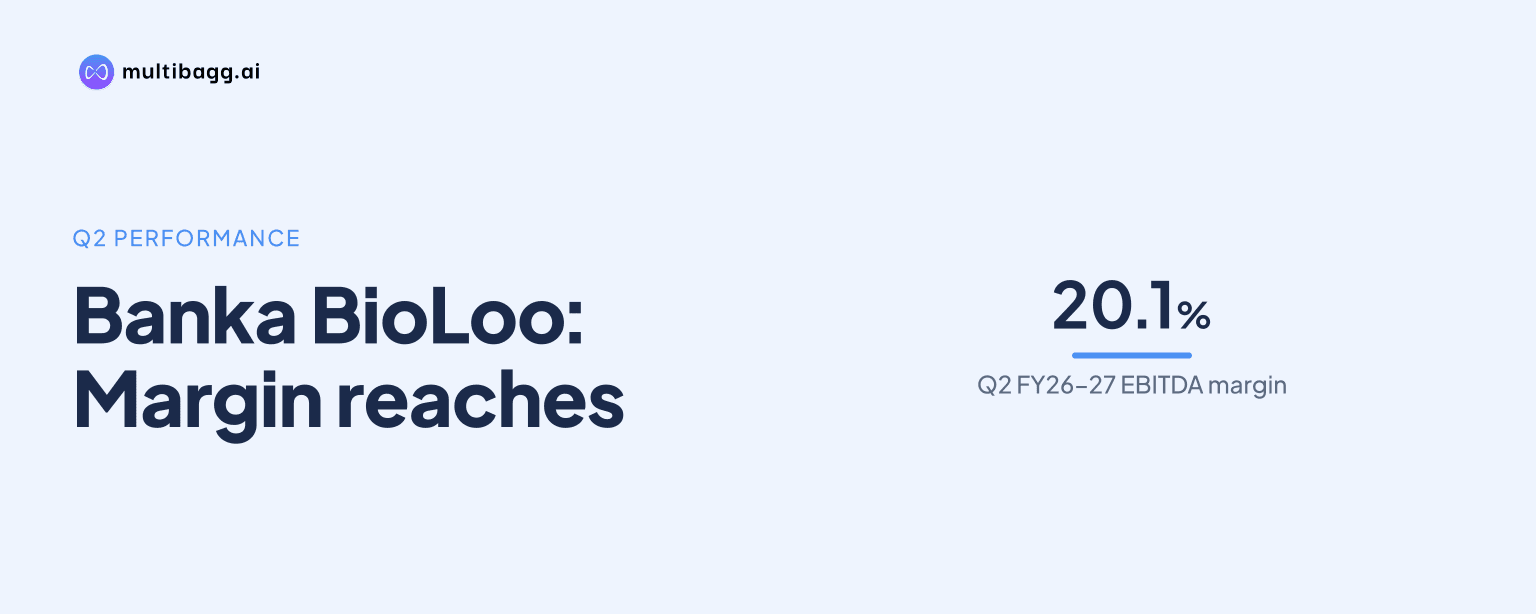
Banka BioLoo Limited reported a 20.1% consolidated EBITDA margin in Q2 FY26-27 despite total income falling 9.2% year on year to Rs 11.87 crore, as Rs 6.83 crore of intercompany engineering, procurement and construction revenue was eliminated while Megaliter added higher-margin recurring plant income.
Know Banka Bioloo inside out
Results, valuation, peers and who's buying, in one view.
Why did Banka BioLoo's consolidated revenue decline in Q2 FY26-27?
Banka BioLoo's consolidated income declined because group accounts eliminated Rs 6.83 crore of intercompany EPC billing, rather than because standalone operations contracted. Standalone Q2 FY26-27 total income rose 24.5% year on year to Rs 16.56 crore from Rs 13.30 crore, while Megaliter added Rs 2.13 crore before consolidation adjustments reduced group income to Rs 11.87 crore.
The elimination was about Rs 1.23 crore a year earlier, compared with about Rs 6.83 crore in Q2 FY26-27. The presentation identifies the adjustment as EPC work between group entities, which cannot be retained in consolidated revenue. Consolidated H1 FY26-27 total income was Rs 22.52 crore, while standalone H1 income increased 22.5% to Rs 32.96 crore.
This difference reflects the group's accounting structure. Banka BioLoo can report construction work performed for Megaliter in standalone results, but the same transaction is removed in consolidated accounts. Management describes the resulting revenue mix as shifting from one-off EPC activity toward annuity revenue from water-treatment plants that Megaliter owns.
How did Megaliter raise Banka BioLoo's EBITDA margin to 20.1%?
Megaliter raised the consolidated margin by adding income at an approximately 55% EBITDA margin, compared with Banka BioLoo's 9.5% standalone Q2 margin. In Q2 FY26-27, Banka BioLoo generated Rs 1.57 crore of standalone EBITDA, Megaliter contributed Rs 1.17 crore, and Rs 35 lakh of intercompany and other adjustments were removed, resulting in Rs 2.38 crore of consolidated EBITDA.
The 20.1% consolidated EBITDA margin compared with about 0.5% a year earlier, according to the presentation. Consolidated H1 EBITDA was Rs 4.31 crore, compared with Rs 2.38 crore in Q2 alone. The comparison shows that the higher-margin plant contribution changed profitability even as reported revenue was reduced by intra-group eliminations.
Consolidated profit after tax did not move in line with EBITDA because the group is funding and depreciating its asset base. Consolidated Q2 PAT was Rs 13.1 lakh, compared with a loss of Rs 1.09 crore a year earlier, while H1 PAT was Rs 9.2 lakh against an H1 loss of Rs 1.09 crore. The presentation attributes Rs 2.20 crore of finance cost and depreciation to building the long-term annuity base.
Banka BioLoo's standalone figures also show an operating turnaround. Q2 standalone EBITDA was Rs 1.57 crore, against a loss of Rs 39.5 lakh in Q2 FY25-26, and standalone PAT was Rs 41.6 lakh, against a loss of Rs 1.10 crore. Consolidated PAT was lower because Megaliter's investment-related finance and depreciation charges remained within the group result.
Got a follow-up? Ask IRIS
What does Megaliter add to Banka BioLoo's earnings model?
Megaliter adds contracted recurring plant revenue after construction because it owns the plants it builds and earns income over the contract period. By H1 FY26-27, Megaliter had 16 contracted projects, including 13 commissioned by Q2 and three under work in progress, with contracted treatment capacity of 11 million litres per day.
The portfolio expanded from six plants, 5.3 million litres per day of capacity and Rs 49.43 crore of contracted lifetime value in FY25-26 to 16 plants, 11 million litres per day and more than Rs 140 crore in H1 FY26-27. The presentation says about 80% of contracted lifetime value is yet to be recognised, which supports management's annuity-income description but does not represent near-term revenue guidance.
The model requires capital expenditure before its contracted income is fully recognised. Megaliter's H1 FY26-27 capital expenditure was Rs 12.43 crore, funded by Rs 5 crore of outside equity and Rs 4.11 crore of net borrowings. The presentation describes this spending as the cost of building plants that can produce contracted revenue for years after commissioning.
The broader operating mix is also becoming more non-Rail oriented. At 30 September 2026, Banka BioLoo's unexecuted order book was Rs 83.4 crore, including Rs 58.5 crore of non-Rail work and Rs 24.9 crore of Rail work. Rail represented about 30% of the book, down from about 39% at 30 June 2026, when Rail orders totalled Rs 32 crore of an Rs 81.8 crore book.
What should investors track in Banka BioLoo's execution and funding plan?
Commissioning, collections and funding are the main disclosed measures for assessing whether contracted projects become recurring earnings. In Q2 FY26-27, Banka BioLoo completed five sewage treatment plants and multiple smaller projects, with four projects commissioned and four under commissioning across EPC and Megaliter. The company plans to place all 25-plus sewage treatment plant sites online in Q3 after bringing more than 10 assets online for monitoring.
Collections remain relevant because receivables were Rs 26 crore at H1 FY26-27, compared with Rs 25.67 crore at 31 March 2026. Standalone H1 operating cash flow was Rs 1.88 crore, compared with Rs 1.06 crore in the comparison cited by the presentation. Management's FY27 scorecard sets out commissioning, billing, collection and delivery of sustainable profit before tax as the intended sequence.
Funding needs monitoring as the asset portfolio expands. Net debt to equity was 0.82 times in Q2 FY26-27, compared with 0.74 times at 31 March 2026, alongside Rs 12.43 crore of H1 Megaliter capital expenditure. The presentation does not disclose a leverage target, but identifies prudent funding as one of five FY27 execution priorities.
Order booking and client mix provide another execution measure. Q2 FY26-27 booking was Rs 16 crore, all from private clients, and the unexecuted order book increased from Rs 81.8 crore at 30 June 2026 to Rs 83.4 crore at 30 September 2026. The presentation names Brigade, Reliance, RMZ and Auro Infra among private-client wins as the group reduces dependence on government and Rail orders.
Conclusion
Banka BioLoo's Q2 FY26-27 revenue decline primarily reflects the Rs 6.83 crore removal of intra-group EPC revenue, while the Rs 2.38 crore of consolidated EBITDA and 20.1% margin reflect Megaliter's higher-margin recurring plant income. Consolidated Q2 PAT of Rs 13.1 lakh shows that finance cost and depreciation still affect reported earnings while the plant portfolio is being built.
The next disclosed milestones are the commissioning of projects now under commissioning and the plan to put all 25-plus sewage treatment plant sites online in Q3. Progress in recognising more than Rs 140 crore of contracted Megaliter lifetime value, collecting Rs 26 crore of receivables and managing net debt to equity of 0.82 times will indicate how the annuity platform develops.