








Bansal Roofing Products Ltd. borrowings rise tenfold with assets

Find your next multibaggerBe a Pro Investor
Research stocks and track your picks on the go. Download the app.
Key highlights
- Bansal Roofing’s non-current borrowings increased to Rs 3.135 crore in September 2026 from Rs 30.2 lakh in March 2026.
- Bansal Roofing’s property, plant and equipment rose by Rs 6.016 crore to Rs 35.754 crore.
- Bansal Roofing’s trade receivables declined by Rs 1.877 crore to Rs 1.628 crore at September 2026.
- Bansal Roofing reported H1 FY27 revenue growth of 36.0% and profit after tax growth of 51.8%.
powered by IRIS
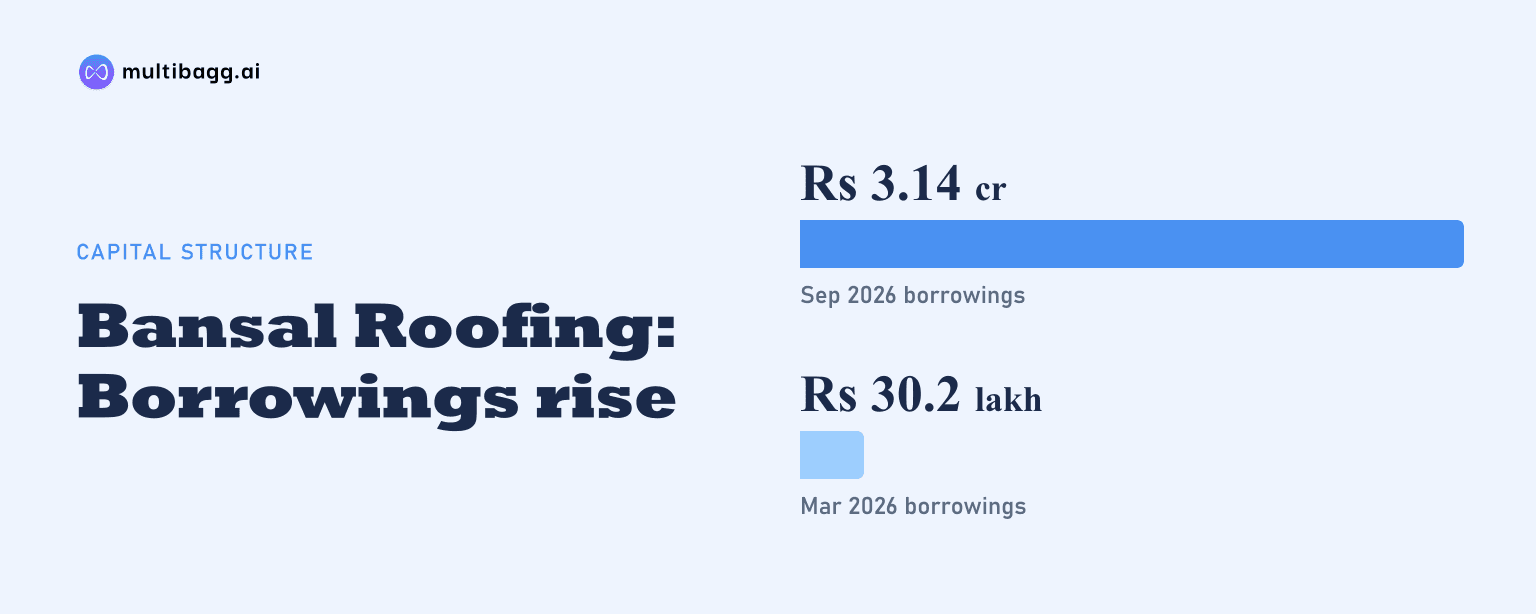
Bansal Roofing Products Ltd. reported non-current borrowings of Rs 3.135 crore at September 2026, up from Rs 30.2 lakh at March 2026, as property, plant and equipment increased by Rs 6.016 crore to Rs 35.754 crore. The six-month balance-sheet movement shows higher long-term funding alongside a larger manufacturing asset base.
Know Bansal Roofing Products inside out
Results, valuation, peers and who's buying, in one view.
Why did Bansal Roofing’s non-current borrowings rise tenfold?
Bansal Roofing’s non-current borrowings rose by Rs 2.833 crore over six months, from Rs 30.2 lakh at March 2026 to Rs 3.135 crore at September 2026. Total non-current liabilities consequently increased to Rs 4.90 crore from Rs 1.775 crore. The presentation does not identify the lender, borrowing instrument, interest rate, maturity profile or specific use of the additional long-term borrowing.
Other non-current liability lines also rose during the period. Net deferred tax liabilities increased to Rs 1.565 crore from Rs 1.344 crore, while provisions rose to Rs 19.9 lakh from Rs 12.9 lakh. These movements, together with the change in borrowings, explain the Rs 3.125 crore increase in total non-current liabilities.
Current borrowings changed comparatively little, increasing to Rs 2.763 crore in September 2026 from Rs 2.667 crore in March 2026. Combined current and non-current borrowings were Rs 5.898 crore at September 2026, compared with Rs 2.969 crore six months earlier, indicating that longer-term borrowings accounted for most of the increase.
Bansal Roofing reported net debt to equity of 0.13 times in September 2026, against 0.07 times in March 2026. Total equity nevertheless rose to Rs 44.834 crore from Rs 42.204 crore over the same period. The presentation reports the ratio but does not set out the underlying calculation or identify which cash and debt balances it includes.
How much did Bansal Roofing’s manufacturing asset base grow?
Bansal Roofing’s total assets increased by Rs 8.941 crore to Rs 71.007 crore at September 2026 from Rs 62.066 crore at March 2026. Non-current assets accounted for Rs 6.452 crore of that movement, rising to Rs 40.193 crore from Rs 33.741 crore.
Property, plant and equipment, or PPE, was the principal source of non-current asset growth, rising to Rs 35.754 crore from Rs 29.738 crore. Capital work in progress increased by Rs 47.2 lakh to Rs 2.255 crore, while investment property declined to Rs 1.695 crore from Rs 1.731 crore. The presentation does not specify the facilities, machinery or projects represented by the additions to PPE and capital work in progress.
The larger fixed-asset base coincided with higher depreciation and amortisation in the first half of FY27. Bansal Roofing reported depreciation and amortisation of Rs 1.065 crore in H1 FY27, compared with Rs 81.8 lakh in H1 FY26, an increase of 30.2%. The source does not explicitly attribute this expense increase to the September 2026 PPE additions.
Got a follow-up? Ask IRIS
What changed in Bansal Roofing’s working capital and liquidity?
Bansal Roofing’s trade receivables declined to Rs 1.628 crore at September 2026 from Rs 3.505 crore at March 2026, a reduction of Rs 1.877 crore. Other current assets also fell to Rs 2.981 crore from Rs 5.072 crore, while inventories increased by Rs 41.8 lakh to Rs 19.875 crore.
Current investments were Rs 6.212 crore at September 2026, compared with Rs 0.1 lakh at March 2026. This new investment balance was a significant change within current assets, but the presentation does not disclose the securities held, their maturity, valuation basis or liquidity terms.
Total current assets rose to Rs 30.813 crore from Rs 28.325 crore, while total current liabilities increased to Rs 21.273 crore from Rs 18.087 crore. Bansal Roofing’s reported current ratio, which compares current assets with current liabilities, therefore declined to 1.45 times from 1.57 times.
Other current liabilities increased by Rs 3.722 crore to Rs 12.645 crore. Trade payables to micro, small and medium enterprises fell to Rs 1.778 crore from Rs 3.339 crore, whereas payables to other suppliers rose to Rs 3.028 crore from Rs 2.355 crore; the two payable categories combined fell by Rs 88.8 lakh.
Cash and cash equivalents were Rs 2.5 lakh at September 2026, down from Rs 4.7 lakh at March 2026, and other bank balances declined to Rs 3.6 lakh from Rs 9.4 lakh. The balance sheet separately records Rs 6.212 crore of investments, but does not state whether those investments can be readily converted to cash.
What do Bansal Roofing’s H1 FY27 earnings show alongside the balance sheet?
Bansal Roofing reported revenue from operations of Rs 95.578 crore in H1 FY27, up 36.0% from Rs 70.282 crore in H1 FY26. Earnings before interest, tax, depreciation and amortisation, or EBITDA, increased 48.7% to Rs 8.352 crore, and the EBITDA margin rose to 8.74% from 7.99%.
Profit after tax increased 51.8% to Rs 5.283 crore in H1 FY27 from Rs 3.481 crore in H1 FY26. The profit after tax margin improved by 58 basis points to 5.53%, while diluted earnings per share increased to Rs 4.01 from Rs 2.64. One basis point equals one-hundredth of a percentage point.
Quarterly data show a sharper increase in finance cost than in revenue during Q2 FY27. Finance cost was Rs 12.0 lakh in Q2 FY27, compared with Rs 2.6 lakh in Q1 FY27 and Rs 3.8 lakh in Q2 FY26, while Q2 FY27 revenue from operations was Rs 49.688 crore. The presentation does not link this quarterly finance-cost movement to a specific borrowing or state average interest rates.
Total equity increased by Rs 2.630 crore in the six months to September 2026. Equity share capital remained Rs 13.183 crore, while other equity rose to Rs 31.651 crore from Rs 29.021 crore. Although H1 FY27 profit after tax was Rs 5.283 crore, the presentation does not provide a reconciliation between that profit and the movement in other equity.
Conclusion
Bansal Roofing’s September 2026 balance sheet records a simultaneous rise in manufacturing assets and long-term funding. PPE increased by Rs 6.016 crore, non-current borrowings increased by Rs 2.833 crore and receivables decreased by Rs 1.877 crore, while the current ratio moved to 1.45 times from 1.57 times.
The next disclosure should clarify the unresolved terms and purpose of the Rs 3.135 crore of non-current borrowings, because the presentation provides no lender, rate, maturity or named project. It will also show whether the Rs 2.255 crore of capital work in progress and the expanded PPE base are followed by further changes in revenue, depreciation and finance cost.

