










Banswara Syntex H1 EBITDA rises 19% as margins expand
Key highlights
- H1 FY27 EBITDA rose 18.9% year on year to Rs 66 crore, while EBITDA margin increased to 9.7% from 8.5%.
- H1 FY27 total income increased 3.6% to Rs 680.8 crore and profit after tax rose 124.6% to Rs 12.5 crore.
- Fabric revenue rose 14% to Rs 303 crore in H1 FY27, with capacity utilisation increasing to 81% from 73%.
- Net debt was Rs 515 crore on September 30, 2026, up Rs 43.28 crore during H1 FY27.
powered by IRIS
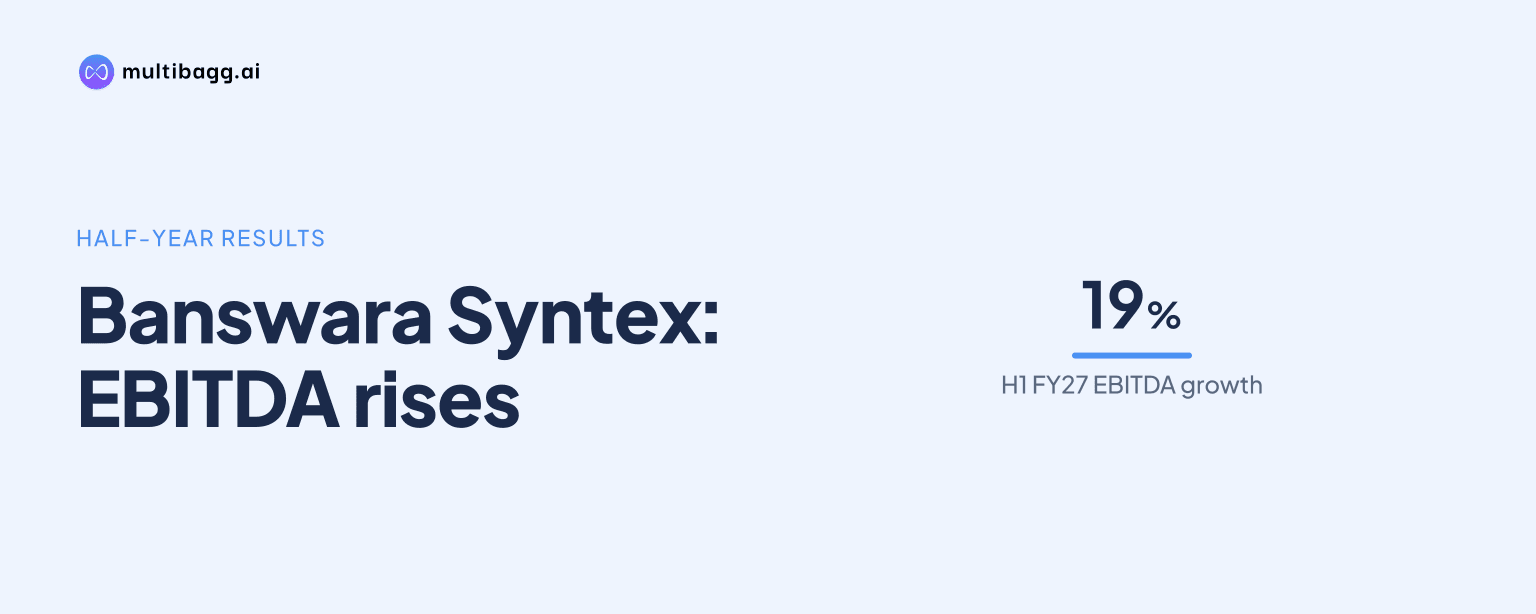
Banswara Syntex Limited raised H1 FY27 EBITDA by 18.9% year on year to Rs 66 crore and expanded its EBITDA margin to 9.7% from 8.5%, as higher-value products and better realisations outweighed rising polyester, power and employee costs. Total income grew 3.6% to Rs 680.8 crore, while profit after tax reached Rs 12.5 crore.
Know Banswara Syntex inside out
Results, valuation, peers and who's buying, in one view.
How did Banswara Syntex's H1 FY27 margin change?
Banswara Syntex's H1 FY27 EBITDA margin increased by 1.2 percentage points to 9.7%, as EBITDA grew substantially faster than total income. EBITDA rose to Rs 66 crore from Rs 55.5 crore in H1 FY26, while total income increased to Rs 680.8 crore from Rs 657.1 crore over the same period.
Profit after tax increased by 124.6% to Rs 12.5 crore from Rs 5.6 crore. The operating change was that income rose 3.6% while EBITDA rose 18.9%; management attributed that difference to better realisations and a greater contribution from value-added products, rather than an increase in sales volume alone.
The Q2 FY27 sequence also improved. Total income was Rs 358.4 crore, up 11.2% from Q1 FY27, and EBITDA increased 23.9% sequentially to Rs 36.5 crore. The resulting Q2 EBITDA margin was 10.2%, compared with 9.1% in Q1 FY27, while Q2 profit after tax was Rs 8.1 crore.
What drove Banswara Syntex's margin expansion?
Banswara Syntex said value-added products and improved realisations drove the margin expansion despite incomplete recovery of input inflation. Management said its focus was to increase the sale of value-added goods rather than maximise volumes, and described Q2 FY27 gross margin as probably the highest it had achieved.
The company cited higher polyester costs linked to West Asia developments, including increases in purified terephthalic acid, or PTA, and monoethylene glycol, or MEG. Management said price pass-through to customers in yarn, fabric and garments occurs with a lag, so the H1 FY27 margin improvement was achieved before it had fully recovered the higher raw-material costs.
Power and employee costs also pressured the Q2 FY27 cost base. Management said its ability to pass through raw-material inflation in the second half would be important to meeting its retained FY27 outlook, which was not quantified in the transcript.
How did Banswara Syntex's fabric and yarn divisions perform?
Banswara Syntex's fabric division grew in H1 FY27, while yarn revenue declined because more yarn was consumed internally. Fabric revenue rose 14% to Rs 303 crore from Rs 266 crore in H1 FY26, sales volume increased to 118 lakh metres from 109 lakh metres, and capacity utilisation improved to 81% from 73%.
In Q2 FY27, fabric revenue rose to Rs 157 crore from Rs 149 crore a year earlier even though volume slipped to 58 lakh metres from 59 lakh metres. That higher turnover with lower quarterly volume is consistent with management's explanation that a richer product mix and improved realisations supported sales.
Yarn revenue declined to Rs 199 crore in H1 FY27 from Rs 222 crore in H1 FY26 because captive consumption increased significantly, management said. Q2 yarn capacity utilisation reached 84%, compared with 81% in Q2 FY26 and 70% in Q1 FY27, as internal transfers supported the fabric and garment businesses.
The yarn unit continued to face elevated raw-material prices and export freight costs, and management said regular export orders were lower because of freight challenges. Its stated response includes reducing slow-moving yarn inventory, maintaining stock of regularly demanded products and improving production output and utilisation in H2 FY27.
Got a follow-up? Ask IRIS
What changed in Banswara Syntex's garment business and H2 outlook?
Banswara Syntex's garment division recovered in Q2 FY27, reporting revenue of Rs 90 crore, up 13% year on year and 30% sequentially. H1 FY27 garment revenue was Rs 160 crore, compared with Rs 155 crore in H1 FY26, after what management called a relatively soft start to the year.
Garment sales volume was 10 lakh pieces in Q2 FY27 and 18 lakh pieces in H1 FY27. The transcript correction says H1 capacity utilisation was 74%, down from 78% a year earlier, although management said export orders picked up in Q2 and identified jackets as an area with a strong order book.
Management expects H2 FY27 to be seasonally stronger, supported by its garment and fabric order books and encouraging Q3 FY27 visibility in fabrics. Vessel availability and logistics remained constraints for customers, but management said it expected the UK free-trade agreement and prospective European Union agreement to support export demand.
Management said C&A had an order pipeline of about Rs 5 crore for execution in FY27 and potential of more than Rs 20 crore in the following year. It also said UK garment business, currently about Rs 20 crore, could more than double in the following year as Next is onboarded and Marks & Spencer is being onboarded; these are management expectations.
What balance-sheet and expansion milestones should readers watch?
Banswara Syntex reported net debt of Rs 515 crore as of September 30, 2026, up Rs 43.28 crore during H1 FY27. Management attributed the increase primarily to working-capital requirements caused by higher raw-material prices and said it was addressing inventory, receivables and the production-to-delivery cycle time.
Management said it had spent about Rs 36 crore of its Rs 130 crore to Rs 140 crore FY27 capital-expenditure plan in H1 and expected most projects to be completed in H2. The projects include an effluent treatment plant and work related to product quality and environmental requirements.
The Surat garment project remained subject to a customs no-objection certificate because the facility is in a special economic zone. Management expected the clearance by the end of November 2026, de-notification by January or February, and production around April in the first quarter of the next financial year, subject to those approvals.
Management estimated that Surat could add Rs 75 crore to Rs 100 crore of garment turnover in the following year after commissioning. Once fully operational over about two years, it estimated additional turnover of Rs 150 crore to Rs 200 crore and additional capital expenditure of Rs 30 crore to Rs 50 crore, depending on automation.
Conclusion
Banswara Syntex delivered a clear H1 FY27 profitability improvement: EBITDA rose 18.9% to Rs 66 crore while total income increased 3.6% to Rs 680.8 crore. Fabric growth, higher captive yarn use and a Q2 garment recovery support management's product-mix explanation, but raw-material, power, employee and freight costs remained operating constraints.
The next disclosures to watch are H2 FY27 order execution, raw-material price pass-through and progress in reducing working-capital use after net debt rose to Rs 515 crore at September 30, 2026. Management also expects most FY27 capital projects to finish in H2 and targets Surat production around April, subject to customs and special-economic-zone approvals.