










Banswara Syntex sees Surat lift garment sales to Rs 550-600 crore
Key highlights
- Banswara Syntex expects garment sales of Rs 360-380 crore in the current year.
- Surat could add Rs 150-200 crore of annual garment turnover after about two years of ramp-up.
- Q2 FY27 garment revenue was Rs 90 crore, up 13% year on year and 30% sequentially.
- C&A has an order pipeline of about Rs 5 crore for this year, with potential above Rs 20 crore next year.
powered by IRIS
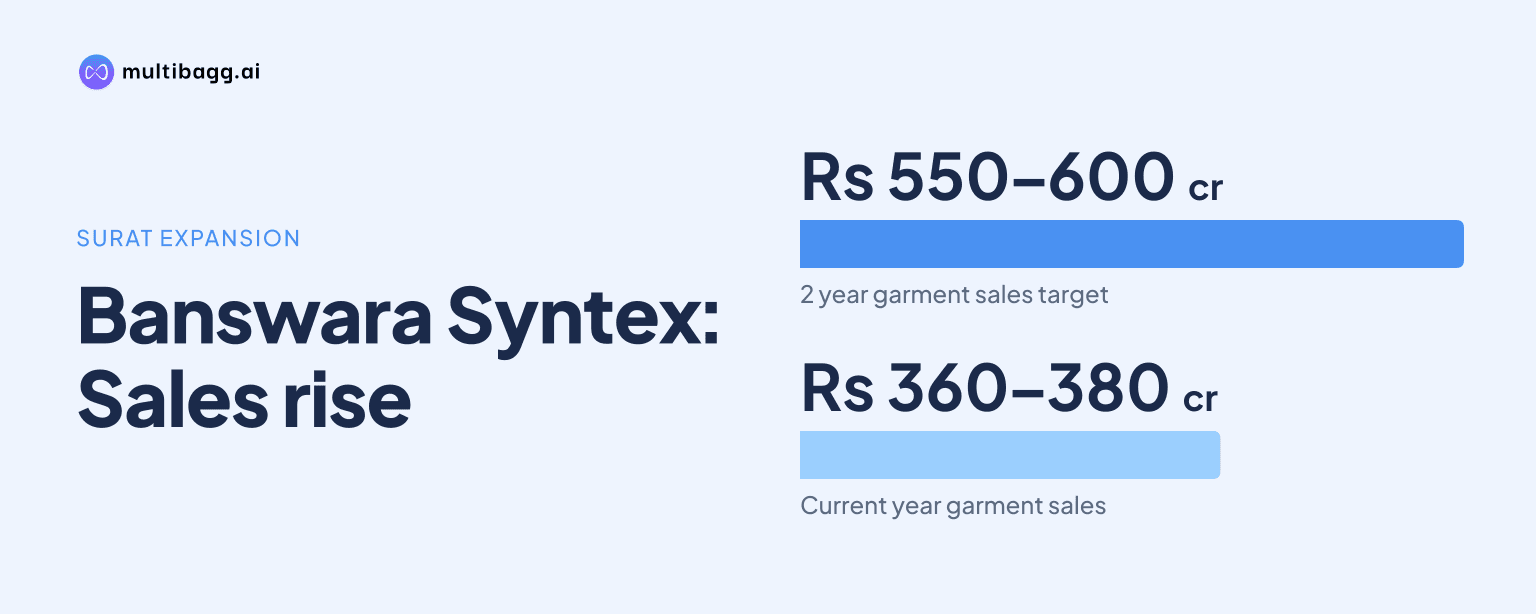
Banswara Syntex Limited said in its Q2 FY27 call that it has a pathway to at least Rs 550-600 crore of annual garment sales within two years, from an expected Rs 360-380 crore this year, led by the Surat facility’s potential Rs 150-200 crore turnover contribution and Europe-focused customer onboarding.
Know Banswara Syntex inside out
Results, valuation, peers and who's buying, in one view.
How will Banswara Syntex reach Rs 550-600 crore in garment sales?
Banswara Syntex expects the Surat facility to provide the main additional capacity required to reach at least Rs 550-600 crore of garment sales within two years. Management said the garment division should close the current year at Rs 360-380 crore of sales and that Surat, once fully operational, could add Rs 150-200 crore of annual turnover.
The contribution is planned to build in phases rather than arrive immediately at full scale. Management said Surat could add Rs 75-100 crore of turnover in the following year if the unit comes on stream, with the Rs 150-200 crore annual potential taking about two years to fully operationalise. It described current garment capacity as fully utilised because the available labour is deployed on machines and the order book is full.
The nearer-term garment performance improved in Q2 FY27 after what management called a relatively soft start to the year. Garment revenue reached Rs 90 crore, up 13% year on year and 30% sequentially, while H1 FY27 revenue was Rs 160 crore against Rs 155 crore in H1 FY26. Sales volumes were 10 lakh pieces in Q2 and 18 lakh pieces in H1, while H1 capacity utilisation was 74%, down from 78% a year earlier.
Why does Banswara Syntex see Europe as its largest export opportunity?
Banswara Syntex sees Europe as its largest prospective export opportunity because management expects a European Union, or EU, free-trade agreement, or FTA, to come into operation around June or July of the next year. Management said customer interest and order enquiries were most encouraging in Europe, while the United Kingdom, or UK, FTA is already in place.
The company identified several customer developments during the call. Management said C&A was fully onboard after a two-week UK trip, with an order pipeline of about Rs 5 crore for execution this year and potential to exceed Rs 20 crore next year. It also said it had onboarded Reserved, a Polish company with about 300-400 stores according to management.
The UK remains part of the garment export plan, although management said Europe represents the larger opportunity. Banswara Syntex said it had onboarded Next and was in the process of onboarding Marks & Spencer. From about Rs 20 crore of current UK garment business, management expects UK revenue to more than double next year.
Management expects earnings before interest, tax, depreciation and amortisation, or EBITDA, margins of 12% to 15% in European customer business and geographies. That is management’s expectation rather than reported profitability for the garment division. It also said the Q2 FY27 garment order book was particularly strong in jackets, though vessel availability and logistics issues were affecting customers.
Got a follow-up? Ask IRIS
When can the Surat garment facility begin production?
Banswara Syntex expects Surat to begin production in the first quarter of the next financial year, around April, subject to customs and special economic zone approvals. Management said it was still seeking a customs no-objection certificate, or NOC, because the site is in a special economic zone, or SEZ.
Management expected the customs NOC possibly by the end of November, followed by de-notification of the SEZ site around January or February. These are management timelines, not completed approvals. The company said the plant could be brought into production in the first quarter of the next financial year if that process progresses as expected.
The Surat-specific capital expenditure is estimated at Rs 30-50 crore, depending on the extent of automation, management said. That investment sits within a wider FY27 capital-expenditure plan of about Rs 130-140 crore, of which about Rs 36 crore had been spent during H1 FY27. Management said there was no delay in the wider programme and expected most projects to be completed in H2 FY27.
The facility’s ramp-up matters because the current garment order book is full against available labour and machine deployment. Management’s Rs 75-100 crore potential Surat contribution in the following year would therefore be an initial capacity-led addition, rather than the full Rs 150-200 crore potential it expects after about two years of operations.
What could affect Banswara Syntex’s garment expansion plan?
Banswara Syntex’s plan depends on executing orders despite higher raw-material and freight costs. Management said polyester prices had risen by 25% to 30% amid the West Asia crisis and higher oil prices, while freight costs had increased sharply. It said increases in raw-material prices had not yet been fully passed to customers across yarn, fabric and garments.
Logistics have also affected the timing of customer shipments. Management said vessel availability and freight challenges had caused customers to lift made-to-order goods more slowly than expected during the quarter. These issues contributed to higher working-capital needs, with net debt at Rs 515 crore on September 30, 2026, up Rs 43.28 crore during H1 FY27, primarily because of working-capital requirements and higher raw-material prices.
The company’s broader response is to increase value-added sales rather than target volume growth alone. Management said internal yarn consumption had reached about 40%, and stretch-yarn use had increased to 450-500 tonnes per month from about 300 tonnes, a rise of roughly 150 tonnes. It linked those yarn inputs to value-added fabrics and a plan to grow turnover while gradually reducing working-capital use.
This strategy was visible in the fabric division’s H1 FY27 performance. Fabric revenue increased 14% to Rs 303 crore from Rs 266 crore in H1 FY26, while volume rose 8% to 118 lakh metres from 109 lakh metres and capacity utilisation reached 81% from 73%. By comparison, yarn revenue fell to Rs 199 crore from Rs 222 crore as more output was consumed internally, according to management.
Conclusion
Banswara Syntex’s stated garment-sales pathway combines existing capacity utilisation, Surat expansion and an export pipeline centred on Europe and the UK. Q2 FY27 garment revenue of Rs 90 crore and the current-year Rs 360-380 crore sales expectation establish the operating base, while Surat’s full Rs 150-200 crore turnover potential underpins management’s target of at least Rs 550-600 crore within two years.
The next disclosed milestones are a possible customs NOC by the end of November, expected SEZ de-notification around January or February, and targeted Surat production around April. Investors should also watch execution of C&A’s Rs 5 crore current-year pipeline, UK revenue expected to more than double next year, the prospective EU FTA timeline, and the company’s ability to pass through polyester and freight-cost increases.