










BCL net-debt-to-equity falls to 0.43 as debt totals Rs 458 crore
Key highlights
- BCL's FY26 net-debt-to-equity ratio was 0.43, down from 0.61 in FY25.
- BCL reported Rs 458 crore of consolidated debt on September 30, 2026, including Rs 278 crore of term loans.
- BCL scheduled Rs 49 crore of term-debt repayment in FY27 and Rs 60 crore in each of FY28 and FY29.
- BCL says average cash flow from operations exceeded Rs 60 crore across FY22 to FY26.
powered by IRIS
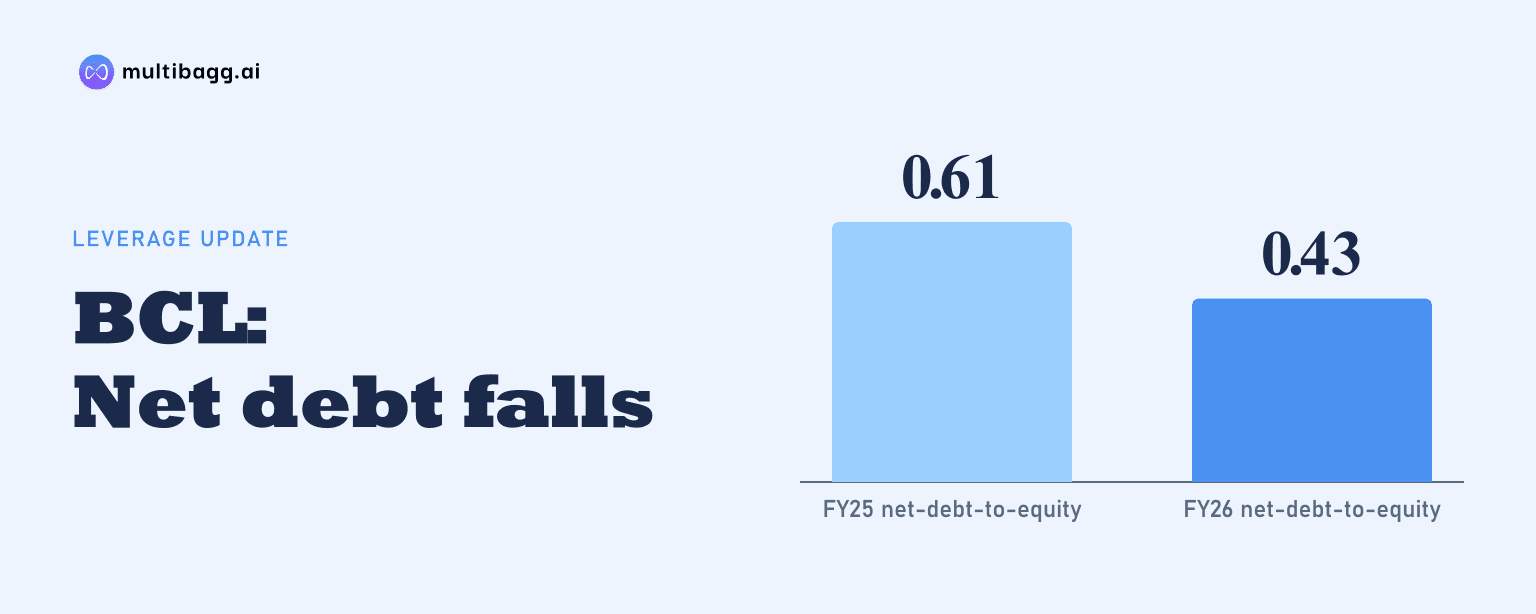
BCL Industries Limited reported FY26 net-debt-to-equity of 0.43, down from 0.61 in FY25, while its consolidated debt was Rs 458 crore on September 30, 2026. BCL says average cash flow from operations exceeded Rs 60 crore from FY22 to FY26, and cites this record in support of its ability to service debt and fund growth.
Know BCL Industries inside out
Results, valuation, peers and who's buying, in one view.
What does BCL's FY26 leverage trend show?
BCL's net-debt-to-equity ratio fell to 0.43 in FY26 from 0.61 in FY25, 0.70 in FY24 and 0.88 in FY23. The FY26 ratio was also below the 0.64 reported in FY22, marking the lowest figure in the five-year series presented by the company.
Interest coverage increased to 7.6 times in FY26 from 6.9 times in FY25 and 6.0 times in FY24. The FY26 level remained below 8.2 times in FY22 but exceeded the 6.6 times recorded in FY23, pairing the lower leverage ratio with a recovery in coverage from FY24.
BCL's gross block rose to Rs 1,068 crore in FY26 from Rs 870 crore in FY25 and Rs 832 crore in FY24. The gross block was Rs 264 crore in FY22, so the presentation shows fixed assets increasing by Rs 804 crore over four years while net-debt-to-equity declined from 0.64 to 0.43.
How is BCL's Rs 458 crore debt composed?
BCL reported Rs 458 crore of consolidated debt as of September 30, 2026, comprising Rs 278 crore of consolidated term loans outstanding and Rs 180 crore of consolidated working-capital utilisation. The debt disclosure is a balance-sheet snapshot dated September 30, 2026, whereas the 0.43 net-debt-to-equity ratio is reported for FY26.
The Rs 180 crore working-capital utilisation accompanies shorter operating-cycle measures in FY26. Receivable days fell to 13 from 16 in FY25 and 21 in FY22, while inventory days declined to 45 from 51 in FY25 and 58 in FY24.
Payable days were 15 in FY26, compared with 18 in FY25 and 25 in FY24. BCL does not provide annual working-capital borrowing balances or a reconciliation between these day metrics and the Rs 180 crore utilisation reported on September 30, 2026.
When are BCL's term-loan repayments due?
BCL's disclosed term-debt repayment schedule begins at Rs 49 crore in FY27, rises to Rs 60 crore in FY28 and FY29, and declines to Rs 14 crore in FY33. The Rs 60 crore amounts in FY28 and FY29 are the largest annual repayments in the seven-year schedule.
The listed repayments total Rs 320 crore from FY27 through FY33. That is higher than the Rs 278 crore of term loans outstanding disclosed as of September 30, 2026, and BCL does not provide a reconciliation of the difference, including any timing or facility-level changes.
BCL says its average cash flow from operations exceeded Rs 60 crore across FY22 to FY26. Management states that this historical cash-flow level puts BCL in a comfortable position to service current and future debt obligations, although the presentation does not provide annual operating cash-flow figures.
Got a follow-up? Ask IRIS
What expansion spending is BCL planning?
BCL estimates capital expenditure of about Rs 250 crore for a 250 KLPD grain-based ethanol plant at Goyal Distillery Pvt Ltd in Fatehabad, Haryana. BCL acquired Goyal Distillery as a wholly owned subsidiary and says the unit holds approvals required for the proposed plant.
The planned 250 KLPD addition would take total distillery capacity from 900 KLPD to 1,150 KLPD. BCL also says its 150 KLPD ethanol plant at Bathinda has been commissioned, while the existing 900 KLPD distillery is operating at almost 100% capacity utilisation.
BCL is also evaluating a 20 tonnes-per-day compressed bio gas plant at Fatehabad that would use about 250 metric tonnes of paddy straw daily. Land has been acquired alongside the Goyal Distillery unit, but the presentation gives no capital cost, funding source or commissioning date for the project under evaluation.
How did BCL's operations and returns change in FY26?
BCL reported distillery business earnings before interest, taxes, depreciation and amortisation of Rs 223 crore in FY26, up from Rs 192 crore in FY25 and Rs 178 crore in FY24. The segment's FY22 EBITDA was Rs 81 crore, and BCL reports a four-year compound annual growth rate of 29% through FY26.
FY26 ethanol production was 191,323 kilolitres, below 196,099 kilolitres in FY25, while extra-neutral alcohol production increased to 59,458 kilolitres from 33,219 kilolitres. BCL reported 100% capacity utilisation in FY25 and FY26, with the production mix shifting toward extra-neutral alcohol in FY26.
BCL reported return on capital employed of 17% in FY26, compared with 16% in FY25 and 19% in FY24. Return on equity was 14% in both FY25 and FY26, below 17% in FY23 and FY24, as gross block reached Rs 1,068 crore in FY26.
Conclusion
BCL's disclosures show lower FY26 leverage relative to equity, with net-debt-to-equity declining to 0.43 from 0.61 in FY25, alongside interest coverage rising to 7.6 times. The company had Rs 458 crore of consolidated debt on September 30, 2026, split between Rs 278 crore of term loans and Rs 180 crore of working-capital utilisation, while average FY22-to-FY26 operating cash flow exceeded Rs 60 crore.
The next disclosed funding demands are Rs 49 crore of term-debt repayment in FY27 and Rs 60 crore in each of FY28 and FY29. Investors can also watch progress on the approximately Rs 250 crore Goyal Distillery ethanol project, which is intended to add 250 KLPD, and on the 20 tonnes-per-day compressed bio gas project that remains under evaluation.