










BCL PML volume reaches 1.3 million cases in H1FY27, IMFL planned
Key highlights
- BCL reported 1.3 million PML cases in H1FY27, including 642,255 cases in Q2FY27.
- BCL's PML volume rose from 1.2 million cases in FY24 to 1.8 million cases in FY26.
- BCL operates eight bottling lines with capacity of 15,000 cases per day.
- Management plans vodka and whiskey IMFL value-segment entry within two years.
powered by IRIS
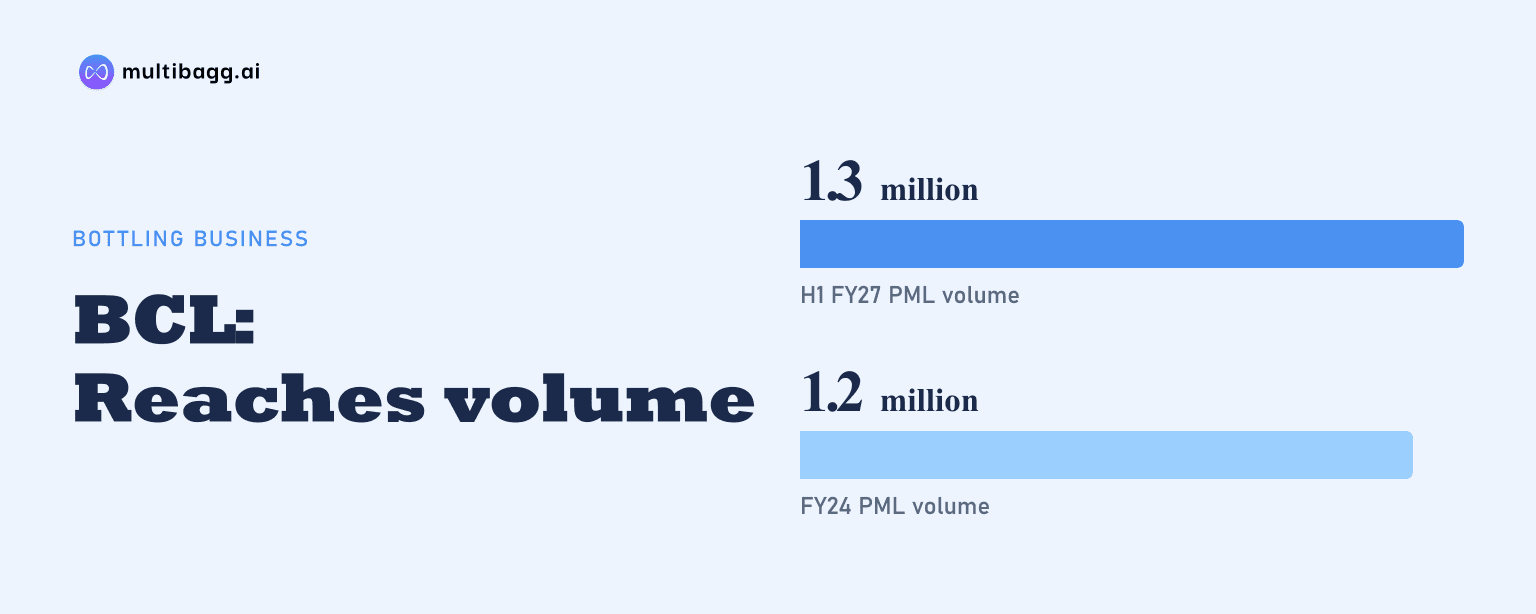
BCL Industries Limited reported PML volume of 1.3 million cases in H1FY27, including 642,255 cases in Q2FY27, after 1.8 million cases in FY26; management plans a vodka and whiskey Indian-made foreign liquor, or IMFL, value-segment entry within two years, while the supplied presentation does not disclose a 12% PML revenue share.
Know BCL Industries inside out
Results, valuation, peers and who's buying, in one view.
What were BCL's PML volumes in H1FY27?
BCL reported PML volume of 1.3 million cases in H1FY27 and 642,255 cases in Q2FY27. PML is the presentation's volume label for BCL's country-liquor portfolio. The source does not provide a Q1FY27 case figure, so the first-half total cannot be split between the two quarters using the supplied pages.
BCL's reported PML volumes increased from 1.2 million cases in FY24 to 1.6 million in FY25 and 1.8 million in FY26. BCL describes the movement from FY24 to FY26 as a 48% scale-up over two years. H1FY27 is a partial-year period, so its 1.3 million cases should not be treated as directly comparable with the 1.8 million cases reported for full-year FY26.
Does BCL disclose a 12% PML revenue share?
No, BCL does not disclose a 12% PML revenue share in the supplied presentation pages. The pages report 1.3 million PML cases in H1FY27 and 642,255 cases in Q2FY27, but provide neither PML revenue nor group revenue from which a revenue share can be calculated.
BCL instead presents the business through brand additions, bottling capability and case volumes. It says it operates eight bottling lines with capacity of 15,000 cases per day, and identifies Jamun Vodka and Punjab Raspberry as newly added brands. Those disclosures describe portfolio breadth and production capacity, not PML sales value, margin or contribution to group profit.
Which brands support BCL's country-liquor strategy?
BCL's disclosed country-liquor brands are Green Apple Vodka, Ranjha Saunfi, Asli Santra and Agni Rum, with Jamun Vodka and Punjab Raspberry listed as new additions. Its roadmap says BCL launched two additional country-liquor brands as part of a plan to strengthen its foothold in Indian-made Indian liquor, or IMIL.
BCL has also introduced Punjab Special Whiskey in glass bottles as a premium IMIL product. Management says the glass-bottle format is intended to improve consumer perception, shelf visibility and trade pull, while serving as a testbed for premium branding and consumer acceptance. The presentation does not disclose sales volumes, pricing or revenue for Punjab Special Whiskey.
How does BCL plan to enter the IMFL market?
BCL plans to introduce IMFL products in vodka and whiskey, with management stating that a stronger IMFL presence should pave the way for entry into the IMFL value segment within the next two years. This is a stated roadmap target, not a disclosed launch date, sales target, capital expenditure figure or market-by-market rollout plan.
BCL positions Punjab Special Whiskey as a stepping-stone towards future IMFL launches because the product uses premium packaging within the existing IMIL portfolio. Management says it can test consumer acceptance and premium brand positioning before an IMFL introduction. The presentation does not identify proposed IMFL brand names, launch states, case volumes or expected revenue from vodka and whiskey.
Got a follow-up? Ask IRIS
What production platform supports BCL's brands business?
BCL's brands strategy sits alongside its extra neutral alcohol, or ENA, and ethanol operations. BCL defines ENA as alcohol with a minimum 96% alcohol content and says it is a key raw material for IMIL and IMFL, as well as cosmetics, pharmaceuticals and personal-care products. It also says it supplies ENA to Pernod Ricard, Amrut, ABD, Mohan Meakin and Diageo.
The presentation identifies a flexible product mix of ENA, ethanol and IML on its business-model slide. BCL's 350-kilolitres-per-day, or KLPD, grain-based ENA and ethanol distillery at Svaksha became wholly owned as of June 30, 2026 after BCL acquired the remaining 25% stake. The source does not state how much ENA is allocated to third-party bottlers versus BCL's own liquor brands.
How do expansion and energy projects relate to BCL's roadmap?
BCL says its distillery capacity is set to rise from 900 KLPD to 1,150 KLPD through Haryana projects. It has commissioned a 150-KLPD ethanol unit at Bathinda, while the acquisition of Goyal Distillery Pvt Ltd in Fatehabad, Haryana, is expected to add 250 KLPD. The presentation does not allocate this added capacity between ethanol, ENA and branded-liquor requirements.
BCL also reports operating two biomass boilers: a 60-tonnes-per-hour, or TPH, paddy-straw boiler and a commissioned 55-TPH paddy-based boiler. BCL says the two boilers together meet 100% of its steam and power requirements. The supplied pages do not quantify any cost effect from these boilers on PML volumes, Punjab Special Whiskey or planned IMFL products.
Conclusion
BCL's disclosures show that its country-liquor portfolio reached 1.3 million PML cases in H1FY27 after full-year volume rose from 1.2 million cases in FY24 to 1.8 million cases in FY26. Two new brands, eight bottling lines, premium glass packaging for Punjab Special Whiskey and access to ENA production form the disclosed operating base for management's proposed vodka and whiskey IMFL strategy. The presentation, however, does not substantiate a 12% PML revenue share.
The next stated milestone is management's aim to establish an IMFL value-segment presence within two years. The information to watch is a named product launch, launch timing, sales geography, pricing, brand-investment plan and volume or revenue targets, because BCL's presentation provides none of those details for the proposed vodka and whiskey entry.