










BCL exits packaged oil as refinery margin reaches 4.45% in H1FY27
Key highlights
- BCL’s refinery EBITDA margin increased to 4.45% in H1FY27 from 2.71% in H1FY26.
- BCL reported H1FY27 refinery EBITDA of Rs 15 crore on revenue of Rs 337 crore.
- Bathinda has 400 TPD of extraction capacity and 100 TPD of refining capacity, both at 100% utilisation.
- BCL’s oil-trading vertical generated Rs 7.16 crore of Q2FY27 revenue from 510 metric tonnes.
powered by IRIS
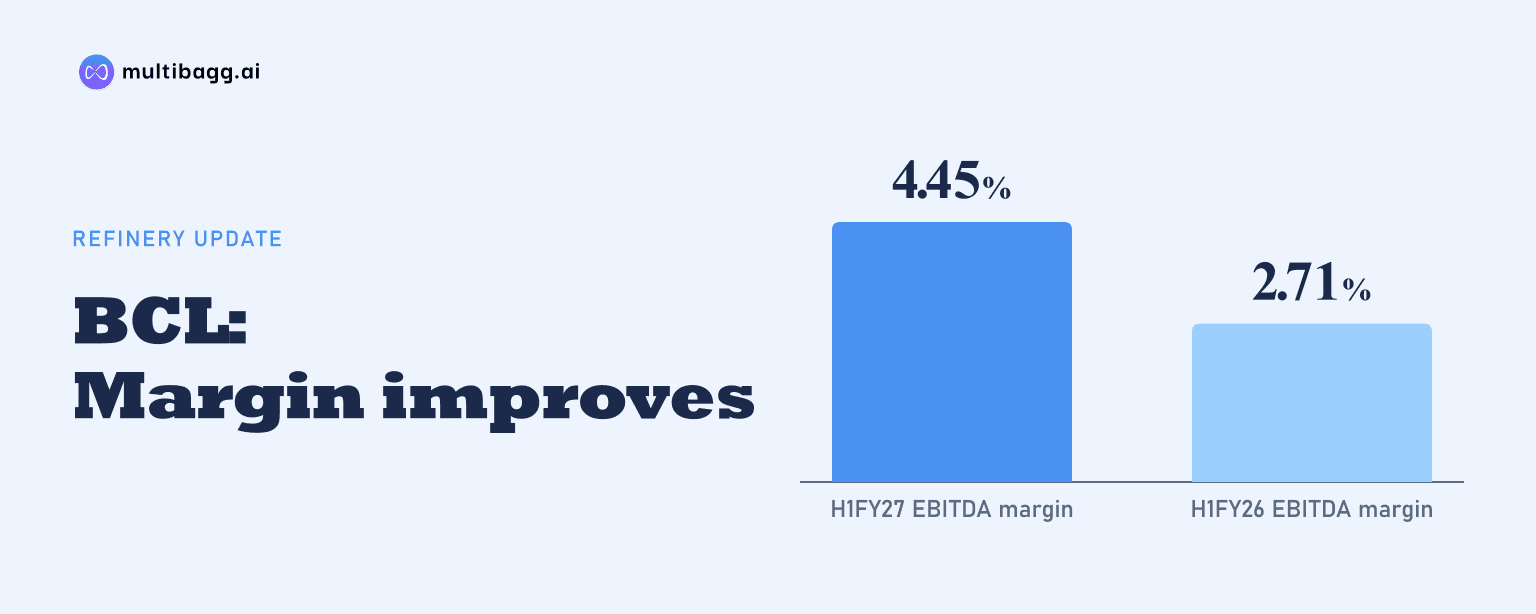
BCL Industries Limited exited packaged edible oil and reported a refinery EBITDA margin of 4.45% in H1FY27, compared with 2.71% in H1FY26, while Q2FY27 refinery EBITDA declined to Rs 7 crore from Rs 10 crore. BCL is repositioning its oil activities around maize extraction, soft-oil refining and trading.
Know BCL Industries inside out
Results, valuation, peers and who's buying, in one view.
Why did BCL exit packaged edible oil?
BCL says the packaged edible oil exit, together with its focus on maize oil processing and soft-oil refining, has supported margin improvement. The presentation describes the revised oil approach as margin accretive, but does not disclose the exit date, the revenue previously generated by packaged edible oil, associated costs or the brands involved.
BCL lists oil trading, maize oil extraction and refinery, distillery, and real estate as its four business divisions. The presentation reported a 9% FY26 EBITDA margin and 17% return on capital employed for the wider company, while separating oil trading from extraction and refining as a distinct division. This structure retains exposure to oil processing and commodity trading rather than packaged consumer-oil sales.
How did BCL’s refinery performance change in H1FY27?
BCL’s refinery EBITDA increased to Rs 15 crore in H1FY27 from Rs 13 crore in H1FY26, even as revenue declined to Rs 337 crore from Rs 486 crore. EBITDA, or earnings before interest, tax, depreciation and amortisation, margin rose by 1.74 percentage points to 4.45% from 2.71% across the two first-half periods.
BCL’s quarterly result moved differently from the first-half comparison. Q2FY27 refinery revenue rose to Rs 188 crore from Rs 171 crore in Q2FY26, but EBITDA fell by Rs 3 crore and margin declined by 1.93 percentage points to 3.72%. The presentation does not explain whether this movement reflected input costs, product mix, pricing, inventory timing or another factor.
How are BCL’s maize extraction and refinery assets configured?
BCL operates oil extraction and refining assets at Bathinda and maize-oil extraction at Kharagpur. Bathinda has 400 tonnes per day, or TPD, of oil-extraction capacity and 100 TPD of refining capacity, both at 100% utilisation. Kharagpur has 400 TPD of maize-oil extraction capacity and reported 95% utilisation.
BCL links the oil operation to its distillery system by processing maize oil extracted from maize used in extra-neutral alcohol, or ENA, production. The presentation cites shared steam, power and infrastructure as cost-efficiency mechanisms in its integrated operations. Bathinda combines extraction and refining, while Kharagpur is presented as an extraction site without disclosed refining capacity.
The disclosed utilisation rates show limited idle capacity at the two operating sites: 100% at Bathinda and 95% at Kharagpur. However, BCL has not provided an expansion target, capital expenditure plan or separate profitability figure for maize extraction, soft-oil refining or the individual Bathinda and Kharagpur assets.
Got a follow-up? Ask IRIS
Can BCL’s oil-trading vertical become a meaningful contributor?
BCL’s oil-trading vertical recorded Rs 7.16 crore of revenue, Rs 1 lakh of EBITDA and a 0.14% EBITDA margin in Q2FY27 on volume of 510 metric tonnes. In the same quarter, the refinery segment reported Rs 188 crore of revenue and Rs 7 crore of EBITDA, placing the disclosed trading activity at a smaller scale.
Management says the trading model builds on BCL’s edible-oil experience through bulk overseas procurement of crude soft oil. It says such procurement can reduce landed cost and improve pricing efficiency. Management also says cash-based imports, instead of letters of credit, can support price negotiations, but the presentation does not disclose import volumes, customer mix, inventory, working capital or an annual trading-revenue target.
The initial figures show that trading generated sales but had a lower Q2FY27 margin than the refinery segment’s 3.72%. The presentation provides only one quarter of trading data, so it does not establish whether volume beyond 510 metric tonnes will change margins or the division’s contribution to BCL’s earnings.
What does the oil shift mean within BCL’s wider business mix?
BCL’s refinery segment remained smaller than its distillery business in H1FY27, with refinery revenue of Rs 337 crore compared with distillery revenue of Rs 970 crore. Within distillery revenue, ENA rose to Rs 243 crore from Rs 139 crore in H1FY26, while ethanol declined to Rs 506 crore from Rs 727 crore. The ENA activity is the disclosed operational link between maize processing and oil extraction.
BCL has disclosed a plan to raise distillery capacity to 1,150 kilolitres per day, or KLPD, from 900 KLPD through Haryana projects. The presentation does not state that this capacity addition will increase maize-oil extraction capacity, oil refining volumes or trading revenue. It also does not provide segment assets, debt or cash flow for the reorganised oil operations.
BCL reported FY26 net debt-to-equity of 0.43 times and interest coverage of 7.6 times. These figures provide context for management’s statement on cash-based imports, but they do not quantify the funds allocated to oil trading, extraction or refining.
Conclusion
BCL has shifted its legacy oil activities away from packaged edible oil toward maize extraction, soft-oil refining and trading. The reported H1FY27 refinery margin improved to 4.45% from 2.71% a year earlier, with EBITDA rising to Rs 15 crore despite a Rs 149 crore revenue decline. The Q2FY27 result, however, showed lower EBITDA and margin despite higher revenue.
The next disclosures to watch are refinery revenue and margin after Q2FY27, along with oil-trading volume beyond 510 metric tonnes and profitability above the initial Rs 1 lakh quarterly EBITDA. Management’s plan to expand distillery capacity from 900 KLPD to 1,150 KLPD through Haryana projects is also relevant because BCL identifies maize used in ENA production as the feedstock connection for oil extraction.