










BCL targets 1,150 KLPD capacity after two acquisitions
Key highlights
- BCL made the 350-KLPD Svaksha Distillery wholly owned on June 30, 2026.
- BCL targets FY28E distillery capacity of 1,150 KLPD, up from 900 KLPD.
- Goyal has approvals for a 250-KLPD grain-based ethanol plant with expected capex of about Rs 250 crore.
- Svaksha revenue rose from Rs 187 crore in FY23 to Rs 898 crore in FY26.
powered by IRIS
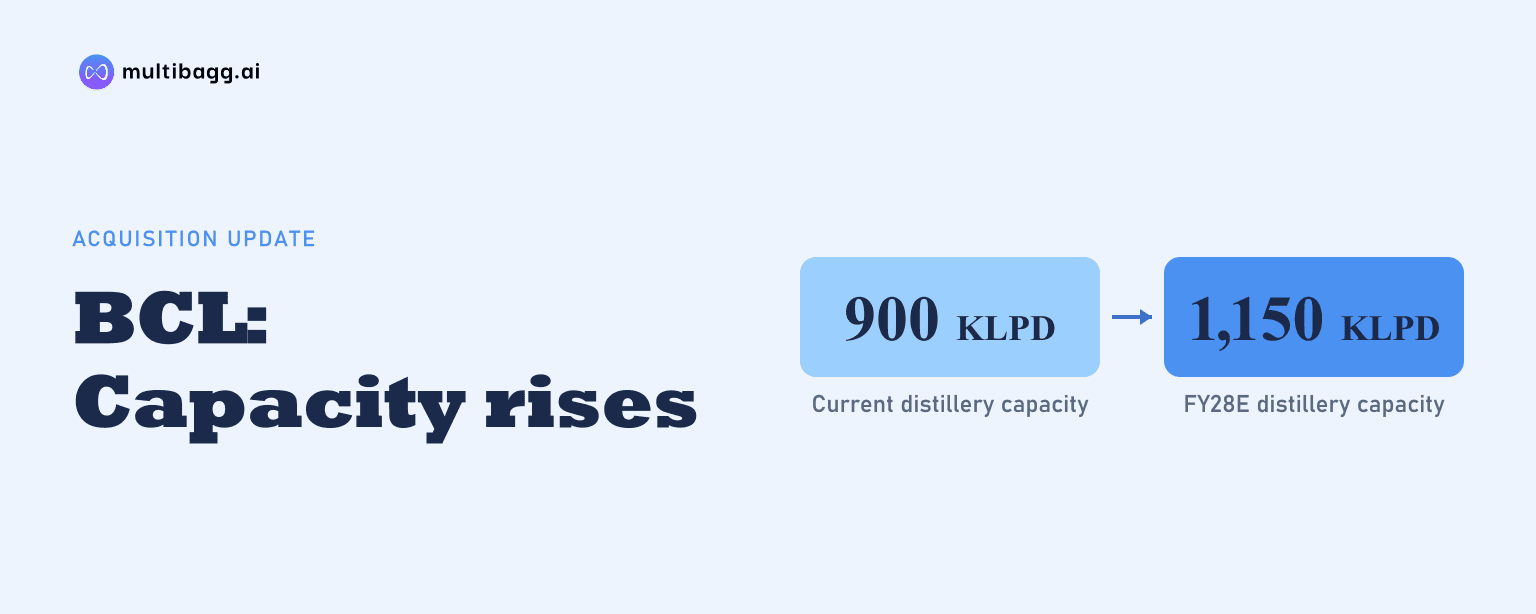
BCL Industries Limited targets distillery capacity of 1,150 kilolitres per day (KLPD) in FY28E, up from 900 KLPD, after making the 350-KLPD Svaksha Distillery wholly owned on June 30, 2026 and acquiring Goyal Distillery, which holds approvals for a 250-KLPD grain-based ethanol plant in Haryana.
Know BCL Industries inside out
Results, valuation, peers and who's buying, in one view.
What did BCL acquire in Svaksha Distillery?
BCL acquired the remaining 25% interest in Svaksha Distillery, making it a wholly owned subsidiary as of June 30, 2026. Svaksha operates a 350-KLPD grain-based extra-neutral-alcohol (ENA) and ethanol distillery at Kharagpur, West Bengal, so the transaction consolidated control of an operating asset rather than adding a new site.
BCL disclosed a total investment outlay of about Rs 55 crore for Svaksha. The presentation shows Svaksha revenue rising from Rs 187 crore in FY23 to Rs 898 crore in FY26, after Rs 504 crore in FY24 and Rs 845 crore in FY25, and describes the FY23-FY26 revenue growth as a 68% compound annual growth rate (CAGR).
Svaksha forms part of BCL’s current 900-KLPD distillery base alongside the 550-KLPD Sangat Distillery at Bathinda, Punjab. The acquisition therefore gives BCL full ownership of 350 KLPD within its existing capacity base, while Sangat remains the larger operating unit at 550 KLPD.
How will BCL reach 1,150 KLPD of distillery capacity?
BCL plans to reach 1,150 KLPD by adding a 250-KLPD grain-based ethanol plant at Goyal Distillery in Fatehabad, Haryana. The capacity schedule identifies this as an FY28E, or estimated FY28, addition rather than current operating capacity.
The FY26-to-FY28E comparison shows that the proposed 250-KLPD Goyal unit accounts for the entire planned increase. Sangat is listed at 550 KLPD in both periods and Svaksha at 350 KLPD, leaving the existing 900-KLPD base unchanged in the capacity plan.
BCL’s historical schedule records Sangat capacity increasing from 200 KLPD in FY22 to 550 KLPD in FY26. Svaksha is shown at 200 KLPD in FY23, 300 KLPD in FY24 and FY25, and 350 KLPD in FY26, while the total FY28E target includes the proposed Goyal plant.
BCL also says it commissioned a 150-KLPD ethanol unit at Bathinda under its growth roadmap. Its capacity schedule nevertheless lists Sangat at 550 KLPD for FY26 and FY28E, making the presentation’s stated 900-KLPD current base and 1,150-KLPD FY28E target the relevant group measures.
What does the Goyal Distillery acquisition include?
BCL acquired Goyal Distillery Pvt Ltd as a wholly owned subsidiary in Fatehabad, Haryana. Goyal holds the prerequisite approvals to establish a 250-KLPD grain-based ethanol plant, which means the presentation describes it as a permitted development project rather than an operating ethanol distillery.
Management expects capital expenditure, or capex, of about Rs 250 crore for the Goyal distillery. That expected development spending exceeds the approximately Rs 55 crore investment outlay disclosed for Svaksha, where BCL purchased the remaining stake in an existing 350-KLPD operating facility.
BCL is also evaluating a 20 metric-tonnes-per-day bio-compressed-natural-gas, or bio-CNG, plant at Fatehabad. The proposed plant would use about 250 metric tonnes of paddy straw a day, and BCL says land has been acquired alongside the Goyal unit, but the bio-CNG facility remains under evaluation.
Got a follow-up? Ask IRIS
Which ethanol markets and feedstocks underpin BCL's plan?
BCL’s grain-based distilleries address fuel blending, potable alcohol, pharmaceutical and healthcare, and industrial and chemical applications. ENA is a base spirit for Indian-made foreign liquor (IMFL) and country liquor, while ethanol is used for petrol blending under the Ethanol Blended Petrol E20 programme.
The presentation says oil marketing companies tendered about 1,100 crore litres for ethanol supply year (ESY) 2026-27, which runs from November 2026 to October 2027. It says the tender is limited to grain-based feedstocks and C-heavy molasses, while sugarcane juice, sugar syrup and B-heavy molasses are excluded.
For ESY 2026-27, the presentation lists maize-based ethanol at Rs 68.86 per litre, down from Rs 71.86 per litre. This compares with Rs 64 per litre for DFG, Rs 60.32 per litre for surplus rice and Rs 57.97 per litre for C-heavy molasses; BCL identifies maize as the highest-priced route in that table.
BCL also identifies distillers dried grains with solubles (DDGS) as a protein-rich co-product from maize-based ethanol production for poultry and cattle feed. The presentation says India plans to use about 156 lakh tonnes of grains, mainly maize, for its 2025-26 ethanol production target.
What operating record supports BCL's proposed expansion?
BCL reported 100% distillery capacity utilisation in FY26, with ENA production of 59,458 kilolitres and ethanol production of 191,323 kilolitres. Compared with FY25, ENA rose from 33,219 kilolitres while ethanol declined from 196,099 kilolitres, although reported utilisation was 100% in both years.
Distillery business earnings before interest, tax, depreciation and amortisation (EBITDA) increased from Rs 81 crore in FY22 to Rs 223 crore in FY26. The presentation reports a four-year EBITDA CAGR of 29%, with EBITDA of Rs 178 crore in FY24 and Rs 192 crore in FY25, but provides no earnings estimate for Goyal.
BCL’s gross block rose from Rs 264 crore in FY22 to Rs 1,068 crore in FY26. Over the same period, net debt to equity declined from 0.64 to 0.43, but the presentation does not disclose funding arrangements, a construction schedule or operating economics for the approximately Rs 250 crore Goyal capex.
Conclusion
BCL’s two acquisitions serve different roles in its stated capacity plan. Full ownership of Svaksha consolidates an operating 350-KLPD grain-based distillery, while Goyal brings approvals for a new 250-KLPD Haryana plant that would take total capacity from 900 KLPD to 1,150 KLPD in FY28E.
The next disclosures to watch are progress towards the FY28E capacity target, spending on the approximately Rs 250 crore Goyal project and BCL’s decision on the 20-metric-tonnes-per-day bio-CNG plant. The presentation also identifies ESY 2026-27 grain-feedstock tender terms and the Rs 68.86-per-litre maize ethanol price as relevant operating conditions.