










Bhagyanagar India Reports Q1 FY27 Profit Growth of 165.8%
Key highlights
- Bhagyanagar India reported Q1 FY27 revenue of ₹705.08 crore, up 45.2% year on year.
- Q1 FY27 net profit was ₹20.2 crore, up 165.8% year on year.
- Bhagyanagar India reported an EBITDA margin of 5.43% and a PAT margin of 2.87%.
- The company plans ₹40 crore of capex to expand capacity to 45,000 MTPA.
powered by IRIS
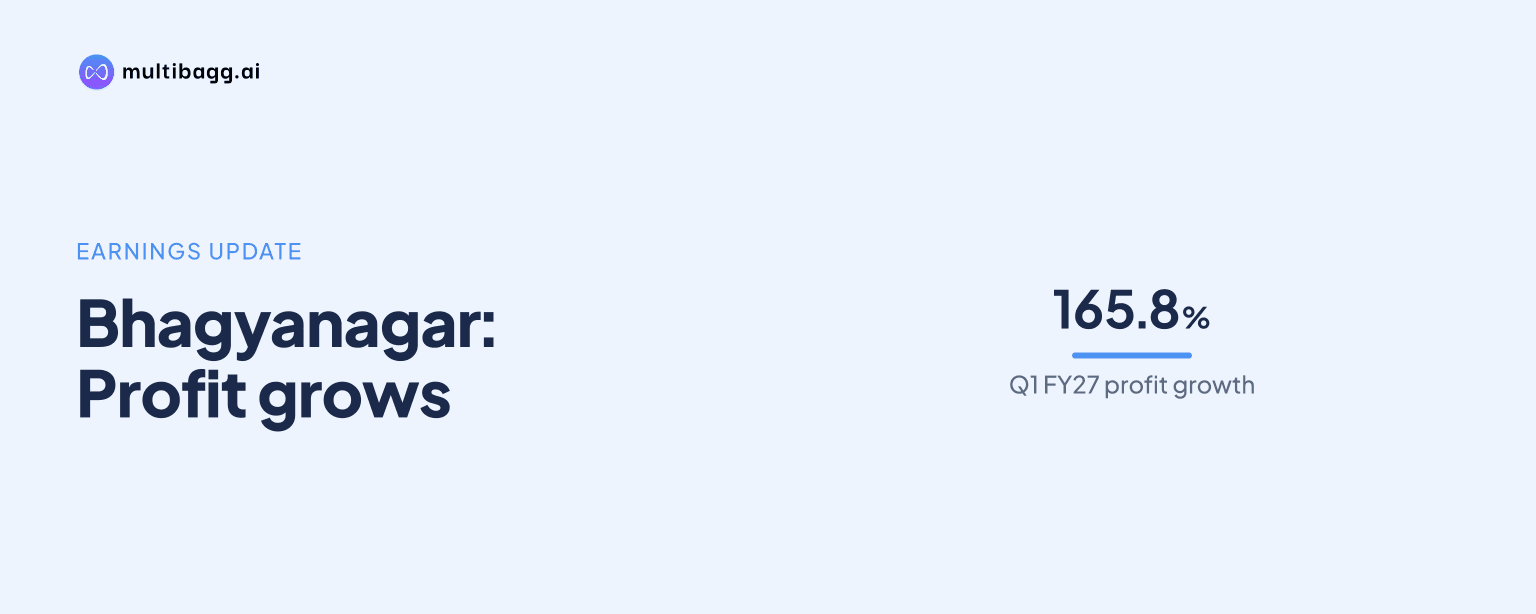
Bhagyanagar India Limited reported Q1 FY27 revenue of ₹705.08 crore and net profit of ₹20.2 crore, with revenue rising 45.2% year on year and profit increasing 165.8%. The quarter also saw EBITDA margin reach 5.43%, supported by a higher contribution from value-added copper products.
Know Bhagyanagar India inside out
Results, valuation, peers and who's buying, in one view.
What did Bhagyanagar India report in Q1 FY27?
Bhagyanagar India reported revenue from operations of ₹705.08 crore for the first quarter of FY27, compared with growth of 45.2% from the corresponding quarter a year earlier. Net profit stood at ₹20.2 crore, up 165.8% year on year. The company described the period as one marked by record EBITDA and profit-after-tax margins.
The reported EBITDA margin was 5.43%, while the PAT margin was 2.87%. These margin levels are important because the company operates in copper and copper-product businesses, where raw-material prices and product mix can materially affect profitability. Revenue growth alone does not indicate the full earnings picture in such businesses, making the stated margin improvement a key part of the quarterly update.
Bhagyanagar India manufactures copper and other copper products as well as alloys. Its Q1 FY27 presentation indicated that value-added products accounted for 63% of the product mix. Management linked improving profitability to the increasing share of these products, rather than relying only on higher volumes or copper-price movements.
The company’s investor presentation was reported as having been filed with the exchanges in July 2026. Bhagyanagar India has also stated that investor presentations and other financial documents are available through its Resources section and on its website.
Why are value-added copper products central to the strategy?
Value-added copper products are central to Bhagyanagar India’s stated strategy because management expects a better product mix to support margins. The company is moving towards higher-margin offerings while retaining its presence in copper manufacturing and processing. Its presentation identified data centres, electric vehicles and renewable energy as demand areas relevant to this approach.
Copper demand is linked to electrical infrastructure, manufacturing and energy-transition applications. However, the company has also identified copper-price volatility and global supply constraints as risks. These factors can influence raw-material procurement costs and working-capital requirements, particularly when metal prices move sharply.
The 63% contribution from value-added products provides context for the Q1 margin outcome. At 5.43%, EBITDA margin was higher than the company’s stated PAT margin of 2.87%, reflecting the impact of costs below the operating-profit line. The presentation does not provide a detailed break-up of those costs, so the quarterly data should be read as a reported snapshot rather than a complete explanation of every profit driver.
The company also flagged regulatory compliance with new recycling mandates beginning in FY28 as a risk factor. This places recycling-related requirements among the operational issues that Bhagyanagar India will need to address alongside capacity growth and product-mix changes.
Got a follow-up? Ask IRIS
What is Bhagyanagar India planning for capacity and the copper business?
Bhagyanagar India is targeting revenue of ₹5,000 crore by FY30 and has outlined ₹40 crore of planned capital expenditure to expand capacity to 45,000 MTPA. The capacity plan is tied to its effort to serve demand from sectors cited in the investor presentation, including data centres, EVs and renewable energy.
Management is also pursuing a strategic demerger of the copper business to unlock its value. The presentation described the restructuring as part of the company’s broader focus on value-added products and a clearer business structure. The supplied information does not state a completion date for the demerger, so its execution remains a key disclosed matter for investors to track.
The planned expansion follows a period in which Bhagyanagar India said it crossed ₹2,000 crore of revenue for the first time in FY26. In its FY26 earnings-call remarks, the company referred to revenue from operations of around ₹735 crore and profit after tax of around ₹18.5 crore for a reported period. The subsequent Q1 FY27 update therefore showed a higher reported revenue and profit figure than those cited in that earlier discussion.
How does the quarter matter for investors and industry operations?
The quarter matters for investors because Bhagyanagar India combined 45.2% revenue growth with 165.8% net-profit growth and a 5.43% EBITDA margin. Profit increased faster than revenue, while the company attributed margin progress to the growing proportion of value-added products. The results also set a measurable base for assessing whether the strategy continues to translate into operating performance.
For industry operations, the update underlines the importance of end-market demand and copper availability. Data centres, EVs and renewable-energy projects were identified as demand drivers, while global supply constraints and metal-price volatility were identified as risks. These factors can affect procurement, production planning and pricing across copper-product manufacturers.
The capital-expenditure plan and proposed demerger are relevant alongside the quarterly numbers. Capacity additions require execution and investment, while the restructuring is intended to separate or unlock copper-business value. Neither development changes the reported Q1 FY27 result, but both form part of the company’s disclosed plan for future operations.
Conclusion
Bhagyanagar India’s Q1 FY27 update showed revenue of ₹705.08 crore, net profit of ₹20.2 crore and improved reported margins, with the company linking performance to a 63% value-added product mix. The figures place profitability, not only sales growth, at the centre of the quarter’s significance.
Investors will next watch progress on the proposed copper-business demerger, the ₹40 crore capacity-expansion plan towards 45,000 MTPA, and the company’s path towards its ₹5,000 crore FY30 revenue target. Copper-price movements, global supply conditions and compliance preparations for FY28 recycling mandates remain relevant disclosed factors.