










Tieramet Ltd projects secondary copper majority by FY30
Key highlights
- Tieramet projects secondary copper’s share of India’s copper industry will rise from 42% in FY25 to 55% in FY30P.
- India’s secondary-copper demand is projected to increase from 789 KT in FY25 to 1,312 KT to 1,410 KT in FY30P.
- Tieramet projects secondary-copper demand CAGR of about 11% to 12% from FY25 to FY30P, versus 5% for total copper demand.
- The presentation shows recycled-content rates for copper of 5% in FY2028, 10% in FY2029 and 20% in FY2031.
powered by IRIS
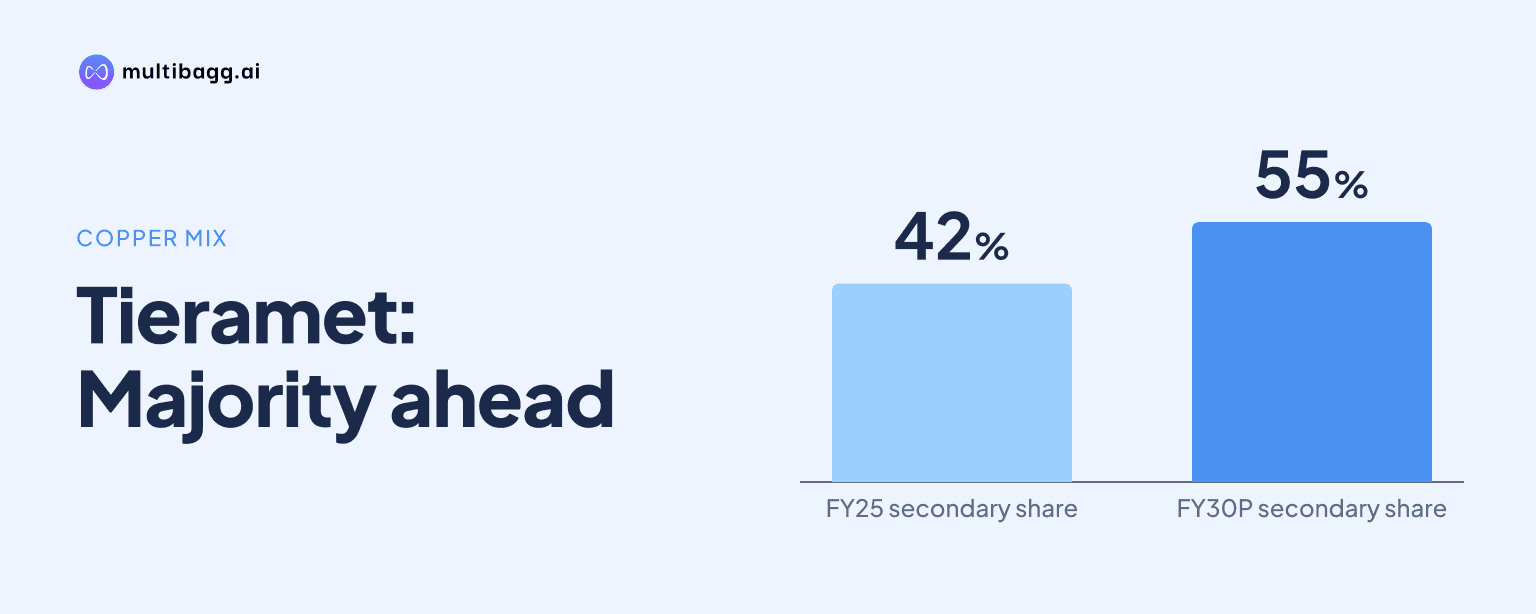
Tieramet Ltd projects secondary copper will account for 55% of India’s copper industry in FY30P, exceeding primary copper’s projected 45% share, after recycled copper represented 42% and demand reached 789 kilotonnes (KT) in FY25. The company presents the change as part of a shift towards recycled material.
Know Bhagyanagar India inside out
Results, valuation, peers and who's buying, in one view.
How does Tieramet project secondary copper to overtake primary copper?
Tieramet projects secondary copper will hold a 55% share in FY30P, compared with 45% for primary copper. This would reverse the FY25 position, when primary copper represented 58% of the industry and secondary copper represented 42%.
The projected FY25-to-FY30P change is a 13-percentage-point rise in secondary copper’s share and a 13-percentage-point decline in primary copper’s share. Over the longer FY21-to-FY30P period, secondary copper’s share is projected to increase by 33 percentage points from 22%.
Tieramet’s FY25 figures put India’s copper demand at 1,878 KT, with recycled or secondary copper at 789 KT. The company’s stated 42% recycling rate for FY25 aligns with that 789 KT secondary-copper market size, while the projected 55% share would make recycled material the larger category by FY30P.
How quickly is India’s secondary copper demand expected to grow?
Tieramet expects India’s secondary-copper demand to rise to 1,312 KT to 1,410 KT in FY30P from 789 KT in FY25. The company gives an expected compound annual growth rate, or CAGR, of about 11% to 12% for secondary copper from FY25 to FY30P.
Total Indian copper demand is projected to grow at a 5% CAGR between FY25 and FY30P, below the approximately 11% to 12% CAGR projected for secondary copper. The difference in growth rates explains why secondary copper’s share is forecast to rise even as total demand expands to 2,398 KT to 2,496 KT.
The previous four-year period showed a faster expansion in both measures. From FY21 to FY25, total copper demand increased from 978 KT to 1,878 KT at an 18% CAGR, while secondary-copper demand increased from 215 KT to 789 KT at an approximately 38% CAGR.
Tieramet’s FY30P secondary-demand range is 523 KT to 621 KT above the FY25 level of 789 KT. The presentation therefore describes the projected transition as a change in market mix as well as an increase in recycled-copper volumes.
Got a follow-up? Ask IRIS
What recycling-content rules support Tieramet’s FY30P outlook?
Tieramet says a government requirement will set minimum recycled content in new non-ferrous-metal products at 5% from FY2028. Its presentation shows the recycled-content rate for copper increasing to 10% in FY2029 and 20% in FY2031.
The presentation also lists the Extended Producer Responsibility, or EPR, framework for non-ferrous metals as effective from April 2026. Tieramet identifies the National Critical Mineral Mission of 2025, the Vehicle Scrappage Policy of 2021, the National Non-ferrous Metal Scrap Recycling Framework of 2020 and the National Resource Efficiency Policy of 2019 as related provisions.
The April 2026 EPR effective date comes before the FY2028 minimum-content requirement shown in the presentation. Tieramet does not quantify the separate effect of either measure on its FY30P industry forecast, but it links higher recycled-content use with the rise from a 42% recycling rate in FY25 to 55% in FY30P.
How does India’s copper recycling rate compare with the global market?
Tieramet shows India’s recycled-copper share at 42% in FY25, compared with 40% of global copper demand in 2024. The comparison is between different reporting periods, with India measured in FY25 and the global market measured in calendar 2024.
For the global market, Tieramet reports total copper demand of 25 million tonnes in 2024 and non-ferrous recycling metal size of 10.08 million tonnes. For India, it reports FY25 demand of 1,878 KT and recycled-metal size of 789 KT, producing a stated 42% recycling rate.
India’s FY25 share was therefore 2 percentage points above the cited global 2024 share. India’s projected FY30P recycling rate of 55% would be 15 percentage points above the global 2024 figure, although Tieramet does not provide a global FY30 forecast.
Tieramet also cites process advantages for copper recycling, stating it can save up to 85% of the energy used in primary production. It says replacing primary production with copper scrap can reduce carbon dioxide emissions by approximately 65%, while identifying sustainability focus and supply constraints as factors accelerating the transition in India.
Conclusion
Tieramet’s industry outlook points to secondary copper moving from 42% of India’s copper market in FY25 to 55% in FY30P, compared with a projected 45% primary-copper share. The shift is supported in the presentation by secondary-copper demand growth of about 11% to 12% annually from FY25 to FY30P, compared with 5% projected growth for total copper demand.
The disclosed milestones to watch are the April 2026 effective date for the EPR framework, the 5% recycled-content requirement shown for FY2028, and subsequent increases to 10% in FY2029 and 20% in FY2031. These dates will provide the next policy checkpoints against Tieramet’s projected increase in recycled copper’s share.