










Bharat Parenterals returns to profit as Innoxel leads EBITDA
Key highlights
- Bharat Parenterals reported Rs 11.8 crore consolidated profit after tax in Q2 FY27, after losses in Q2 FY26 and Q1 FY27.
- Innoxel generated Rs 14.6 crore of Q2 FY27 EBITDA at a 33% margin and contributed more than 60% of group EBITDA.
- Innoxel and Varenyam Healthcare accounted for 45% of Q2 FY27 revenue before eliminations, up from about 40% a year earlier.
- Bharat Parenterals’ standalone order book was Rs 117 crore at the end of September 2026.
powered by IRIS
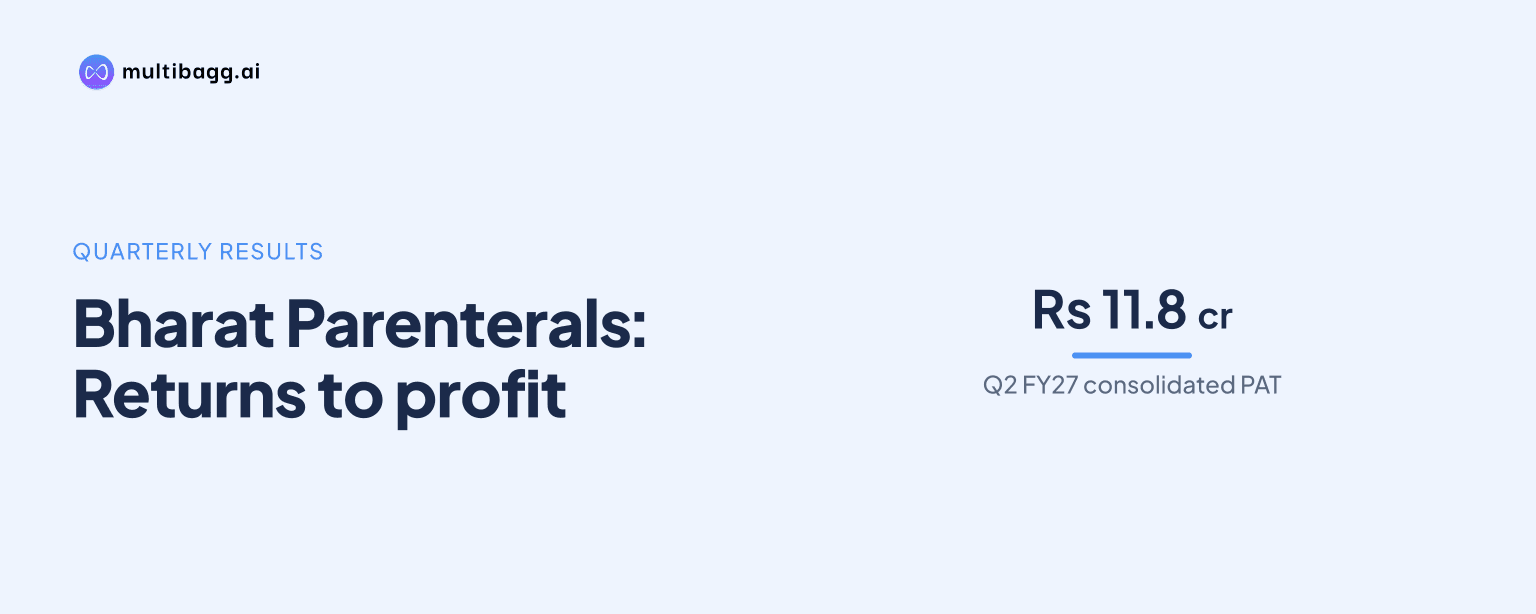
Bharat Parenterals Limited returned to consolidated profit in Q2 FY27 with profit after tax of Rs 11.8 crore, versus losses in the prior-year quarter and Q1 FY27, as Innoxel generated Rs 14.6 crore of earnings before interest, tax, depreciation and amortisation (EBITDA) and contributed more than 60% of group EBITDA.
Know Bharat Parenterals inside out
Results, valuation, peers and who's buying, in one view.
How did Bharat Parenterals return to quarterly profit?
Bharat Parenterals returned to profit as consolidated revenue rose 45% sequentially to Rs 136.3 crore in Q2 FY27 and EBITDA increased to Rs 26.6 crore from Rs 8.5 crore in Q1 FY27. The EBITDA margin expanded to 17.3% from 9.1% in the preceding quarter, while revenue was also 110% above Rs 64.6 crore in Q2 FY26.
Profit after tax was Rs 11.8 crore, compared with a loss of Rs 8.6 crore in Q2 FY26 and a loss of Rs 3.6 crore in Q1 FY27. Of the Q2 FY27 profit, Rs 9.4 crore was attributable to Bharat Parenterals shareholders, while Rs 2.4 crore was Innoxel minority partners’ share because Bharat Parenterals owns 55.9% of Innoxel.
Management said the sequential comparison was more meaningful because Q2 FY26 included deferred export shipments and a shutdown of the general injectables line for nearly a month. For H1 FY27, consolidated revenue rose 27% to Rs 230 crore, EBITDA increased 120% to Rs 32.1 crore, and the EBITDA margin reached 14%, compared with 8.1% a year earlier.
Why did Innoxel become Bharat Parenterals’ largest EBITDA contributor?
Innoxel became Bharat Parenterals’ largest EBITDA contributor after reporting Rs 14.6 crore of EBITDA at a 33% margin in Q2 FY27. Its revenue reached Rs 44.5 crore, up 253% year on year and more than double Rs 21.4 crore in Q1 FY27, and management said it produced more than 60% of EBITDA across the group’s four companies.
The quarter marked a reversal from EBITDA losses of Rs 2.1 crore in Q2 FY26 and Rs 1.8 crore in Q1 FY27. Innoxel also reported profit after tax of Rs 5.4 crore, compared with losses of Rs 11 crore a year earlier and Rs 10.4 crore in the preceding quarter.
Management attributed the change to Innoxel’s largely fixed cost base. Between Q1 FY27 and Q2 FY27, revenue rose Rs 23.1 crore while EBITDA increased Rs 16.5 crore. Management cautioned, however, that licensing, milestone and development income is recognised when partners reach milestones, so the 33% quarterly margin is not necessarily a recurring quarterly run rate.
How has Bharat Parenterals’ business mix changed?
Bharat Parenterals’ mix has moved towards Innoxel and Varenyam Healthcare, which accounted for 45% of Q2 FY27 revenue before eliminations, up from about 40% a year earlier. Management identifies both operations as margin-growth platforms, while Innoxel supplied the majority of group EBITDA during the quarter.
Varenyam Healthcare recorded Q2 FY27 revenue of Rs 19.7 crore, up 33.2% year on year, EBITDA of Rs 1.8 crore and a 9.2% margin. Revenue declined 21.5% from Q1 FY27, which management described as its normal pattern because sales are highest in Q1 and taper through Q4.
For H1 FY27, Varenyam Healthcare’s revenue rose 43.2% to Rs 44.9 crore, with an 11% EBITDA margin and Rs 3.8 crore of profit after tax. Management retained its FY27 target of 20% to 25% revenue growth and an 8% to 13% margin, while saying its Bhuvah gynaecology and women’s health division, due to launch later in the year, will initially add cost.
Got a follow-up? Ask IRIS
What pressures remain in Bharat Parenterals’ standalone operation?
Bharat Parenterals’ standalone operation faces pressure from higher input costs, despite Q2 FY27 revenue increasing 88.4% year on year to Rs 78.6 crore and 41.5% sequentially. EBITDA rose to Rs 7 crore from Rs 2.3 crore a year earlier, but the margin fell to 9% from 12.3% in Q1 FY27.
Management said material costs increased by about 5 percentage points of revenue during the quarter because several inputs became more expensive amid geopolitical conflicts. It also said some outstanding orders were priced before the increase, meaning margins could remain under pressure until input costs ease or the order book turns over at current prices.
The standalone operation reported H1 FY27 revenue of Rs 134.1 crore, compared with Rs 136.1 crore a year earlier, leaving the second half to drive annual growth. Its H1 EBITDA was Rs 13.9 crore at a 10.3% margin, within management’s 10% to 15% margin guidance range.
What supports Bharat Parenterals’ second-half execution?
Bharat Parenterals entered the second half with a Rs 117 crore total standalone order book at the end of September, spanning domestic tenders, exports and international tenders. Its domestic tender book fell to Rs 65 crore from Rs 119 crore at the end of June, largely because orders had been supplied.
Capacity utilisation increased in H1 FY27 without new capacity being required for management’s standalone growth target. The general block ran at 70%, compared with 48.5% in FY26, while beta-lactam utilisation was 33% against 21% and cephalosporin utilisation was 31.5% against 24%.
Standalone cash from operations was Rs 65 crore in H1 FY27, while capital expenditure was about Rs 15 crore, leaving roughly Rs 50 crore of free cash. Trade receivables declined to Rs 105 crore from Rs 120 crore in March and Rs 130 crore a year earlier, while standalone debt to equity was 0.08 times.
What is management expecting from Innoxel and group funding?
Management expects Innoxel’s manufacturing revenue to begin building in H2 FY27 after its first product under a contract manufacturing organisation agreement was exported to the United States by its sponsor partner on 20 October 2026. The export occurred after the Q2 close, so no revenue from that commercial supply was included in Q2 FY27.
Management expects a second contract-manufacturing product to be commercialised within FY27, subject to approval from the US Food and Drug Administration. It retained Innoxel’s FY27 target of 35% to 45% revenue growth, a 20% to 25% EBITDA margin and licensing income of roughly Rs 80 crore to Rs 90 crore, citing the uneven timing of milestones and the developing supply ramp.
Shareholders approved a preferential issue on 23 October 2026 of 9,12,759 shares at Rs 1,522.85 per share, intended to raise roughly Rs 139 crore from 15 non-promoter investors. Management said up to Rs 135 crore is planned for subsidiaries over two years; the funds were not in the 30 September balance sheet, when consolidated borrowings stood at Rs 160 crore, mainly at Innoxel.
Conclusion
Bharat Parenterals’ Q2 FY27 profit reflects both higher consolidated revenue and a changed earnings mix. Innoxel moved from an EBITDA loss in Q1 FY27 to Rs 14.6 crore of EBITDA, while Innoxel and Varenyam Healthcare together increased their share of pre-elimination revenue to 45% from about 40% a year earlier.
The next results will show whether Innoxel’s first US commercial supply builds through H2 FY27 and whether a second product receives US Food and Drug Administration approval within FY27. Management’s unchanged targets also leave investors to track conversion of the Rs 117 crore standalone order book, input-cost effects on older orders, and the initial cost of Varenyam Healthcare’s Bhuvah launch.